The Great Stink That Transformed London
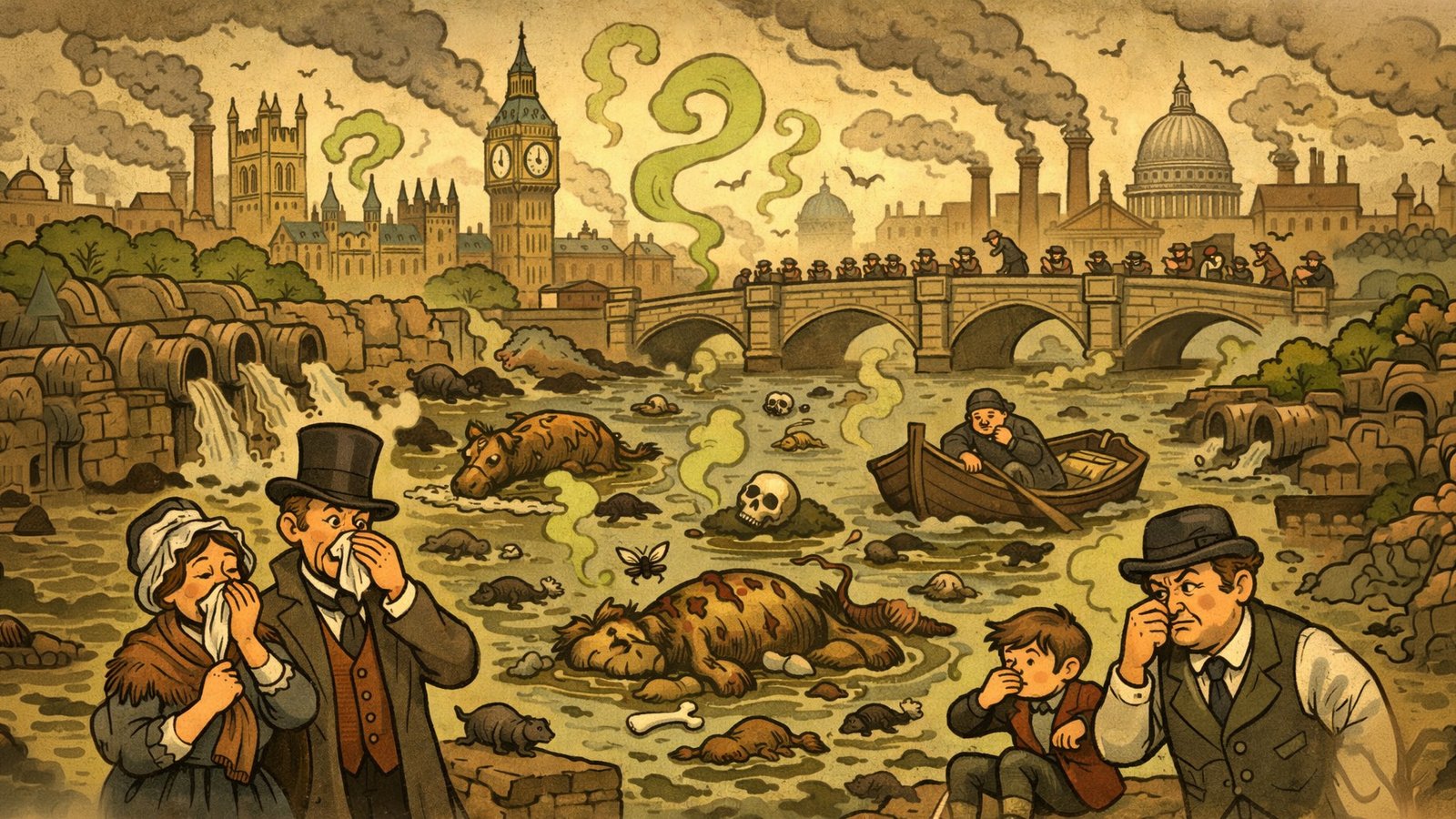
Summer in London can be rather lovely. Parks brimming with picnickers, the Thames glittering in the sunshine, perhaps a cold pint by the river. However, rewind to the summer of 1858, and you’d find yourself in what might be the most revolting summer on record. Notably, the smell was so horrific that it earned its own capitalised title: The Great Stink. We’re not talking about a bit of urban whiff here – rather, this was a full-on olfactory assault that brought the world’s most powerful city to its knees.
For centuries, London had been quite literally flushing its problems down the river. Consequently, the Thames, that majestic waterway that poets once waxed lyrical about, had become the world’s filthiest toilet. Every household, every slaughterhouse, every factory – they all treated the river as a convenient dumping ground. Human waste, dead animals, industrial chemicals, and the occasional murder victim all found their way into the water. Between 1800 and 1850, London’s population more than doubled. It ballooned from one million to three million people. Clearly, more people meant more poo, obviously. Unfortunately, the city’s medieval infrastructure simply couldn’t cope.
The real kicker? Astonishingly, Londoners were also drinking from this same river. Yes, you read that correctly. Essentially, the same water that received their chamber pots in the morning was being pumped back into their homes as drinking water. Eight private water companies were extracting their supply directly from the Thames. Meanwhile, the river was receiving an estimated 250 tonnes of faecal matter every single day. One Victorian wit described drinking a tumbler of London water as having “more animated beings in your stomach than there are men, women and children on the face of the globe.” Delightful.
Now, you might wonder why nobody did anything about this rather pressing issue. Plenty of people tried, actually. Michael Faraday, the brilliant scientist who revolutionised our understanding of electromagnetism, took a boat trip down the Thames in 1855 to investigate. He dropped white pieces of paper into the water to test visibility. He described how “near the bridges the feculence rolled up in clouds so dense that they were visible at the surface.” His letter to The Times fell on deaf ears. Similarly, Charles Dickens wrote about it extensively in his novels. He described London’s “deadly sewer ebbed and flowed, in the place of a fine fresh river.” Still, nothing changed.
The problem was that whilst everyone acknowledged the Thames was disgusting, the government couldn’t quite agree on who should fix it or how much money to spend. Various schemes were proposed and rejected. Tragically, three cholera outbreaks swept through the city between 1848 and 1854. These epidemics killed over 30,000 Londoners. Dr John Snow brilliantly deduced that cholera spread through contaminated water rather than “bad air.” Unfortunately, his theory was largely dismissed. The prevailing belief was in “miasma theory” – the idea that disease came from noxious vapours rather than germs.
Then came the summer of 1858. London had experienced hot summers before, but this was something else entirely. Temperatures soared to 34-36°C in the shade and an absolutely blistering 48°C in the sun. Moreover, it barely rained. The water level in the Thames dropped dramatically. Enormous mounds of sewage piled up on the riverbanks. In some places, these festering heaps stood six feet high, baking in the scorching heat. The smell became so overwhelming that people reported vomiting if they went anywhere near the river. Remarkably, one woman who attempted to drown herself in the Thames survived, but was knocked unconscious by the toxic fumes before she could go under.
The stench infiltrated everything. Naturally, curtains and blinds were soaked in chloride of lime in desperate attempts to block it out. Naturally, people who could afford to fled the city entirely. Even Queen Victoria and Prince Albert, armed with scented handkerchiefs, attempted a leisurely cruise down the river. They lasted mere minutes before ordering the boat back to Buckingham Palace. The Queen was not amused.
But here’s where things get particularly British. What finally spurred the government into action wasn’t concern for the thousands dying of cholera. It wasn’t the dire state of public health, or even the collective misery of millions of Londoners. No, what really got Parliament moving was the fact that their newly rebuilt Houses of Parliament sat right on the riverbank. The MPs simply could not bear the smell anymore. Some attempted to work in the library, handkerchiefs pressed to their noses. They were “instantaneously driven to retreat.” Debates were conducted with windows closed despite the heat. Incredibly, the government even considered relocating Parliament entirely to Oxford or Edinburgh.
Benjamin Disraeli, speaking in the House of Commons, declared the Thames “a Stygian pool, reeking with ineffable and intolerable horrors.” Within 18 days – yes, you read that correctly, 18 days – Parliament passed the Metropolis Local Management Amendment Bill. For context, that’s faster than most modern governments can agree on what to have for lunch. The Bill gave the Metropolitan Board of Works full authority to clean up the Thames. Crucially, it also provided £3 million to do it.
Interestingly, before this decisive action, the authorities had attempted various half-baked solutions. They dumped 200 to 250 tonnes of lime into the river each week. This cost £1,500 per week. Rather than neutralising the smell, the lime reacted with the sewage to create even more noxious gases. Brilliant. Additionally, they employed thousands of day labourers to spread lime onto the exposed riverbanks during low tide. This had about as much effect as you’d expect.
The man tasked with solving this monumental crisis was Joseph Bazalgette. He was chief engineer of the Metropolitan Board of Works. This wasn’t his first rodeo – he’d been drawing up plans for years. Unfortunately, he’d watched them repeatedly shelved due to political squabbling. Ironically, Bazalgette himself had suffered a nervous breakdown in 1847 from overwork on railway projects. He had to leave London to recuperate. When he returned, he joined the Metropolitan Commission of Sewers just as the second cholera epidemic was killing thousands. Both his parents died during outbreaks.
Bazalgette’s solution was audacious. Essentially, he proposed constructing a massive underground network of intercepting sewers. These would carry waste away from central London to treatment works downriver. The system would consist of 82 miles of main sewers plus over 1,000 miles of street sewers. All would slope eastward to use gravity. Moreover, he also proposed building enormous embankments along the Thames to house the low-level sewers. These would have the added benefit of reclaiming riverside land and creating new public spaces.
What’s remarkable about Bazalgette’s design is his attention to detail and future-proofing. He meticulously checked every single connection to the sewerage system himself. His legacy includes thousands of plans with handwritten notes in Indian ink. Furthermore, he calculated the capacity needed not just for the current population, but for future growth – and then doubled it. When questioned about the extra expense, he reportedly said that he was “only going to do this once.” Fortunately, his foresight proved spot-on. By the time he died in 1891, London’s population had doubled to 5.5 million. Impressively, his sewers were still coping admirably.
Construction began in 1859. Ultimately, it wasn’t fully completed until 1875. It was the largest civil engineering project in the world at the time. Despite his hard work potentially saving millions of lives, the stress of the project nearly killed Bazalgette. He worked himself ragged checking plans, managing consultants, and dealing with bureaucratic scrutiny. His capacity for hard work was described as “remarkable” – which is Victorian for “this man needs a holiday.”
The results were transformative. Cholera was virtually eliminated from London. Gradually, the Thames became cleaner. Eventually, it supported fish and wildlife again. Bazalgette was knighted in 1875. Later, he became president of the Institution of Civil Engineers. When he died, his obituary noted that he “probably did more good, and saved more lives, than any single Victorian official.” There’s a small memorial to him on the Victoria Embankment, though it seems inadequate recognition for the man who literally saved London.
Curiously, Bazalgette achieved all this whilst most people still believed in miasma theory rather than germ theory. The sewers were built to eliminate bad smells, not waterborne bacteria. It was a complete accident that removing sewage from the drinking water supply also stopped cholera. Dr John Snow, who correctly identified contaminated water as the culprit, died in 1858 during the Great Stink itself. Tragically, he never knew he’d been vindicated. His theory wasn’t widely accepted until 1866.
Fast forward to today, and London faces a similar crisis. Bazalgette’s Victorian sewers, brilliant as they were, simply can’t cope with a population that’s grown from four million to over nine million. Climate change brings heavier, more frequent rainfall. Combined with modern hard surfaces that prevent water absorption, this means sewage overflows into the Thames more than once a week. Indeed, even a couple of millimetres of rain can trigger a discharge.
The solution? Another super sewer. The Thames Tideway Tunnel, completed in 2025, was officially opened by King Charles III. It runs 25 kilometres from Acton to Abbey Mills at depths of up to 70 metres. Four giant tunnel boring machines, each named after inspirational women, excavated over 3.48 million tonnes of earth. Construction materials were transported by barge rather than lorry. This saved 344,000 truck journeys and 24,400 tonnes of CO2 emissions. Since becoming operational, the tunnel has already captured millions of tonnes of sewage that would otherwise have polluted the river.
The parallels with 1858 are striking. Population growth outstripped infrastructure in both crises. Massive investment and political will were required in both cases. Indeed, both projects will serve London for well over a century. The main difference? This time around, we understood the actual problem. We didn’t need a fortnight of unbearable stench to force Parliament’s hand. Nevertheless, our privatised water companies’ tendency to dump sewage into rivers certainly helped concentrate minds.
The Great Stink remains a peculiar episode in British history. It took a smell so foul that it literally stopped government from functioning. Only then would anyone spend the money to fix a problem that had killed tens of thousands. Yet from that revolting summer emerged one of the greatest public health achievements in history. Bazalgette’s sewers transformed London from a disease-ridden cesspit into a modern metropolis. Not bad for a project that started because some politicians couldn’t hold their noses any longer.
So next time you’re enjoying a riverside walk along the Thames, spare a thought for Victorian Londoners. They couldn’t go near the water without a scented handkerchief. And remember Joseph Bazalgette, the engineer who literally changed the course of the river and saved countless lives – all because Parliament finally got fed up with the smell.