The Great Green Wall of China
Northern China contains landscapes that feel almost extraterrestrial. Wind combs the earth into long ridges of pale dust. Gravel plains stretch for hundreds of kilometres without a tree. Occasionally a sandstorm rises suddenly and sweeps across the horizon like weather made of soil. For centuries people living near the Gobi Desert understood one stubborn fact: the desert moves.
Unlike the Sahara, the Gobi is not a sea of towering dunes. Instead it consists largely of gravel plains, dry basins, and scattered patches of sand. Nevertheless powerful winds lift fine soil from these surfaces and carry it enormous distances. When the dust travels south, it reaches farmland, villages, highways, and eventually the vast urban basin surrounding Beijing.
During the late twentieth century the situation began to look increasingly serious. Sandstorms intensified. Agricultural land turned infertile. Entire communities abandoned villages gradually swallowed by drifting sand. Meanwhile Beijing, now home to more than twenty million people, sat directly in the path of these dust clouds.
Chinese planners eventually realised that ordinary conservation measures would not be enough. Instead they launched a campaign that resembled environmental engineering on a continental scale. Forestry, agriculture, economics, and desert science all joined the same project. Gradually one of the largest ecological experiments in modern history began to take shape.
The most famous element of this strategy appeared in 1978. Officials announced the Three-North Shelterbelt Programme. The technical name sounded bureaucratic, yet the idea itself was simple. China would plant enormous belts of vegetation across northern regions to reduce wind speed and stabilise soil. Soon journalists began calling it the Great Green Wall.
The scale quickly became extraordinary. Workers planted trees across thousands of kilometres from Xinjiang in the west to Heilongjiang in the northeast. Millions of volunteers participated in seasonal planting drives. Soldiers, students, and farmers appeared in photographs carrying shovels and saplings into dusty landscapes.
Gradually the geography began to change. Rows of trees appeared where bare ground had once dominated the horizon. Counties organised entire road networks around windbreak forests. Railways acquired protective corridors of vegetation designed to trap sand before it reached the tracks.
The numbers still sound improbable. Estimates suggest more than sixty billion trees have been planted since the programme began. Meanwhile China’s forest cover has more than doubled compared with the middle of the twentieth century. Satellite imagery now reveals a broad arc of vegetation spreading across the country’s northern frontier.
However trees alone cannot defeat a desert. Early planners discovered this lesson rather painfully. Several large plantations failed within a decade. Fast-growing poplar forests initially looked impressive, yet disease and drought eventually destroyed many of them.
Consequently scientists revised the entire strategy. Instead of forcing conventional forests into dry terrain, researchers began studying native vegetation already adapted to desert climates. Hardy shrubs, drought-resistant grasses, and mixed ecosystems replaced many water-hungry plantations. As a result restored landscapes proved far more resilient.
Even with better vegetation another challenge remained. Wind does not politely wait for seedlings to mature. Moving dunes can bury young plants within weeks. Engineers therefore developed methods to stabilise sand long before roots could secure the soil.
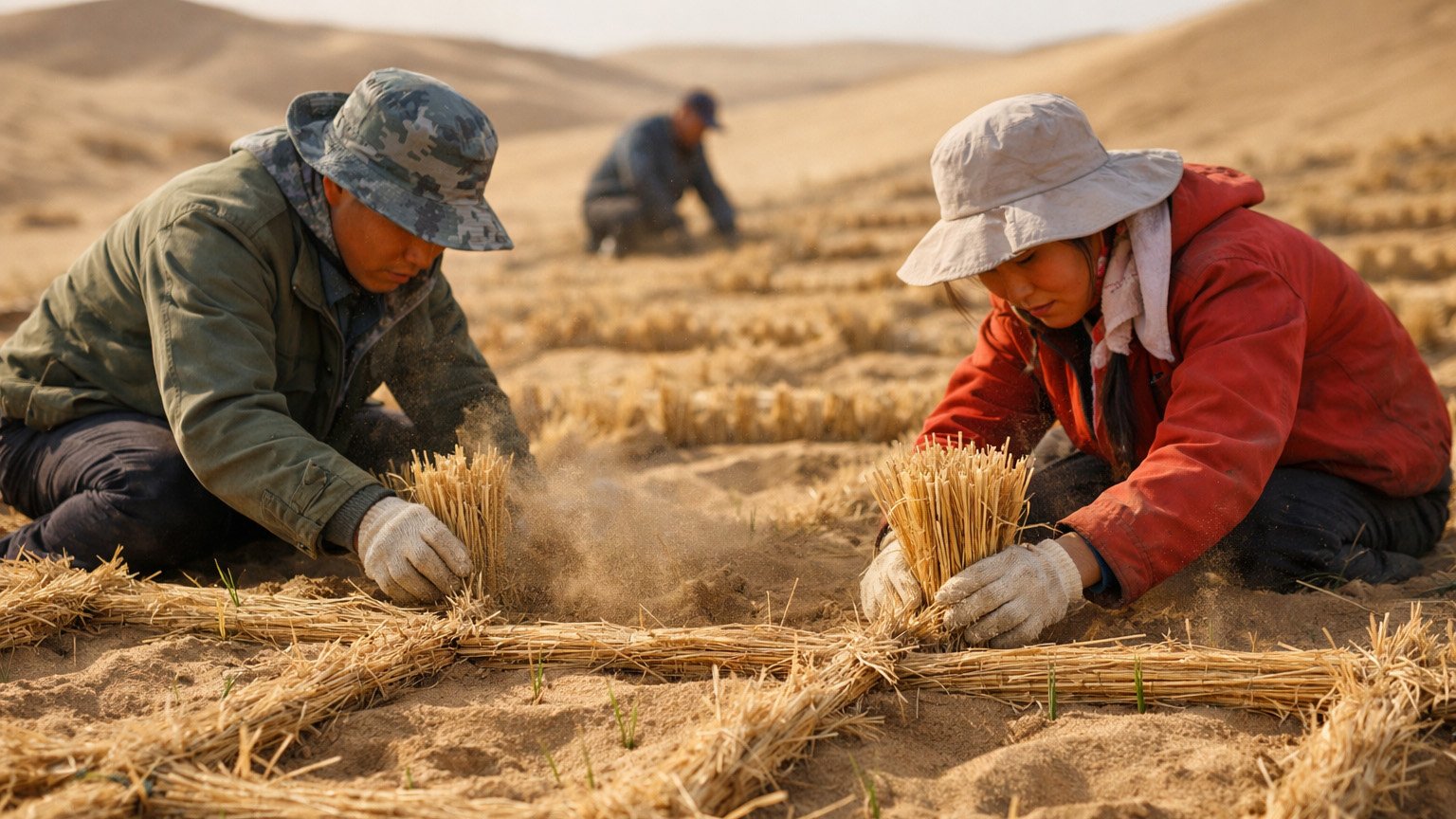
One solution looks surprisingly simple. Workers insert bundles of straw into the sand in a grid pattern resembling a giant chessboard. Each square measures roughly one metre across. At first the desert appears covered with thousands of small fences lying flat on the ground.
Yet these straw checkerboards perform several subtle tasks. First they reduce wind speed close to the surface. Next they trap drifting grains of sand. Finally they help retain moisture after rare rainfall. Within a few seasons the sand begins to settle.
Eventually grass seeds germinate between the straw lines. Later shrubs appear, and small ecosystems begin forming where dunes once moved constantly. Travellers crossing parts of Inner Mongolia often see entire hillsides patterned with these geometric grids. From the air the formations resemble enormous pieces of land art carved into the desert.
Human activity had originally accelerated the desert’s advance. Decades of overgrazing removed protective vegetation from fragile steppe soils. Intensive farming also exposed loose earth to powerful winds. Once the soil structure collapsed, dust storms carried enormous quantities of sediment southward.
By the end of the twentieth century nearly a third of China’s territory showed signs of desertification. Planting trees alone could never solve a problem partly caused by economic pressure on rural communities. Therefore policymakers introduced a second strategy alongside ecological restoration.
The Grain-for-Green programme paid farmers to convert marginal cropland back into forest or grassland. Instead of growing grain on exhausted slopes, landowners could plant orchards, nuts, or other drought-tolerant crops. Consequently agriculture gradually shifted toward land uses better suited to dry climates.
Across several provinces hills once stripped bare by cultivation slowly regained vegetation. Farmers who had struggled to grow wheat on dusty slopes started harvesting fruit instead. The land stabilised while rural incomes improved.
Meanwhile technology joined the campaign in an unexpected way. Large solar farms began appearing along desert margins as part of China’s renewable energy expansion. At first these installations seemed unrelated to desert control.
However engineers soon noticed a useful side effect. Solar panels cast shade across the soil beneath them. As a result ground temperatures fall slightly and evaporation decreases. Plants growing below the panels experience milder microclimates than surrounding desert terrain.
Researchers therefore began experimenting with vegetation beneath solar arrays. In several regions shrubs and grasses established themselves successfully between rows of panels. In some locations farmers even cultivate goji berries under the structures.
Consequently solar stations now serve two purposes at once. They generate electricity while also protecting fragile vegetation. Energy infrastructure and ecological restoration share the same landscape.
For Beijing the most visible transformation appeared in the atmosphere. During the 1990s spring frequently arrived with spectacular dust storms. Entire cities turned orange as sand clouds rolled across northern China. Aircraft struggled to land, while residents wore masks to filter the dust.
One famous storm in 2001 lifted so much soil that it travelled across the Pacific Ocean and reached North America. Satellite images showed a plume stretching thousands of kilometres. The event demonstrated how regional desertification could quickly become a global environmental issue.
Over the last two decades these storms have become less frequent. Scientists attribute the improvement to restored vegetation, stabilised dunes, and improved land management. Although the desert still generates dust, its advance toward major cities has slowed.
Visitors sometimes imagine an enormous wall of trees standing heroically between civilisation and sand. In reality the defence looks more subtle. Instead of a single barrier the landscape contains thousands of restored patches, windbreak corridors, stabilised dunes, and protected grasslands.
Together these elements form a network rather than a wall. Each restored zone interrupts wind flow and traps drifting soil. Gradually the mosaic of defences stretches across thousands of kilometres of northern China.
Naturally the project has critics. Some ecologists warn that large plantations may strain scarce water resources in arid regions. Others argue that certain restoration efforts still rely too heavily on limited tree species. Environmental engineering at this scale inevitably produces mistakes.
Nevertheless satellite studies reveal measurable improvement. Comparisons between imagery from the early 2000s and recent observations show a noticeable increase in vegetation cover across several northern provinces.
The campaign also carries a cultural dimension. Tree planting has become a civic ritual across China. Every spring schools organise Arbor Day events where children plant young trees. Local governments arrange volunteer planting campaigns in nearby hills.
For many participants the activity symbolises resilience against environmental decline. The idea that human effort can slow an advancing desert resonates strongly in a country accustomed to large collective projects.
Yet the Gobi Desert remains immense. It covers more than a million square kilometres and stretches across two countries. Wind will always reshape its gravel plains and dunes.
Therefore the real objective is not conquest but balance. Stabilise the soil, protect farmland, and reduce the dust reaching cities. If those goals succeed, the desert can remain where geography placed it.
In that sense the project resembles a long negotiation between civilisation and landscape. Humans plant vegetation, alter farming practices, and build new infrastructure. Meanwhile the desert responds through drought, wind, and shifting sand.
From space the result appears subtle yet unmistakable. A widening belt of green now stretches across northern China. It does not resemble a fortress. Instead it looks like a slow ripple of life spreading across once-barren ground.
Whether this transformation will last centuries remains uncertain. Climate change introduces new variables while economic development continues reshaping land use. Still the effort demonstrates something unusual in environmental history.
Rather than accepting desertification as inevitable, China decided to confront it with patience, experimentation, and persistence. The Gobi still breathes dust into the wind. However between that wind and Beijing now stands a landscape gradually learning how to hold the soil in place.
Post Comment
You must be logged in to post a comment.