The Gloucestershire Crocodile That Looked More Like a Greyhound
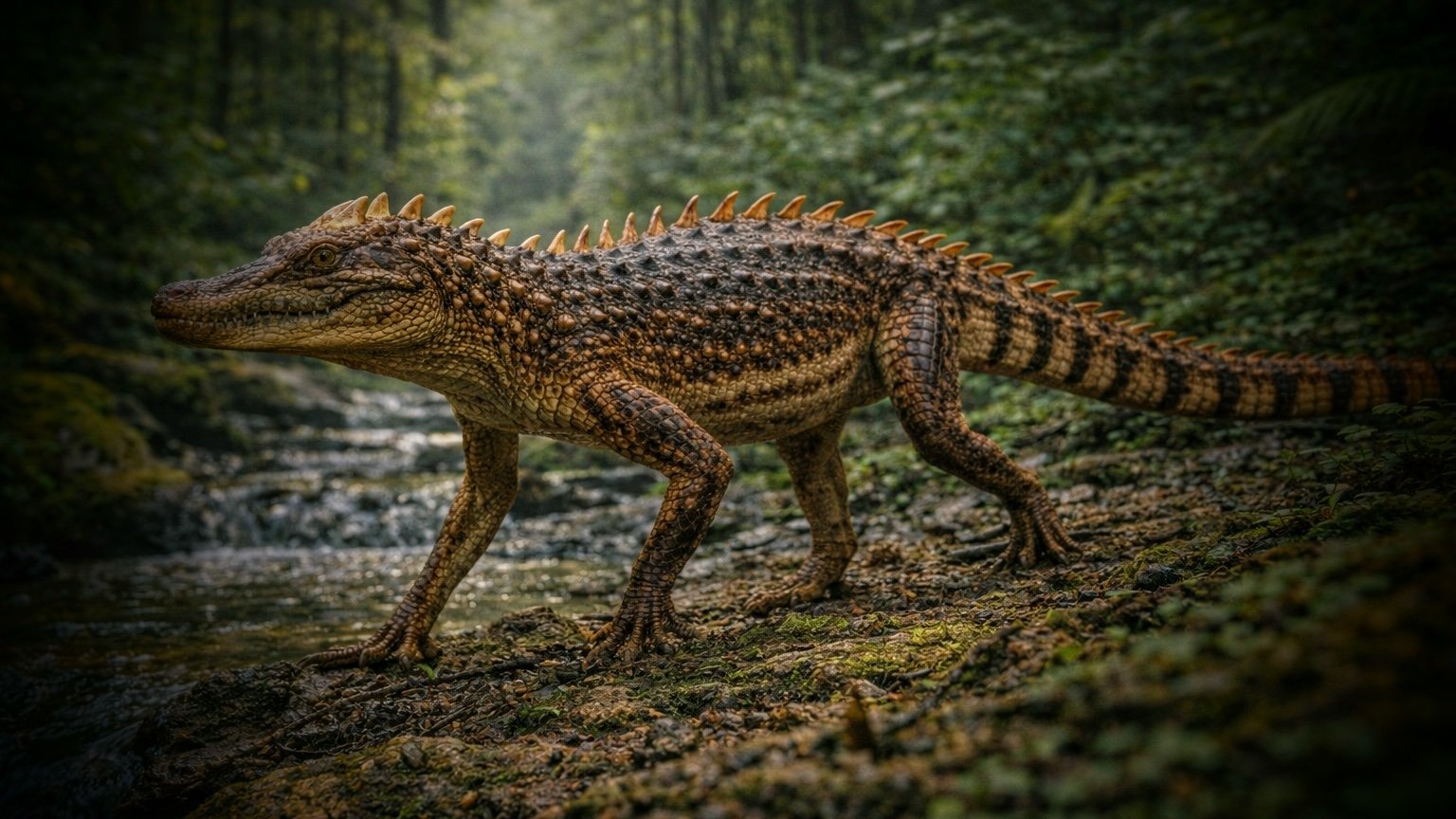
If you say “ancient crocodile,” most people picture something low, scaly, swampy, and slightly offended by evolution. They do not usually imagine a lean little predator built like a racing dog, sprinting across dry ground in what is now Gloucestershire. Yet that is exactly the sort of creature scientists have now formally identified from fossils dating to about 215 million years ago. Its name is Galahadosuchus jonesi, and it has quietly made early crocodile history much less predictable.
That matters because modern crocodiles are such successful specialists that they tend to bully our imagination. We look at their heavy bodies, broad snouts, and semi-aquatic ambush lifestyle, then casually project that whole package backwards through time. Problem solved, we think. Apparently crocodile ancestors were always lurking somewhere near water, waiting with grim patience for lunch. Galahadosuchus jonesi ruins that tidy picture rather beautifully.
Instead of a squat swamp machine, this animal seems to have been light, upright, long-limbed, and fast. Researchers describe it as looking a bit like a reptilian greyhound, which is not the usual brand identity for the crocodile family line. It lived on land, not in rivers. Moreover, its body suggests a creature built to move quickly through undergrowth in pursuit of small prey rather than to float about performing the classic crocodilian trick of pretending to be a log with opinions.
The fossil itself was not discovered yesterday in some dramatic cinematic moment involving dust, brushes, and a triumphant shout. In fact, the remains were unearthed back in 1969 from Cromhall Quarry in Gloucestershire. Then they sat in museum collections for decades. That happens more often than people realise. Palaeontology is full of fossils that spend years, sometimes generations, being politely ignored until someone comes along with sharper questions, better comparisons, or better technology. In this case, a fresh look turned a familiar specimen into a formally recognised new species.
That fresh look came from researchers including Ewan Bodenham of the Natural History Museum and UCL. By comparing the specimen closely with related early crocodylomorphs and using modern imaging methods, they concluded it was not simply another example of a previously known species. Instead, it had its own distinctive mix of anatomical features. So a fossil once filed under something more generic suddenly acquired a much sharper identity. Science can be wonderfully dramatic, although it often stages the drama in storage drawers.
The period in which this animal lived was the Late Triassic, long before modern crocodiles appeared and before dinosaurs had fully monopolised the public imagination. Britain did not look remotely like Britain. This part of the world was an upland environment bordered by hot, arid plains. So the setting was less green-and-pleasant Gloucestershire and more dry prehistoric terrain populated by small reptiles, amphibians, early mammal relatives, and various archosaurs experimenting with body plans as if evolution had not yet settled on its final script.
That wider context matters, because Galahadosuchus is not just a charming oddity. It adds to growing evidence that early crocodylomorphs were more varied than the modern crocodile brand would suggest. Some were clearly terrestrial, lightly built, and adapted for speed. In other words, the early family was doing more ecological improvisation than many people assume. The line that would eventually give us modern crocodiles once included animals that looked less like riverbank assassins and more like compact endurance runners.
There is an almost comic irony in this. Crocodiles today are often treated as symbols of prehistoric stubbornness, creatures that found one excellent design and refused to update it. Yet their distant relatives were once experimenting with a much wider range of forms and lifestyles. Galahadosuchus reminds us that evolutionary history is usually messier, more inventive, and more entertaining than the simplified version that settles into popular culture.
The name helps too, because it is unusually human in the best way. The first part, Galahado-, refers to Sir Galahad of Arthurian legend, a nod to the animal’s upright stance. That is already more poetic than many scientific names, which often sound as though someone sneezed in Latin. But the species name, jonesi, carries the more touching tribute. It honours David Rhys Jones, a secondary school physics teacher in Wales who inspired Bodenham to pursue science.
That detail gives the fossil a second life beyond anatomy. Yes, it tells us something about crocodylomorph evolution. However, it also says something quietly lovely about how science actually works. Discovery is not just fieldwork and specimens and journal articles. It is also encouragement, teachers, passing comments at the right age, and the odd adult who convinces a teenager that curiosity is not ridiculous. A fossil from the Triassic ends up carrying the memory of a modern classroom. That is hard not to like.
There is also a useful lesson here about the fossil record itself. People tend to imagine that every major discovery requires a spectacular new excavation in some remote landscape. Sometimes that happens. Just as often, though, a big shift comes from reinterpreting material already sitting on a shelf. Museum collections are not dusty graveyards of finished knowledge. They are more like archives of unanswered questions. One label changes, one comparison sharpens, one scan reveals hidden details, and a supposedly known animal turns into a new species with a new story.
As for what Galahadosuchus jonesi was doing with those long legs, the best guess is that it hunted small animals on land. It probably moved quickly and actively rather than waiting in ambush like its modern descendants. So if you could visit Gloucestershire 215 million years ago, you would not find a familiar crocodile basking by a murky bank. Instead, you might glimpse a sleek little predator dashing through vegetation with the posture of something far too athletic to fit our modern crocodile stereotype.
And that is why this fossil matters. It does not merely add one more difficult Latin name to the catalogue of extinct reptiles. Rather, it nudges the whole picture sideways. Early crocodylomorphs were not just rough drafts of modern crocodiles. They were an inventive cast of animals exploring different ways to live, move, and hunt in a changing Triassic world. Gloucestershire, of all places, has now handed us one more reminder that prehistory rarely behaves as neatly as we expect. Even the crocodile family, it turns out, once had its greyhound phase.
Post Comment
You must be logged in to post a comment.