The Genie Was Never Meant to Live in a Lamp
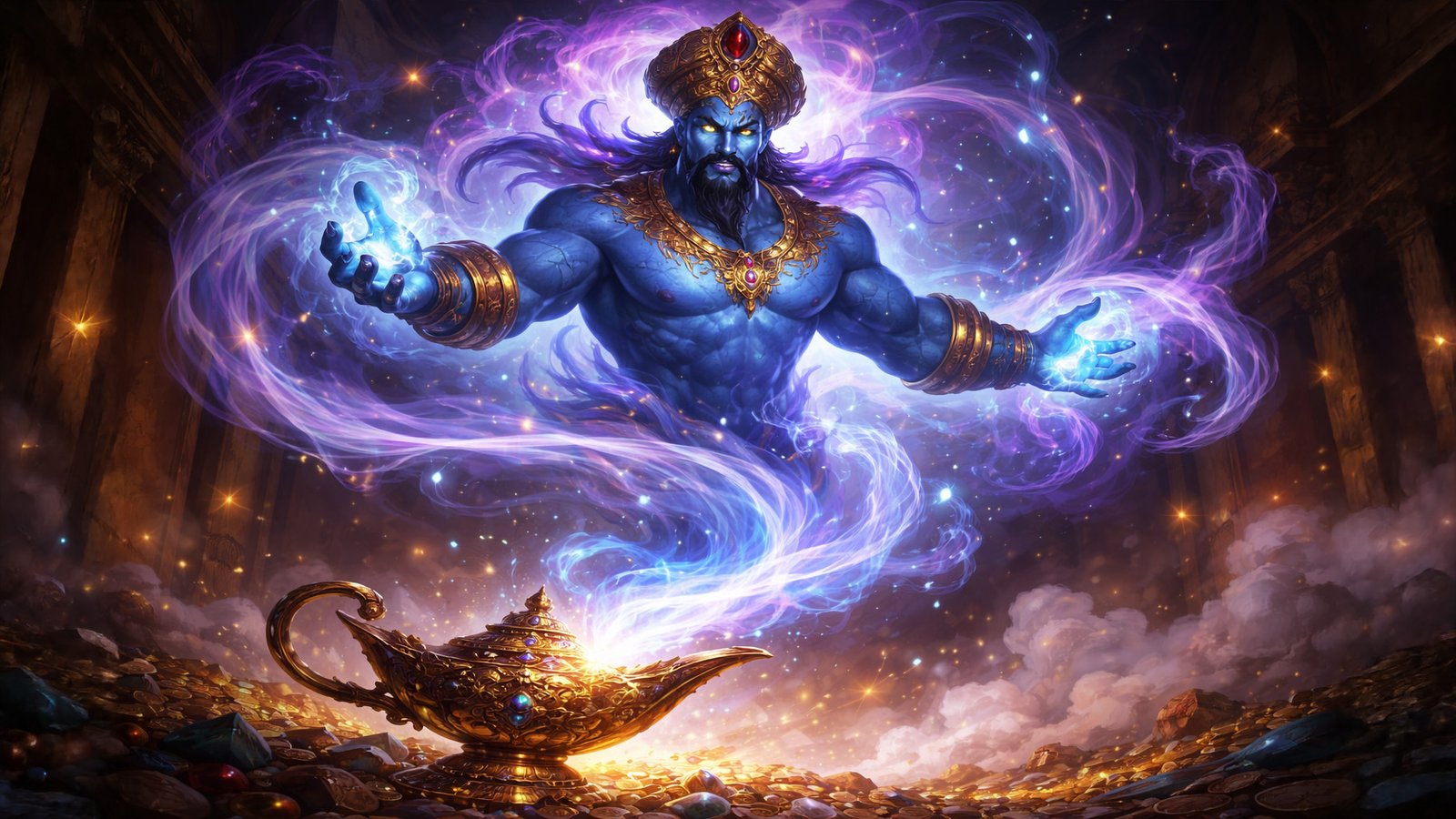
The genie and the lamp feel inseparable. At first glance, a glowing vessel, a curl of smoke, and a booming voice announcing eternal servitude seem eternal. As a result, the scene looks ancient, as though it has always existed. Yet the truth feels messier and far more revealing. In reality, the lamp arrived late. Meanwhile, the genie lived a long and unruly life before anyone tried to trap him inside polished brass.
Long before lamps, wishes, or neat rules, there were djinn. In fact, they belonged to the landscape rather than the household. In pre-Islamic Arabia, these beings occupied deserts, wells, crossroads, ruins, and abandoned places. Consequently, people did not summon them for favours. Instead, they avoided them, placated them, or blamed them when things went wrong. Moreover, djinn inspired poets, caused madness, triggered sudden insight, and explained accidents that lacked better explanations. Overall, they behaved less like servants and more like volatile neighbours.
Crucially, these spirits possessed agency. They chose, they resisted, they remembered insults. Because of this, many stories warned against attracting their attention at all. For example, shouting at night might disturb one. Likewise, pouring hot water onto bare ground could injure one. In short, respect mattered, and caution worked better than courage. Ownership, therefore, never entered the equation.
With the spread of Islam, djinn did not vanish. Instead, they gained definition. In Islamic tradition, they appear as beings made of smokeless fire, separate from humans and angels, yet still morally accountable. Accordingly, some believed, while others rebelled. Even so, their complexity remained intact. They still wandered, interfered, and resisted easy control.
Nothing in this world, therefore, suggested that a djinn would calmly live inside an object, waiting to be activated on demand.
The lamp enters much later, through a story that would eventually overshadow all others. Specifically, the tale of Aladdin did not circulate for centuries as a stable part of Arabic tradition. Rather, it appeared in Europe in the early eighteenth century, recorded by a French scholar who collected Middle Eastern stories for a fascinated audience. As a result, Aladdin arrived as an addition rather than an inheritance, told by a Syrian storyteller and reshaped in translation.
That origin matters because Aladdin reflects the concerns of its moment. In this version, power comes from possession rather than piety. Aladdin does not earn the genie through wisdom or virtue. Instead, he acquires an object. Consequently, the lamp behaves like technology. Rub it correctly and power appears. Conversely, lose it and power disappears. Steal it and power changes hands. In effect, magic now obeys rules that resemble property law.
Earlier djinn stories often punished arrogance. By contrast, Aladdin’s world rewards cleverness. He survives through improvisation, timing, and opportunism. Notably, the genie does not judge intention. Instead, the genie executes commands.
Portability also changes everything. After all, a desert spirit tied to a place cannot fit into a pocket. A lamp can. As a result, the djinn shifts from environmental force to personal asset. Gradually, power becomes mobile. Likewise, control becomes private. The supernatural, therefore, shrinks to human scale.
Another element slips into the myth later: the fixed number of wishes. In early versions, the genie does not enforce strict limits. Instead, help arrives repeatedly. Over time, however, European retellings sharpen boundaries. Limits create tension. Consequently, they force choices. Because unlimited power removes consequence, stories collapse without consequence.
As retellings multiplied, the genie softened. Gradually, the sharp edges wore down. The spirit who once inspired fear became theatrical, humorous, and oddly sympathetic. He joked, complained, and longed for release. Thus, the genie’s tragedy shifted from danger to exhaustion.
This change reveals more about audiences than mythology. As societies moved away from animistic explanations, spirits lost menace. Instead, they became metaphors. Therefore, the genie turned into a lesson rather than a threat. Rather than warning listeners to respect unseen forces, the story warned them about desire.
Every lamp story, however, circles the same trap. Wishes expose what people think they want. For instance, wealth isolates. Meanwhile, power attracts enemies. Love obtained by magic feels thin. Even when instructions are followed perfectly, outcomes disappoint. In the end, precision becomes punishment.
That irony keeps the myth alive. The genie does not sabotage wishes. Instead, humans do. The lamp amplifies intention without adding wisdom. Consequently, it reveals character rather than correcting it.
In this way, the genie and the lamp operate as satire. They mock shortcuts. Moreover, they ridicule entitlement. They also question the fantasy of effort-free success. Aladdin rises quickly, yet the story never pretends that speed equals maturity.
The lamp also reflects anxiety about control. Initially, owning immense power feels comforting. However, comfort fades once power responds too literally. The myth suggests that absolute control removes the margin for error that makes life bearable. As a result, negotiation disappears and consequences remain.
Modern adaptations push this further. Often, the genie appears more human than the humans. He understands cost. He senses imbalance. Therefore, he wants limits because limits protect him from misuse. In these versions, freedom becomes the highest wish of all.
Ironically, this returns the genie closer to his roots. After all, a free djinn resembles the old desert spirits far more than an enslaved one. Independence restores unpredictability and dignity.
The lamp’s persistence also owes much to visual simplicity. A lamp feels ordinary. Consequently, anyone can imagine owning one. That familiarity invites projection. Over time, the object becomes a blank canvas for ambition. Kings do not need lamps. Ordinary people do.
Over time, the lamp lost its regional identity. Instead, it became global shorthand. Cartoonish brass. Decorative smoke. Although cultural specificity blurred, the emotional core survived.
Today, the genie and the lamp feel strikingly contemporary. We live among objects that promise instant solutions. Touch the screen. Ask the question. Receive the answer. Although the response arrives faithfully, wisdom remains optional.
Like the lamp, modern tools amplify intent. They do not refine it. Instead, they make wishes louder, faster, and more literal. As a result, regret follows accordingly.
Perhaps that explains the myth’s endurance. It adapts effortlessly. Settings change. Costumes update. Yet the warning stays intact.
Ultimately, the genie was never really about magic. He was about power arriving too quickly, without the patience required to carry it. The lamp simply made that danger portable.
Strip away the smoke and spectacle and the story feels almost mundane. Someone finds leverage. Then someone uses it badly. Eventually, someone learns, usually too late, that desire needs restraint.
That lesson, inconveniently, never goes out of fashion.