The First European Sighting of New Zealand and Tasman’s Big Mistake
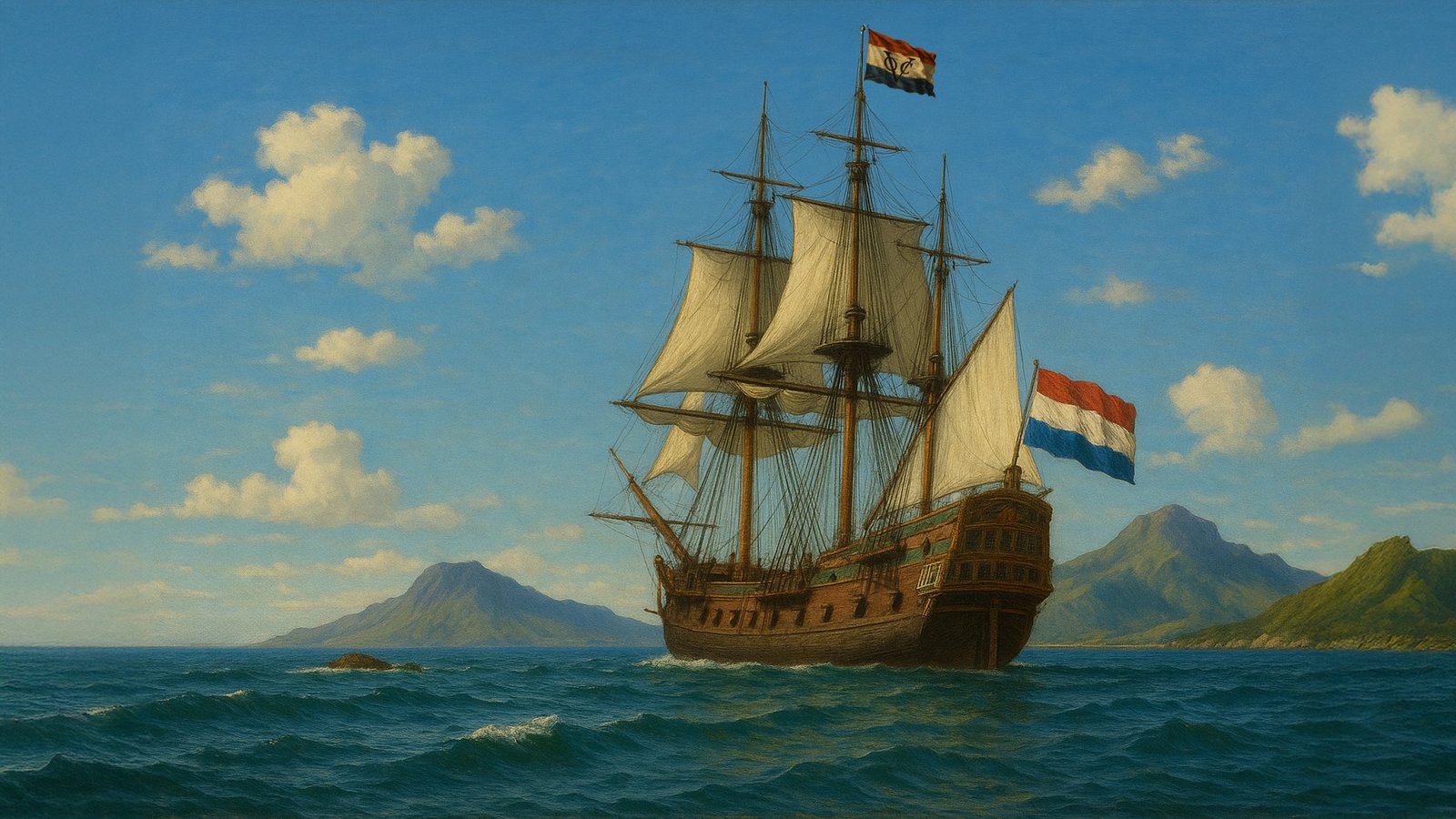
On this day in 1642 Abel Tasman sailed into the kind of weather that makes you question whether the world hides secrets on purpose. The sea rolled under his two Dutch East India Company ships as the crew spotted something rising beyond the mist. Mountains. Not the polite, rounded sort that reassure you, but sharp, brooding silhouettes rising from the South Pacific like a warning. This became the moment historians later called the first European sighting of New Zealand, although Tasman himself thought he had brushed the edge of a far grander mystery. The man feared neither ocean nor myth, yet even he didn’t quite grasp the scale of the place unfolding beyond the spray.
Anyone who has stood on the west coast of the South Island remembers the drama. Granite cliffs. Dense forest. A horizon that doesn’t bother with modesty. Tasman approached this coastline with the same mixture of hope and nerves. His logbook describes land “upright and lifted high,” which reads like the understatement of the century when one remembers he was staring toward the Southern Alps. Those peaks do not simply sit in the landscape; they dominate it. For a navigator searching for the fabled southern continent, they looked promising enough to spark theories that would outlive him.
The dream of a hidden southern land had haunted European cartographers for generations. They pictured a vast counterweight at the bottom of the world balancing the continents to the north. This imagined place appeared in maps with sweeping coastlines and decorative sea monsters, none of which bothered with accuracy. Tasman sailed with instructions shaped by this fantasy. His duty was to explore, confirm, or gently disprove the geography of wishful thinking. He didn’t set out to find New Zealand because no one in his part of the world knew it existed. He set out to solve a different riddle and found a completely unexpected one instead.
The name he chose says everything. He called the land Staten Landt, believing it might connect to a similarly named territory near South America. This was a decent piece of cartographic improvisation for a man who had been staring at empty ocean for weeks. Mist clung to the water. The coastline curved away into haze. Without modern charts or detailed soundings, he saw cliffs and thought they might stretch endlessly. Of course he misinterpreted the strait at the top of the South Island as a bay. Cook Strait hides its true nature when viewed from the wrong angle. It is a trick of geography that has teased more than one sailor.
The next days brought moments that still echo in national memory. Tasman headed north, fighting winds that refused to behave, and eventually anchored in a calm stretch now known as Golden Bay. Here the first European–Māori encounter took place, and nothing about it followed the optimistic script one might hope for. Tasman’s crew planned a gentle reconnaissance. Māori from Ngāti Tūmatakōkiri paddled out to assess the visitors. Communication failed instantly. The Dutch sounded their trumpets. The Māori answered with their own instruments. Each group interpreted the other’s music as challenge rather than greeting. Stories often turn tragic when meanings slip in those early minutes.
What followed felt inevitable once fear outweighed curiosity. A Dutch boat carrying seven men rowed between the two ships. A Māori waka rammed it. Four sailors died in the chaos. Tasman ordered his cannons to fire when more waka approached. Those onboard the Dutch ships described the encounter with horror and confusion, while Māori oral histories speak of strangers arriving with strange weapons, acting unpredictably. Both sides believed they defended themselves. Both were right in their own frame of reference. Their worlds collided with neither side prepared for the other’s customs.
Tasman had planned to land. After that morning he decided the land did not wish to receive him. He named the bay Moordenaers Baij, Murderers’ Bay, in his journal and turned away without stepping onto the shore. The name no longer appears on modern maps for good reason. New Zealanders prefer to honour both sides with a more generous reading of the past, though the episode remains one of those historical moments that illustrate how easily misunderstanding escalates into conflict.
The crew kept the coast in sight as they sailed further north. The outline of the North Island emerged through summer haze. Rivers carved bright streaks along the landscape. Birds circled above the water. Forest met the sea in deep folds of green that must have felt almost enchanted to men accustomed to the flat horizons of the Dutch Republic. Here was a place with no familiar logic. Vegetation pressed close to the shore. Waves thundered against cliffs. Even the shadows fell differently.
By early January 1643 the expedition had drifted out of New Zealand waters. Tasman believed he had proved the existence of a landmass, though not necessarily its boundaries. He turned his attention to Tonga and Fiji, leaving the islands behind with only sketchy maps and a story that future explorers would revisit with more patience and better luck. Tasman would never return. Despite giving his name to a sea, a national park, and eventually an Australian state, he never fully understood the significance of what he had found. European curiosity shifted elsewhere for more than a century.
The irony lies in what this moment became rather than what it was. Tasman didn’t plant flags or make grand speeches. He didn’t interact deeply with Māori society. He didn’t explore inland. His impact came from simply seeing the land and writing it down for others to find. That slight gesture altered the trajectory of European knowledge in the Pacific. Once the islands appeared on charts, even roughly, they drew the interest of navigators who followed. James Cook arrived more than a hundred years later with a much clearer scientific mission and a talent for chart making. Cook’s maps and descriptions reshaped global understanding. Tasman’s sighting provided the spark.
For Māori communities the first European sighting of New Zealand represents something different. Their own ancestors had arrived more than a millennium earlier, guided by ocean‑faring skill unmatched anywhere else at the time. They named the land, settled its valleys, developed sophisticated navigation and agriculture, and built a society that thrived long before European ships appeared on the horizon. From this perspective Tasman didn’t discover anything. He noticed something that already hosted generations of history. That distinction matters. It adds depth to a moment that often gets simplified in textbooks.
Yet Tasman’s appearance still marks a turning point. The Pacific was no longer a world of isolated archipelagos connected only by Polynesian voyaging networks. European trade, competition, science, and ambition eventually swept through. Contact changed technology, economies, and politics. Sometimes this exchange brought innovation. Often it brought disruption. The first European sighting of New Zealand becomes a symbolic doorway into those transformations, standing at the threshold between isolated maritime worlds and the global one that followed.
One detail often missed is the emotional landscape of the crew. Reading their journals reveals a mixture of awe and anxiety. They described clouds clinging to steep mountains, winds shifting without warning, and entire nights where the sea felt like it held its breath. Tall mountains unsettled sailors from lowland Europe. Every shadow suggested a hidden reef. Every gust whispered that they might be sailing too close to unknown dangers. Their astonishment feels sincere, even centuries later.
Tasman’s maps from this voyage show coastlines bending strangely, curling into shapes that look almost playful now. The artist on board sketched cliffs floating out of proportion. Turning the pages, one sees a mind grasping at something vast with limited tools. Even in their inaccuracies, these maps reflect the thrill of contact with the unknown. They remind us how difficult it is to translate a raw landscape into cartography when one has only a rocking deck and a memory of the horizon.
Golden Bay, the site of the fraught encounter, now shelters swimmers, kayakers, seals, and holidaymakers. Abel Tasman National Park offers tidy walking tracks where shouts echo softly through coastal forest. Visitors picnic on beaches whose names Tasman never heard. They dip their toes in the Tasman Sea, wander across estuaries at low tide, and watch the sunrise light the water gold. Few pause to imagine Dutch ships anchored in the distance or elaborately carved Māori waka approaching with cautious eyes. The coastline holds those stories quietly, letting the waves do the remembering.
When people speak of the first European sighting of New Zealand they often focus on the date and the drama. Yet the real interest lies in the combination of certainty and error. Tasman saw the land clearly enough. He misread its context spectacularly. He believed he had brushed the edge of a massive continent when he had in fact grazed one of the most geographically distinct nations on Earth. His mistake shaped the next century of exploration. Sometimes progress begins with the wrong conclusion written confidently in a captain’s log.
This moment continues to fascinate because it captures exploration at its rawest. No satellite images, no forecasts, no detailed charts… Just two wooden ships, a determined crew, and an open ocean that both reveals and hides its secrets. Tasman’s sighting might feel modest now, but it altered maps, inspired future voyages, and linked two worlds that had developed along entirely separate lines.
Standing today on the same coastline you see a landscape that refuses to shrink for anyone. Wind brushes the dunes. Forest leans toward the tide. Light shifts across water with the same indifference it showed Tasman. Modern travellers arrive by plane or ferry, cameras at the ready, yet the sense of scale remains humbling. Even knowing what the land is, people still feel overwhelmed by its presence. Tasman felt that without the benefit of context.
The first European sighting of New Zealand endures because it sits precisely where imagination meets geography. One man looked across the Pacific hoping for a mythical continent. Instead he saw the beginning of a story that would grow far beyond him. New Zealand became a fixture on European maps, a point of interest for scientists, traders and settlers, and eventually a nation known worldwide for its landscapes and cultures. Tasman’s misunderstanding takes nothing away from the moment. It adds character to it.
History rarely offers perfect symmetry. Tasman didn’t know the full meaning of what he saw. The people living on that land didn’t know who he was or where he came from. Their encounter lasted minutes yet shaped centuries. This story sits somewhere between triumph and cautionary tale, full of bravery, misjudgement, wonder and regret. That combination makes it irresistible.
Looking back, the first European sighting of New Zealand feels less like a triumphant revelation and more like a snapshot of humanity at sea—curious, fallible, and always convinced that the next horizon holds an answer. Tasman’s horizon delivered an island nation wrapped in mountains, forests and stories older than his own civilisation. He glimpsed it, misread it, and kept moving. The world, however, refused to forget what he saw.