The Dark History of Chimney Boys
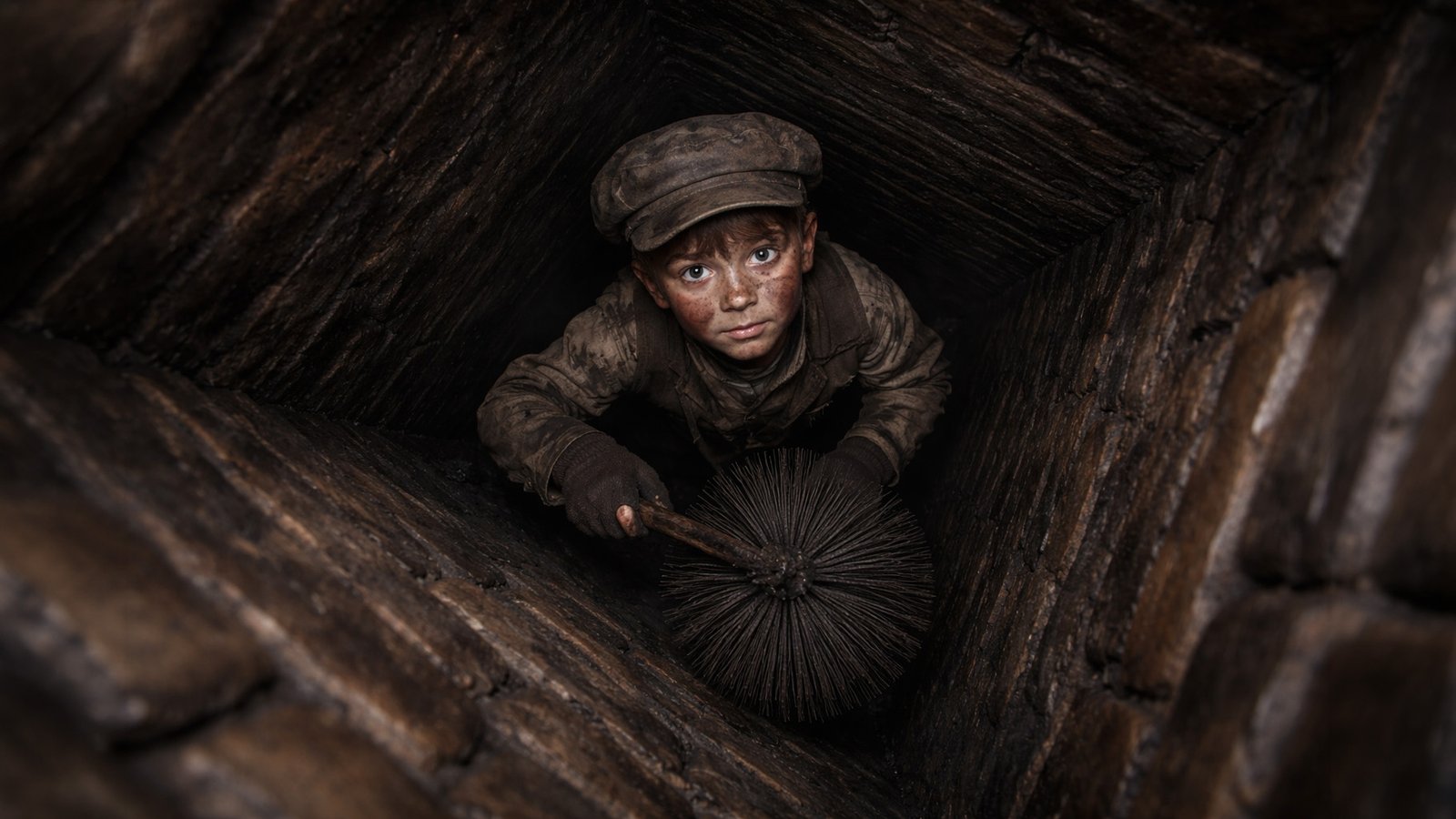
When London burned to the ground in September 1666, nobody could have predicted the horror show that would follow. Certainly, the Great Fire was catastrophic – it gutted the medieval city and left thousands homeless. However, what came next was arguably worse, and it lasted for two centuries. Ironically, the tragedy could have been prevented entirely. After the flames died down, city officials scrambled to prevent another disaster. Consequently, they rewrote the building codes with one crucial change: chimneys had to be narrower. It makes sense – skinnier flues meant better draught and less chance of fire spreading between buildings. Brilliant thinking, except for one tiny problem – somebody still had to clean those chimneys. Moreover, the new design meant that adults simply couldn’t fit inside. Their solution? Children. The chimney boys.
Thus began one of Britain’s darkest chapters, a practice so normalised that society barely batted an eyelid for generations. Boys as young as four – yes, four – were purchased from their poverty-stricken parents or plucked from orphanages and workhouses. Master sweeps would pay anywhere from twenty shillings to five guineas for a child, effectively buying a small human being to do their dirty work. These weren’t apprenticeships in any meaningful sense. The children became property, bound by legal papers that made the master sweep their guardian until adulthood. Most never made it that far.
The work itself was nightmarish. Imagine being six years old and having to shimmy up a pitch-black tunnel barely nine inches wide, using only your back, elbows, and knees for support. You’d push upwards in the dark, soot raining down on your face whilst you tried not to breathe it in. A brush held overhead would knock loose the coal deposits, which would then cascade over your entire body. Meanwhile, if you slowed down or showed any reluctance, your master might light a fire below to ‘encourage’ you along. That’s where we get the phrase ‘light a fire under someone’, by the way. Charming origin story, isn’t it?
Buckingham Palace boasted one particular chimney with fifteen different angles and a flue that narrowed to just nine by nine inches. Astonishingly, this architectural monstrosity reportedly killed fourteen boys before someone finally worked out how to clean it safely. Nevertheless, across London and throughout Britain, such death traps were considered perfectly normal. Children navigated these twisted passages daily, often naked because clothes would catch on the brickwork, scraping their skin raw against the rough surfaces.
The health consequences were catastrophic. Boys developed twisted spines and deformed ankles from contorting their growing bodies through impossibly tight spaces. Similarly, their knees swelled grotesquely from constant friction. Eye inflammation was rampant because soot would fall directly into their faces, and rubbing only made things worse. Tragically, some lost their sight entirely. Lung problems plagued the profession, hardly surprising given that these children essentially inhaled coal dust for hours every day.
Then there was the cancer. In 1775, surgeon Sir Percival Pott identified the first recorded industrial cancer in history: chimney sweep’s carcinoma. This scrotal cancer struck boys in their adolescence, a direct result of constant soot irritation combined with the fact that most sweeps bathed perhaps three times yearly. The diagnosis was a death sentence. Interestingly, whilst Pott’s findings should have sparked immediate reform, they barely made a ripple in public consciousness.
Death stalked these children constantly. Boys got stuck in flues with alarming regularity. When that happened, masters would send another boy up from below to push or prod them free. If that didn’t work, they’d drop a rope with a hook from above, hoping to snag the trapped child. If neither method succeeded, the boy would die of suffocation or exposure. Sometimes walls had to be torn down to retrieve bodies. In 1794, two boys died in the same Lothbury chimney after being sent in from opposite ends. Neither was older than eight.
Living conditions offered no respite whatsoever. The children slept in cellars on bags of soot – not near the bags, literally on top of them. They worked from pre-dawn until noon, then spent their afternoons crying their services through the streets whilst carrying heavy sacks. Food was scarce. Beatings were common. They received no wages, only the ‘privilege’ of room and board. Once a year, on May Day, they got a single day off. That’s it. One day of freedom, which they spent dancing through the streets in whatever tattered clothes they owned.
Society’s response to all this suffering? Largely indifference. Wealthy homeowners needed their chimneys cleaned, and climbing boys were the cheapest solution. The practice was so widespread and accepted that it barely registered as controversial. Machines that could clean chimneys without using children existed from 1803 onwards – George Smart invented the first mechanical sweeper that year. Joseph Glass improved upon it in 1828, creating the basic design still used today. However, master sweeps and their clients actively resisted these innovations. They claimed children did a better job. In reality, they simply preferred cheap child labour over investing in equipment.
Reformers did try to intervene. Jonas Hanway, a London merchant and philanthropist, began campaigning in the 1760s. Subsequently, he published two influential works detailing the atrocities: ‘The State of Chimney Sweepers’ Young Apprentices’ in 1773 and ‘Sentimental History of Chimney Sweeps in London and Westminster’ in 1785. Hanway boldly compared the practice to slavery, pointing out the hypocrisy of a Parliament concerned with abolition in the colonies whilst ignoring child exploitation at home. Initially, his efforts led to the 1788 Chimney Sweepers Act, which set a minimum age of eight for apprentices. Predictably, nobody enforced it.
More legislation followed, each attempt more toothless than the last. The 1834 Act banned apprenticing children under ten and prohibited anyone under fourteen from actually climbing chimneys. Punishment for violations? Three months imprisonment, later reduced to a mere twenty-shilling fine. Masters simply paid up when caught and carried on as usual. An 1840 revision raised the minimum age to sixteen. It made absolutely no difference because, once again, there was no enforcement mechanism.
Literature proved more effective than law in shifting public opinion. William Blake’s poem ‘The Chimney Sweeper’, published in 1789, captured the grim reality with haunting simplicity: ‘When my mother died I was very young, And my father sold me while yet my tongue, Could scarcely cry weep weep weep weep. So your chimneys I sweep and in soot I sleep.’ The poem’s genius lay in its matter-of-fact delivery, presenting unspeakable tragedy through a child’s resigned acceptance.
Charles Dickens wrote frequently about climbing boys in his novels, most notably in Oliver Twist. Whilst his work sometimes veered into sentimentalism, it nonetheless brought the issue before middle-class readers who might otherwise have remained blissfully ignorant. In 1863, Reverend Charles Kingsley published ‘The Water-Babies’, a fantasy novel about a chimney sweep boy who escapes his cruel existence. The book became wildly popular and significantly raised public awareness.
Eventually, a final tragedy forced Parliament’s hand. In February 1875, twelve-year-old George Brewster was sent into the Fulbourn Hospital chimneys by his master, William Wyer. He got stuck. Workers tore down an entire wall trying to free him. They succeeded in pulling him out, but he died shortly afterwards. Wyer was convicted of manslaughter and sentenced to six months with hard labour – a punishment that seems laughably inadequate given the crime.
Lord Shaftesbury, a tireless reformer, seized upon Brewster’s death. He wrote a series of letters to The Times and pushed aggressively for new legislation. In September 1875, the Chimney Sweepers Act finally included the crucial missing element: enforcement. The Act required sweeps to be licensed by police, who were then responsible for ensuring compliance with all previous legislation. At long last, the practice ended.
Ironically, chimney sweeps today are considered lucky. Brides in Britain still hire them for weddings, hoping a kiss from a soot-covered man will bring good fortune. The superstition supposedly dates back to King George II, whose horse was spooked by a dog during a royal procession. A chimney sweep calmed the animal and disappeared into the crowd before the King could thank him, leading George to declare all sweeps lucky. Whether this story is true hardly matters – it’s certainly more palatable than the real history.
The climbing boys’ story isn’t just about child labour. Rather, it’s about how economic convenience can blind an entire society to unconscionable cruelty happening in plain sight. Machines existed that could have replaced these children decades before they were actually used. Laws existed that could have protected them if anyone had bothered to enforce them. Society simply chose profit over humanity, again and again, until public outrage finally made the practice untenable. That it took two hundred years and countless dead children for Britain to do the right thing remains one of history’s most shameful lessons.