The Cyrus Cylinder: How an Ancient PR Text Became a Human Rights Legend
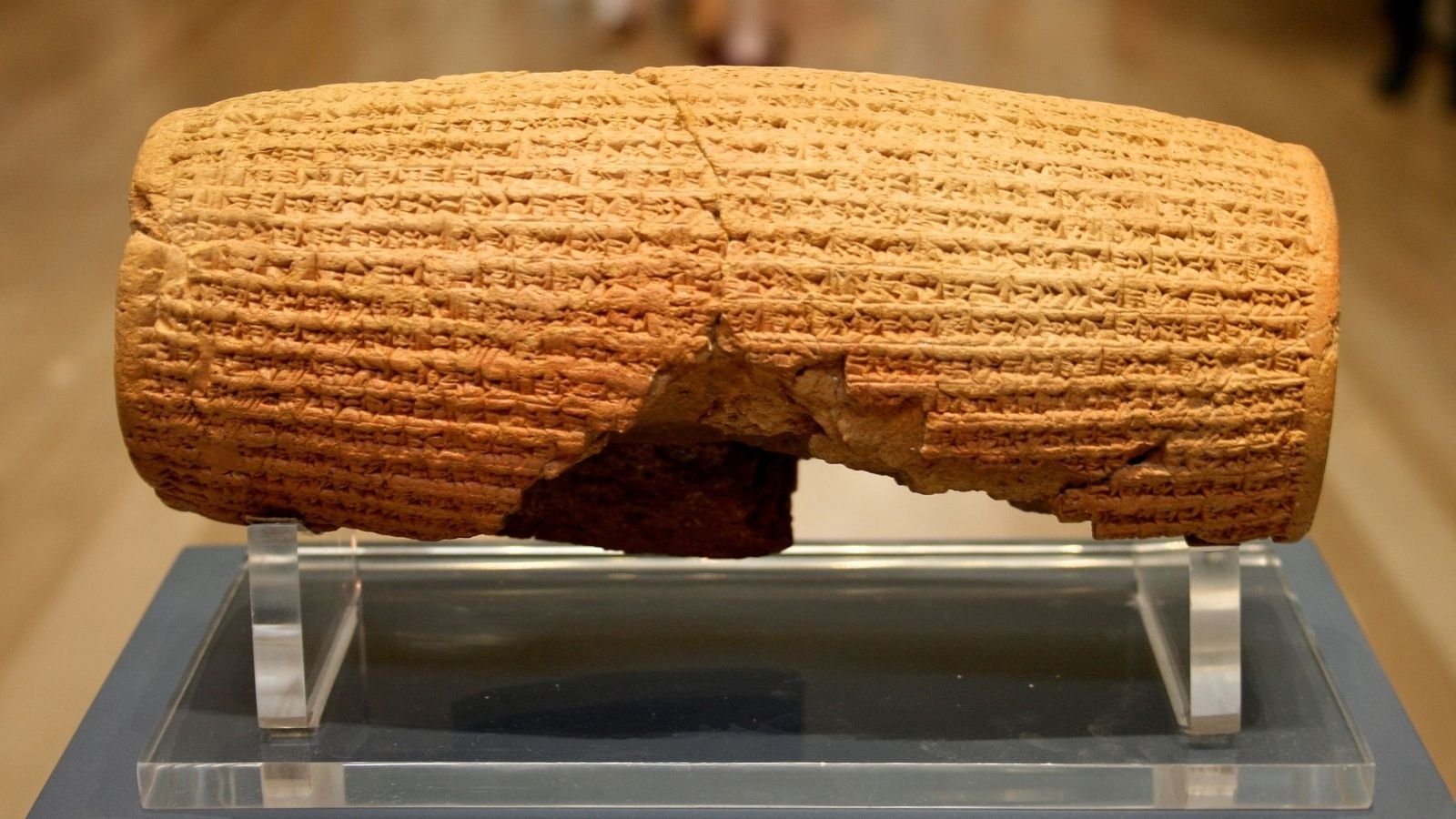
Cyrus the Great keeps turning up in places where you might not expect a sixth‑century BCE Persian king. He appears in UN exhibitions, school textbooks, museum labels, political speeches, and the occasional social media post declaring him the father of human rights. The centrepiece of this reputation sits quietly in the British Museum: a baked‑clay cylinder covered in Akkadian cuneiform, cracked, unassuming, and far less poetic than its modern admirers might hope. The Cyrus Cylinder entered the story in 1879, when archaeologists excavating Babylon uncovered it among the ruins of the city. At first glance, it reads like many Mesopotamian royal inscriptions. A victorious king announces that the gods favoured him, condemns the defeated ruler as impious and incompetent, and promises to restore order, temples, and cosmic balance. Anyone familiar with Assyrian or Babylonian proclamations would have nodded along. This was how power spoke in the ancient Near East.
Yet Cyrus did stand out in important ways. When he captured Babylon in 539 BCE, he chose restraint over spectacle. No mass deportations followed. No razing of temples. No triumphal terror campaign. Instead, Cyrus presented himself as a restorer. He allowed religious practices to resume, supported local priesthoods, and permitted some displaced communities to return to their homelands. The Hebrew Bible famously credits him with enabling the Jews to return from exile and rebuild the Temple in Jerusalem. That single act alone helped secure Cyrus a remarkably positive afterlife in Western religious memory.
It is tempting to read these policies through a modern lens and see the beginnings of tolerance, pluralism, even rights. Compared with the brutality often associated with Assyrian kings, Cyrus looks humane, measured, almost enlightened. For subjects accustomed to rulers who ruled through fear, this approach must have felt refreshing. Empires rarely grow large by accident, and Cyrus understood that stability mattered more than cruelty once conquest ended.
The problem begins when this pragmatism becomes philosophy. The Cyrus Cylinder does not proclaim freedom of religion as a universal principle. It does not argue that individuals possess inherent rights simply by being human. It does not limit royal power or establish protections against the state. Cyrus speaks as a king chosen by the gods, acting benevolently because it suits both divine order and imperial efficiency. The people benefit, but only because the ruler wills it.
That distinction matters. Ancient kings did not imagine society as a collection of equal individuals. They imagined it as a hierarchy upheld by divine favour. Mercy flowed downward, never upward. Cyrus allowed temples to reopen because it stabilised Babylon and pleased Marduk, not because priests held inviolable freedoms. He allowed some exiles to return because it reduced unrest and earned loyalty, not because exile violated human dignity.
The idea of Cyrus as a human rights pioneer gained traction much later. In the twentieth century, especially during the reign of Mohammad Reza Shah Pahlavi in Iran, Cyrus became a political symbol. The Shah presented ancient Persia as a civilisation of tolerance and enlightenment, positioning modern Iran as the heir to that legacy. The Cyrus Cylinder suited this narrative perfectly. In 1971, during the lavish celebrations of 2,500 years of Persian monarchy, it featured prominently as proof that Iran had championed human rights long before the West.
International organisations played their part too. In the 1970s, translations of the cylinder circulated with creative embellishments. Phrases about restoring temples turned into declarations of religious freedom. Administrative decrees became moral commitments. The story was appealing. Human rights needed an ancient, non‑European origin story, and Cyrus fit the role neatly. The fact that the cylinder predated Magna Carta by more than two millennia made the contrast irresistible.
Scholars pushed back. Assyriologists pointed out that nearly every claim attributed to the cylinder had precedents. Babylonian kings before Cyrus had restored temples and returned cult statues. Assyrian rulers occasionally repatriated populations when it suited them. Cyrus followed a well‑established script, albeit with unusual consistency and scale. His restraint was real, but not revolutionary.
Still, dismissing the entire idea as propaganda misses something important. Cyrus did govern differently from many of his contemporaries. He ruled an empire of extraordinary diversity, stretching from Anatolia to Central Asia, and he understood that tolerance, however instrumental, worked. Empires thrive on compliance more than coercion. By respecting local customs, Cyrus reduced rebellion and administrative burden. That insight shaped Persian governance long after his death.
The Achaemenid system that followed relied on satraps, local laws, and cultural autonomy. While the king remained absolute, daily life for many subjects changed little under Persian rule. That model influenced later empires, including Alexander’s successors and even Rome. Pragmatic tolerance became a tool of long‑term control.
Cyrus himself cultivated an image of the just ruler. Greek sources, especially Xenophon, later romanticised him as an ideal king, wise, fair, and self‑controlled. Xenophon’s Cyrus became a moral example for rulers rather than a historical record, but the image stuck. Western political thought absorbed this fictionalised Cyrus alongside biblical praise, reinforcing the idea of benevolent kingship.
This layered legacy explains why the human rights label refuses to die. Cyrus sits at the intersection of myth, memory, and measurable difference. He was not a rights theorist, but he was not a tyrant either. His policies created breathing room in an ancient world that often suffocated its subjects. For many people living under Persian rule, life likely felt safer and more predictable than it had before.
The danger lies in flattening history into slogans. When the Cyrus Cylinder appears as a proto‑UN charter, it loses its real value. It stops being evidence of how ancient power justified itself and becomes a feel‑good artefact pressed into modern debates. That does a disservice both to the past and to the hard‑won struggles that actually produced human rights law in the modern era.
Human rights emerged from centuries of conflict, philosophy, and social change. They required ideas about equality, individual autonomy, and legal accountability that simply did not exist in Cyrus’s world. Claiming otherwise risks trivialising those achievements. It also risks turning ancient figures into mascots rather than understanding them on their own terms.
A balanced view leaves room for admiration without anachronism. Cyrus deserves credit as a skilled ruler who chose integration over terror. He deserves recognition for policies that reduced suffering and respected cultural diversity, even if the motives were practical rather than moral. He does not need to be crowned the inventor of human rights to matter.
The Cyrus Cylinder works best as a mirror. It shows how rulers spoke, how empires stabilised themselves, and how easily later generations project their values onto ancient clay. It reminds us that tolerance can arise from calculation as much as conviction, and that humane outcomes do not always require humane intentions.
In that sense, Cyrus remains relevant. Modern states still wrestle with the tension between principle and pragmatism. They still celebrate restraint when it produces stability. They still prefer uplifting origin stories to messy realities. Cyrus the Great did not give the world human rights, but he did offer an early example of how power can soften itself without surrendering control.
That may be less romantic than the myth, but it is far more interesting. History rarely hands us saints. It hands us rulers navigating chaos, ambition, belief, and necessity. Cyrus navigated better than most. The rest is what we chose to make of him.
Photograph by Mike Peel