The Confucius We Know and the Confucius Who Actually Lived
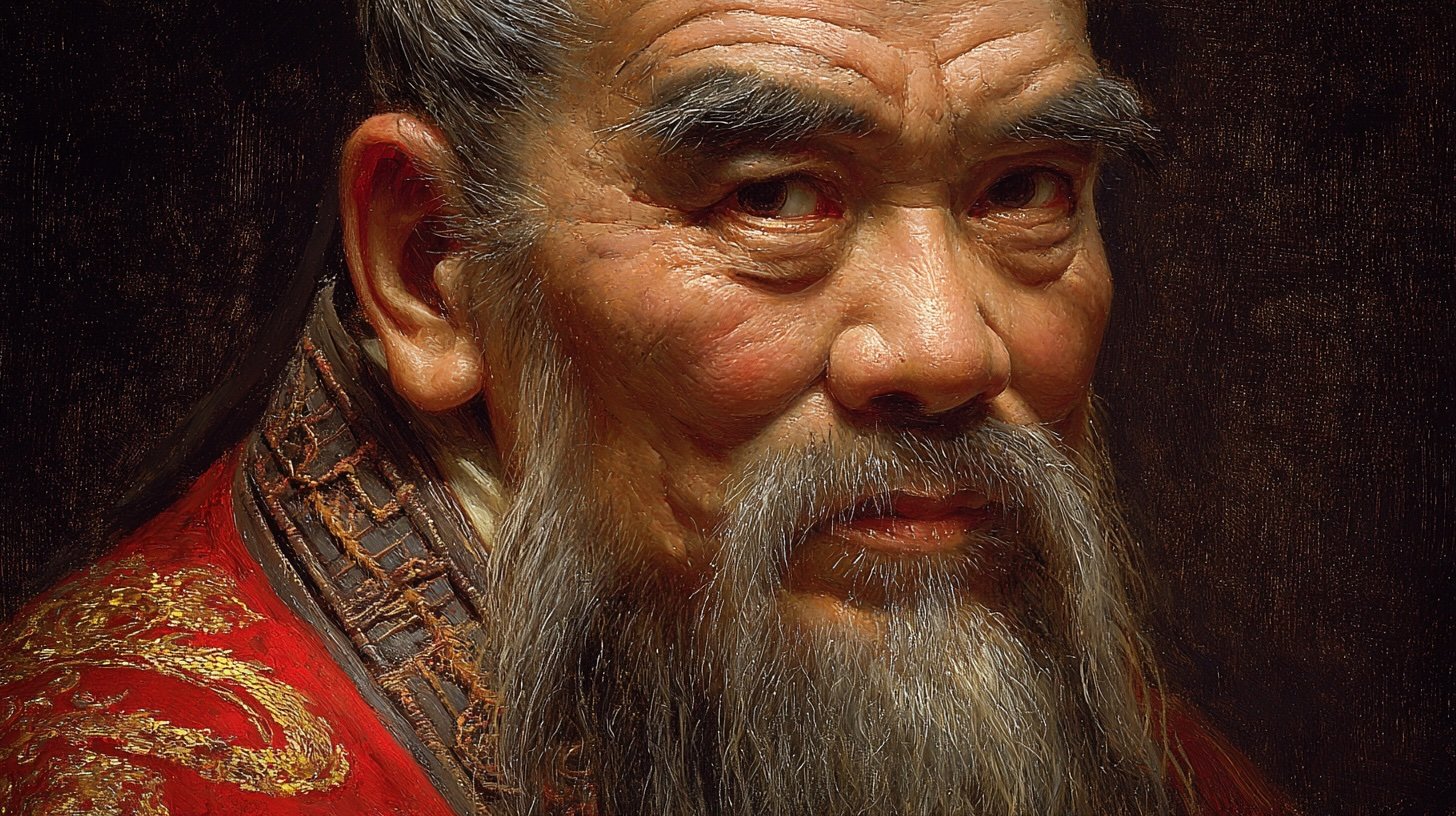
Confucius is usually imagined as a finished statue: calm face, flowing robes, hands folded in eternal wisdom. He looks like someone who never hurried, never doubted, never had a bad day. That image feels comforting, yet it also happens to be wildly misleading.
In reality, the man lived in a China that was anxious, violent, and politically exhausted. The old Zhou order was cracking. Rituals still existed; however, people ignored them whenever it suited them. Alliances shifted constantly, and minor wars flared without pause. Everyone agreed something had gone wrong, yet nobody agreed on how to fix it.
Into this mess stepped Confucius, not as a priest or prophet, but as a frustrated professional moralist. He did not claim access to divine truth, nor did he announce a new cosmic system. Instead, he insisted that humans could behave better if they learned, practised, and took responsibility for one another. It sounds modest. Nevertheless, it was deeply unfashionable.
He was born around 551 BCE in the state of Lu, a small polity that liked to think of itself as cultured while quietly decaying. His family background was respectable but not powerful. Moreover, his father died early. That detail matters, because Confucius grew up without automatic access to influence. As a result, education became his ladder.
At the time, education belonged mostly to aristocrats. Confucius disrupted that arrangement by teaching anyone who showed commitment. He did not offer free wisdom out of generosity alone. Instead, he charged fees, accepted gifts, and treated teaching as serious work. This was not a sage floating above material concerns. Rather, it was a man paying rent.
His classroom was informal and mobile. Students followed him from place to place, arguing, questioning, and sometimes misunderstanding him. Their conversations later formed the core of what we now call the Analects, although Confucius himself never edited or authorised that collection. The text feels fragmented because the man himself was fragmented. He answered differently depending on who asked. For that reason alone, later claims that he offered a single, rigid doctrine deserve suspicion.
Confucius wanted a job in government, which often surprises people. He did not preach withdrawal from politics. On the contrary, he wanted power for the chance to demonstrate what ethical rule looked like in practice. He believed good governance flowed downward from example, not upward from punishment.
For a brief moment, he got his chance. He held minor offices in Lu, dealing with administration and justice. According to later tradition, crime dropped while he served. Whether or not that detail is true, his reform efforts soon collided with entrenched interests. Powerful families disliked moral lectures. Consequently, reform stalled, and Confucius resigned.
After that came the wandering years. He travelled from state to state, offering advice to rulers who listened politely and then did nothing. Sometimes he was welcomed. At other times, he was ignored or openly mocked. There are stories of hunger, danger, and near-starvation. None of this fits neatly with the marble statue. Yet he kept going.
Throughout these journeys, his teaching remained stubbornly practical. He avoided theology and showed little interest in metaphysical speculation. When asked about spirits, he redirected the conversation to human duties. Likewise, when questioned about death, he replied that one should understand life first.
Instead, he focused on relationships. How should a ruler treat ministers? How should children treat parents? And how should friends behave when trust wobbles? Society, in his view, functioned as a web of obligations rather than a collection of isolated individuals.
Central to this thinking was the idea of ren, often translated as humaneness. Ren was not a feeling. Rather, it was behaviour. It appeared in patience, restraint, generosity, and sustained moral effort. Importantly, Confucius never claimed anyone achieved it fully. He included himself among the unfinished.
Then there was li, ritual propriety. Later systems turned li into a stick with which Confucianism beat people into obedience. In Confucius’ own time, however, li meant something subtler. Ritual trained the emotions, disciplined impulses, and created shared expectations. He believed manners mattered because they shaped character, not because they preserved hierarchy for its own sake.
Crucially, Confucius did not argue that rulers governed by divine right. Instead, he argued that they ruled by moral credibility. A ruler who failed ethically lost legitimacy. Heaven, in his thinking, acted more as a moral backdrop than an interventionist god. As a result, space remained for quiet resistance, even though later systems would close that gap.
He also believed learning never ended. He mocked those who thought they had arrived. At the same time, he warned against clever talk divorced from action. He distrusted charisma without substance. Consequently, he often sounds more like a weary mentor than a commanding authority.
By the time Confucius died in 479 BCE, he had followers but not triumph. He did not see his ideas implemented at scale. Nor did he found a school with buildings and uniforms. Instead, he left behind conversations, examples, and a sense of moral stubbornness.
For several centuries, his ideas competed with others. Daoists laughed at his obsession with ritual. Legalists dismissed moral persuasion as naive and pushed harsh laws instead. Mohists argued for universal love and calculation. In that crowded field, Confucius remained respected but hardly inevitable.
Everything changed under the Han dynasty. The Han rulers inherited a traumatised empire after years of brutal unification. They needed stability without constant terror. Confucian language offered something useful, since it preached hierarchy, duty, and moral cultivation. At the same time, the state quietly kept Legalist tools close at hand.
This fusion transformed Confucius. His flexible, conversational ethics hardened into orthodoxy. Meanwhile, his warnings against shallow conformity softened into slogans about obedience. Gradually, his scepticism toward power faded as emperors embraced him as a symbol of continuity.
Posthumously, honours accumulated. Titles grew grander. Temples appeared, and sacrifices followed. Confucius shifted from teacher to cultural ancestor. Once imperial examinations crystallised around Confucian texts, questioning him began to resemble questioning the state itself.
The examination system deserves both blame and credit. On one hand, it created one of the world’s earliest meritocratic bureaucracies. On the other, it froze interpretation. Success depended on mastering authorised readings rather than wrestling with uncertainty. As a result, Confucius became something to memorise, not argue with.
Later philosophers layered metaphysics onto his thought. Cosmology crept in. Moral psychology hardened. Neo-Confucianism built towering systems that would have baffled the wandering teacher of Lu. Even so, these systems continued to speak in his name.
Over time, Confucius acquired traits he never claimed. He became flawless, he became serene, he became the guarantor of order. Meanwhile, his doubts disappeared, his failures vanished, and his humour dulled.
This saintly Confucius proved extremely useful. Emperors invoked him to justify hierarchy. Officials cited him to demand obedience. Families used him to reinforce patriarchy. Each move sounded traditional, even when it contradicted his lived experience.
Modern critics eventually noticed. In the early twentieth century, reformers blamed Confucius for authoritarianism and stagnation. They smashed statues, banned teachings, and declared him obsolete. Ironically, this reaction also flattened him into a symbol.
Today, Confucius circulates once more, repackaged for soft power, education brands, and debates about cultural identity. Once again, the historical man slips quietly behind the image.
The gap between who Confucius was and who he became is not accidental. Rather, it shows how ideas survive by changing shape. At the same time, it warns that moral philosophies can be conscripted by systems their authors never imagined.
Confucius was not a saint guarding an eternal order. Instead, he was a man arguing, travelling, failing, and trying again in a collapsing world. That version may feel less comforting than the statue. It is also far more interesting.