The Cold Truth About the Gobi Desert
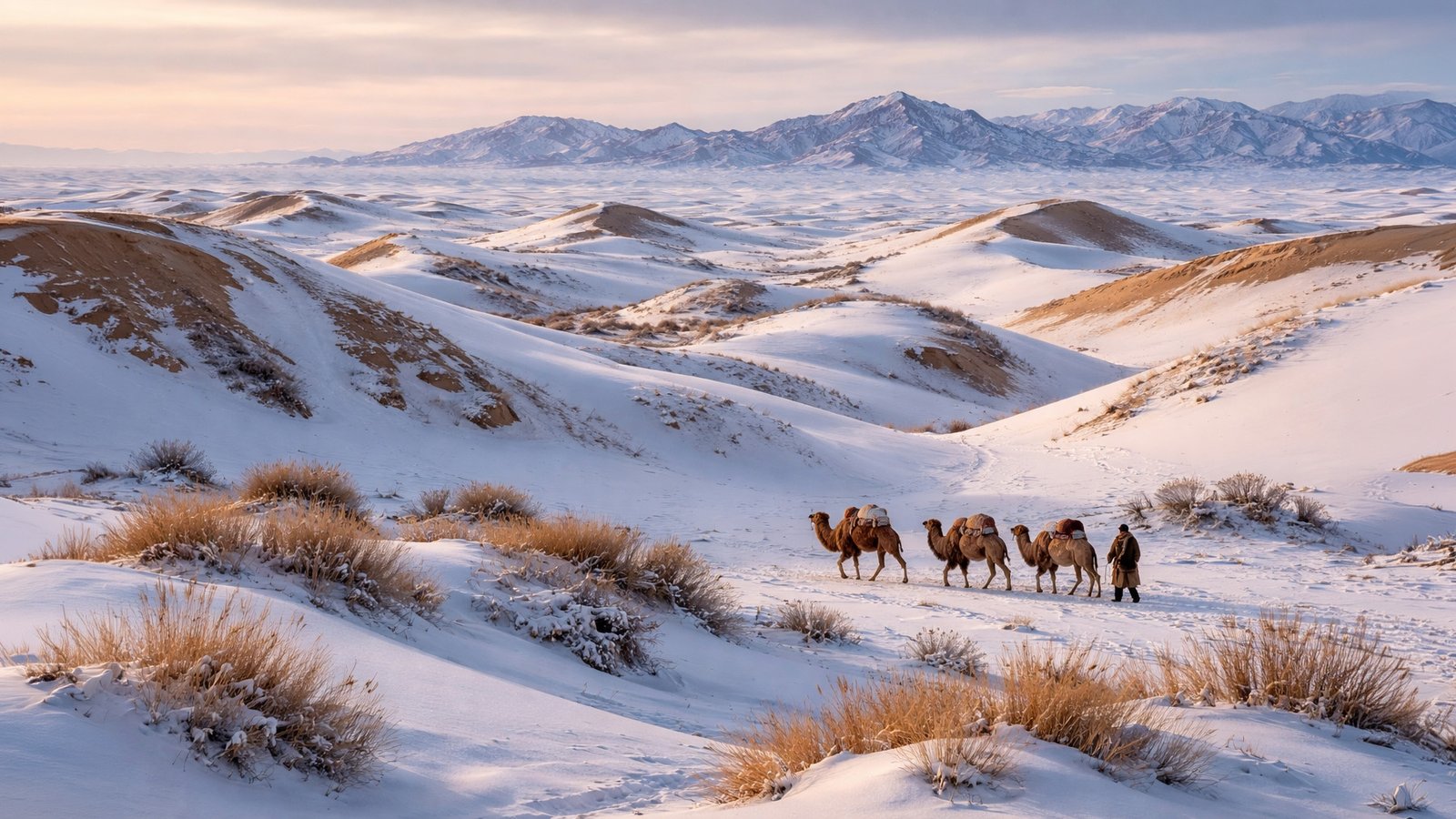
Say “desert” and most people picture dunes, mirages, and the sort of heat that makes metal objects feel personally hostile. Yet the Gobi would like a word. It stretches across southern Mongolia and northern China, looking less like a postcard fantasy and more like the aftermath of a planetary argument. Yes, there are dunes in parts of it. However, much of the Gobi is not a rolling sea of sand at all. Instead, it is gravel, bare rock, hard-packed earth, salt flats, and plains so stern they seem designed by someone with a grudge against softness.
That is the first surprise. More importantly, the second is even better. The Gobi is a cold desert. In winter, temperatures can plunge to around minus 40 degrees Celsius in some areas. So the place many people imagine as a furnace can behave more like an open-air freezer with excellent views. Scandinavia at least has forests, lakes, and a certain hygge public relations machine. By contrast, the Gobi offers wind, stone, and the kind of silence that makes you rethink every life choice that brought you there.
This is not a contradiction, though. A desert is defined by dryness, not heat. That small detail has confused generations of people who learned geography through cartoons. The Gobi gets very little precipitation, often under 200 millimetres a year. Moreover, some of what it does receive comes as snow rather than rain. Consequently, that creates a wonderfully rude twist on the classic desert script.
Its climate turns brutal because of geography. The Gobi lies far inland, away from the moderating effects of oceans. In addition, it sits in the rain shadow created by enormous mountain systems, including the Himalayas and the Tibetan Plateau, which block moisture from moving north. As a result, the air arrives poor, dry, and stingy. Then Siberian air masses join the party in winter and drag temperatures even lower. So the Gobi is not merely dry. It is dry with ambition.
Even the ground refuses to play along with fantasy. Many travellers expect endless soft dunes, only to find landscapes that look almost lunar. You can drive for long stretches over stony surfaces instead of sand. In places, the earth is scattered with gravel and broken rock, with low shrubs clinging on like pessimists who turned out to be correct. Then, suddenly, a band of cliffs or a set of singing dunes appears, just to remind everyone that the Gobi still enjoys theatrical timing.
That mix of terrains is one reason the Gobi feels so strange. It does not perform desert in the neat, cinematic way people expect. Instead, it keeps changing the set. One area looks like a vast gravel basin. Another resembles a steppe that gave up halfway. Elsewhere there are canyons, escarpments, and chalky expanses where almost nothing seems willing to grow. Consequently, the Gobi can feel less like one desert and more like several severe landscapes sharing a postcode.
Winter is when its reputation really earns its keep. Snow can dust the ground. Ice can grip the surface. Wind can cut straight through clothes, optimism, and any romantic attachment to the word “adventure”. Meanwhile, the temperature swing is part of the drama too. Summers can be intensely hot, while winters become viciously cold. Even within a single day, the desert can shift sharply between daytime warmth and night-time chill. The Gobi does not do moderation. It prefers mood swings.
Yet life persists there with suspicious competence. The wild Bactrian camel is the obvious celebrity, largely because it looks as though it was assembled for impossible weather on purpose. It can handle scorching summers and bitter winters, which is more than most people can say after a delayed train and a mild drizzle. Meanwhile, snow leopards roam some of the Gobi’s mountainous margins, and the critically endangered Gobi bear survives in tiny numbers in one of the harshest habitats any bear has the misfortune to call home.
Plants are equally stubborn. Saxaul shrubs and other hardy desert vegetation survive where the soil is poor, water is scarce, and the climate behaves like a menace. They do not create lush scenery. Instead, they create the botanical equivalent of grim determination. Still, that sparse cover matters enormously. Without it, erosion worsens, dust rises more easily, and the line between harsh landscape and ecological damage grows thinner.
That leads to one of the modern arguments around the Gobi. People often talk about desert expansion as though nature alone is marching forward with a villain’s cape. However, the reality is messier. Drought and climate patterns matter, certainly. At the same time, overgrazing, land degradation, mining pressure, and poor water management can intensify the damage in parts of the wider region. So the Gobi is not simply a natural spectacle. It is also a place where climate, economy, and policy keep colliding in full view.
Dust storms add another layer to the story. Popular imagination loves great walls of cinematic sand. In reality, dust from arid and semi-arid landscapes can travel enormous distances and create serious environmental and health problems far from where it began. Therefore, what happens in landscapes like the Gobi does not stay politely in the Gobi. Instead, it can affect agriculture, air quality, transport, and public health across a much larger area.
And then there is the other reason the Gobi never quite behaves like an ordinary desert in the public imagination: dinosaurs. The Flaming Cliffs of Bayanzag helped make the region world-famous for fossil finds, including some of the first dinosaur eggs ever identified by science. That fact alone sounds almost too perfectly theatrical. A desert of ice, gravel, and savage winters also turns out to be one of the great palaeontological treasure houses on Earth. Naturally, it is. The Gobi was never aiming for simplicity.
Historically, the desert also sat near major routes of movement and exchange across Inner Asia. Caravans skirted or crossed its harser reaches. Empires treated it as barrier, corridor, and test. However, even when people used it, very few could pretend it was tame. The Gobi has always kept a certain moral upper hand over human plans.
Perhaps that is why it unsettles the modern imagination so effectively. We like our categories clean. Deserts should be hot. Cold places should be snowy and forested. Sand should be everywhere. Nature, in the popular mind, is expected to respect branding. The Gobi refuses. It freezes, bakes, scrapes, blinds, and astonishes, often in the same broad sweep of land.
So when people picture the Gobi as a giant sandbox under a merciless sun, they are only catching a fragment. The fuller version is harsher and more interesting. This is a desert built from absence rather than stereotype: little rain, little shelter, little mercy. Yet it holds extraordinary life, deep history, and landscapes that look as though weather spent centuries experimenting without supervision. In other words, the Gobi is not a failed Sahara. It is its own formidable category, and it has no interest in making itself easier to imagine.
Post Comment
You must be logged in to post a comment.