The Bethlehem Star: Planets, Comets or Clever Storytelling?
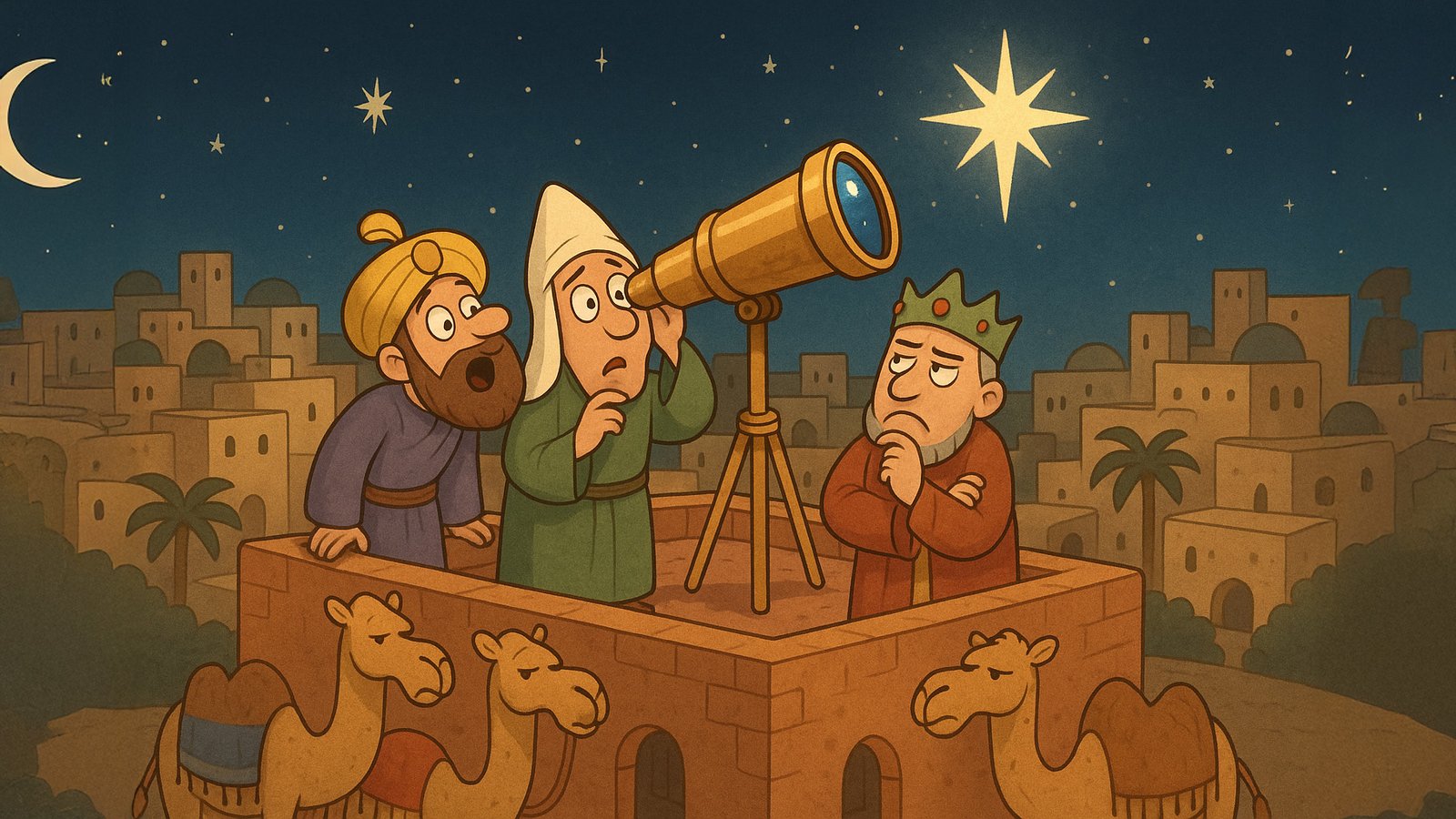
The Bethlehem star sits at the crossroads of history, astronomy and a very human love for celestial drama. Ancient sky‑watchers spent nights scanning the heavens for hints about kings, empires and impending change, so a mysterious light appearing over Judea would have caused more than a few raised eyebrows. The familiar story describes Magi following a remarkable sign across awkward distances, guided not by maps but by the sky itself. Modern astronomy approaches this tale with curiosity, updated data and a willingness to separate cosmic possibility from charming myth, all while keeping its sense of humour. and a slightly sceptical grin.
People often imagine a blinding sphere bursting through the night like a cosmic torch. In reality, most astronomers suspect the so‑called Bethlehem star wasn’t a singular explosion but something subtler. Planets love a bit of theatre, and two of them can come close enough to look almost fused. Jupiter and Saturn pulled precisely this trick back in 7 BC. Imagine two bright dots edging nearer over weeks, until casual stargazers start asking whether the gods are trying to send a heavily coded memo. To astrologers in the ancient Near East, the arrangement of planets meant more than the planets themselves. Constellations added context, and Pisces, where this conjunction happened, carried associations with rulers and new eras. You can easily picture a cluster of scholars deciding this unusual arrangement pointed to something political brewing in Judea.
The planets weren’t finished either. A few years later, Jupiter teamed up with Venus in a chin‑tiltingly bright encounter. Venus already behaves like a diva, the brightest planet in the sky, and Jupiter isn’t exactly shy. Put the two together near the horizon and you get something that could make even the most cynical scribe mutter, “that’s… unusually luminous”. A pair of brilliant points merging into what looks like a single star might have been enough to fuel a rumour mill stretching from Babylon to Jerusalem.
Comets, however, march into the chat with a certain swagger. They show up unpredictably, glow for weeks and drag those glamorous tails behind them. Chinese astronomers noted a “broom star” in 5 BC, bright enough to earn a place in their sky logs. A comet tends to drift slowly across the heavens, giving people plenty of time to notice and assign meaning. Unlike planets, which move along predictable paths, a comet in an odd position might have felt genuinely new. Some modern astronomers ran simulations suggesting a comet that year approached Earth closely enough to seem unusually bright. With enough imagination, you might picture its gradual motion as a form of cosmic guidance, shifting position night by night, encouraging travellers to head in a particular general direction.
Then there’s the glamorous idea of an exploding star. Novae and supernovae can blast themselves into visibility so dramatically they stay in daytime skies. A new star appearing where none existed before would certainly make an impression. Ancient observers in China and Korea left records of many such events. The snag: they didn’t reliably note one at the precise period we care about. Nothing in the known sky remnants points clearly to an explosion timed around the birth of a famous first‑century figure. So this theory often floats around on charm rather than hard evidence.
Other possibilities rely less on spectacular events and more on interpretation. Astrologers would have watched for heliacal risings, those first seasonal reappearances of planets just before dawn. A planet suddenly turning up after a period of invisibility carries symbolism, depending on its constellation. Jupiter rising in Aries, for instance, could have been read as a sign related to Judea, thanks to the complex weave of astrological associations in that era. The story’s authors might have focused less on a literal bright dot in the sky and more on a meaningful arrangement that ancient readers would have understood instinctively.
Then we get to the awkward detail: the star supposedly “stood over” a specific house. No natural object performs that party trick. Stars rise in the east, set in the west and drift across the sky in patterns so reliable you can set clocks by them. Even comets, for all their meandering, don’t pause elegantly above a particular street like a cosmic delivery driver checking directions. Which leaves two explanations: either the text uses poetic language to describe a general direction of travel, or the story operates symbolically rather than literally. The latter has fans among historians, who note that nativity narratives in antiquity often used celestial imagery to frame the importance of key figures.
The Magi themselves add intrigue. These weren’t casual wanderers; they most likely came from regions steeped in astrology, where planetary motion carried political implications. They read the sky as a coded newspaper. A conjunction in a constellation tied to royal symbolism might have screamed “new king”. So the star narrative may reflect intellectual interpretation rather than a blazing point you could photograph on your phone. Picture a group of specialists poring over star charts with dramatic flair, convincing each other that something significant was unfolding, and then packing frankincense just in case.
Of course, speculative theories bloom every year. Some insist the event was supernatural. Others try to anchor the story to obscure astronomical alignments that require spreadsheets and three cups of coffee to understand. A more grounded view suggests a combination of events — perhaps a conjunction witnessed first, then a comet reinforcing the sense of cosmic importance. Ancient cultures saw layered meaning in the heavens; coincidences became messages, and rare alignments turned into omens. The sky didn’t need to do anything particularly outrageous; it simply had to behave strangely enough to spark imagination.
What’s striking is that no single modern explanation fully satisfies every detail of the account. Conjunctions don’t travel. Comets don’t pause. Supernovae don’t hide from Chinese chroniclers. Yet the story persists in cultural memory because it blends sky‑watching, politics and myth in a way that feels unmistakably human. We’re wired to hunt for signs in darkness, to imagine meaning in faint lights drifting overhead. Whether that ancient glow was a rare gathering of planets, a wandering comet or something purely symbolic, it left enough of an impression for people to talk about it two millennia later.
So the Bethlehem star may never reveal its true identity, but its allure works better than most marketing campaigns. Over two thousand years on, we’re still peering up, half hoping the sky will try that trick again, half relieved it hasn’t yet pointed us towards another long journey carrying expensive gifts.