Temples as Hospitals: Inside the Asclepieion
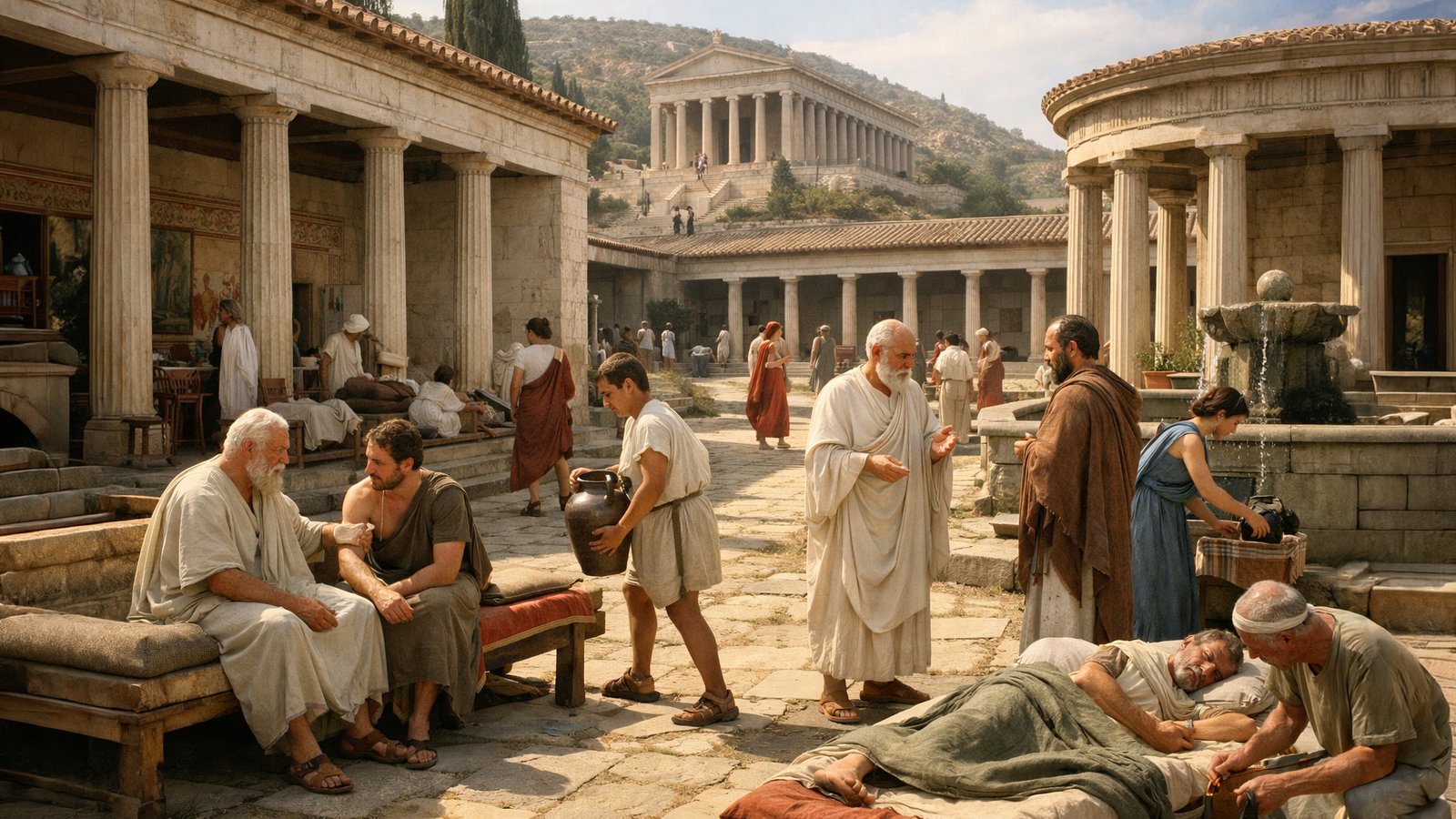
The Asclepieion sat in a curious space between temple, clinic, guesthouse, and theatre of hope. People did not arrive there for a quick tablet and a brisk discharge summary. Instead, they came because pain had lingered, ordinary remedies had failed, and the god Asclepius still had a reputation for seeing cases that everyone else found inconvenient. That alone gave the place a certain advantage. When medicine feels uncertain, authority wrapped in marble tends to look extremely persuasive.
These sanctuaries spread across the Greek world and later the Roman one, from Epidaurus and Kos to Athens and Pergamon. They were not all identical, yet the pattern feels recognisable. The site itself mattered. Builders chose healthy-looking settings with clean air, water, shade, and room to move. That was not decorative. A healing sanctuary had to look as though recovery belonged there. Even before the rituals began, the landscape was already making an argument.
Patients did not simply wander in, lie down, and wait for a miracle with good lighting. First came preparation. Visitors purified themselves, often through washing, fasting, prayer, and sacrifice. That process was religious, obviously, but it also imposed order. You left ordinary life outside, slowed your body down, and entered a place with rules. In modern language, we might call that intake, triage, and environmental reset. The Greeks, naturally, made it holier and much better staged.
Then came the famous part: incubation. The patient slept in a special hall, often called the abaton, after making offerings and observing the sanctuary’s procedures. During the night, Asclepius was expected to appear in a dream. Sometimes he healed the person on the spot. Sometimes he gave instructions. At times, the cure was oddly specific, mildly absurd, or both. Ancient inscriptions preserve stories that sound less like sober case notes and more like a medical drama written by a poet with a taste for symbolism. Yet that is exactly why they mattered. A memorable cure travels further than a quiet one.
Priests stood at the centre of this system, although calling them merely priests is a little too tidy. They managed ritual, interpreted dreams, supervised sacred practice, and maintained the institution. The sanctuary also had attendants, regulations, sleeping areas, water facilities, and spaces for offerings. In some places, medicine and religion overlapped so closely that trying to peel them apart feels modern in the least useful way. The patient was not choosing between science and faith. Instead, the patient was entering a system that used both observation and divine theatre at once.
That blend is what makes the Asclepieion interesting. It is easy to mock dream healing until one notices how practical some sanctuaries could be. Diet mattered. Exercise mattered. Baths mattered. Rest mattered. Clean surroundings mattered. Routine mattered. Even the journey there mattered, because pilgrimage itself interrupted ordinary stress and created a psychological threshold. So yes, there was divine revelation. However, there was also fresh air, sleep, controlled ritual, and a structured belief that one might improve. Human beings have responded quite well to that combination for a very long time.
The sanctuaries also collected evidence, though not in the form a modern journal editor would welcome with unseemly enthusiasm. At Epidaurus, cure inscriptions recorded striking recoveries and displayed them publicly. These stories advertised the god’s power, of course, but they also preserved patterns of illness, treatment, and expectation. In that sense, the walls became a kind of testimonial archive. Not objective, not complete, and certainly not free of selection bias. Still, they reveal what people thought counted as proof. If enough healed bodies, grateful offerings, and compelling stories accumulated in one place, the sanctuary’s authority grew.
Those offerings could be wonderfully direct. People dedicated models of healed body parts: eyes, limbs, breasts, ears, genitals, and other anatomical reminders that suffering tends to become very specific very quickly. A bad knee is never philosophically interesting when it belongs to you. These votives turned private pain into public evidence. They also made the sanctuary look like a stone catalogue of human frailty. One can imagine the effect on a new arrival: alarming, reassuring, and very good for brand credibility.
Sacred animals added another layer. Snakes, especially, belonged to Asclepius and became one of his most durable symbols. That was not random decoration. In the ancient imagination, snakes carried strong associations with renewal, hidden power, and healing. Therefore, a sanctuary where sacred serpents moved through the precinct did not feel like ordinary civic space. Instead, it felt charged, alive, and slightly beyond normal rules, which was probably excellent for the atmosphere and less excellent for anyone already nervous.
The line between miracle and treatment was never fixed. Some inscriptions describe instant cures in dreams. Others suggest instructions that could be followed after waking. There are also hints of more recognisable interventions around these sanctuaries, including bathing, regulated living, and forms of medical care that sat beside ritual rather than beneath it. However, scholars still argue about how far to call these places hospitals in the modern sense. That label helps explain their social role, but it can also flatten what made them distinct. A hospital promises professional medicine. By contrast, an Asclepieion promised access to a healing god within a carefully managed environment.
That difference matters because ancient people were not naive dupes shuffling into superstition because no one had invented reason yet. Greek medicine already had observers, theorists, and practical healers. Figures like Hippocrates were trying to explain disease in natural terms, not as a tantrum from Olympus. Yet the sanctuary model thrived anyway. Why? Because illness is never only technical. It is frightening, isolating, expensive, and often humiliating. The Asclepieion addressed the whole experience. It gave suffering a setting, a ritual, a narrative, and a chance to become legible.
Meanwhile, the priests were not necessarily competing with every secular physician in sight. The boundaries were blurrier than that. Patients might consult different healers at different moments. A sanctuary could offer one kind of help, while a travelling doctor offered another. Ancient healthcare was not a neatly regulated national system with cheerful pamphlets in the waiting room. Instead, it was a marketplace of trust. Asclepius succeeded because his sanctuaries made trust feel visible.
The architecture did part of that work. Porticoes created shelter and order. Water features suggested purity and care. Sleeping halls gave ritual a physical location. Large sanctuaries sometimes included theatres and stadiums, which seems odd only if one assumes healing must look grim to count. However, the Greeks did not always make that mistake. Music, spectacle, movement, and communal life could belong near medicine. A patient is easier to imagine as recoverable in a place built for living, not merely for enduring.
Even so, the Asclepieion was not some ancient version of evidence-based medicine in sandals, and it was not merely fraud with incense. Instead, it sat in the awkward, fertile territory where belief, environment, suggestion, routine, and practical care all pushed in the same direction. That makes modern readers a bit uncomfortable because we like our categories tidy. The sanctuary refused tidy. It understood that a person might need treatment, interpretation, reassurance, and ceremony all at once.
That, perhaps, is why these healing temples still feel strangely modern. Not because they had MRI scanners hiding behind the columns. They did not. Not because dream interpretation should replace antibiotics. It should not. Rather, they feel modern because they grasped something hospitals still struggle with: people do not arrive as broken mechanisms. They arrive frightened, hopeful, suggestible, exhausted, and deeply aware that the body has suddenly stopped keeping its side of the bargain.
So the Asclepieion worked not only by promising cure, but by choreographing the experience of being ill. It gave patients a route through uncertainty. First purification, then waiting, then sacred sleep, then interpretation, then gratitude. That sequence mattered. Recovery, or even the hope of it, became something you could move through step by step. And in a world without modern pharmacology, that was no small thing.
The sanctuary of Asclepius therefore deserves its reputation, though perhaps not for the simplest reason. It was not just a temple. It was not just a clinic. Instead, it was a machine for turning fear into meaning and sometimes, perhaps, meaning into relief. That may sound mystical. However, it is also extremely human.
Post Comment
You must be logged in to post a comment.