Stink Pipes and Victorian Art of Managing Bad Smells
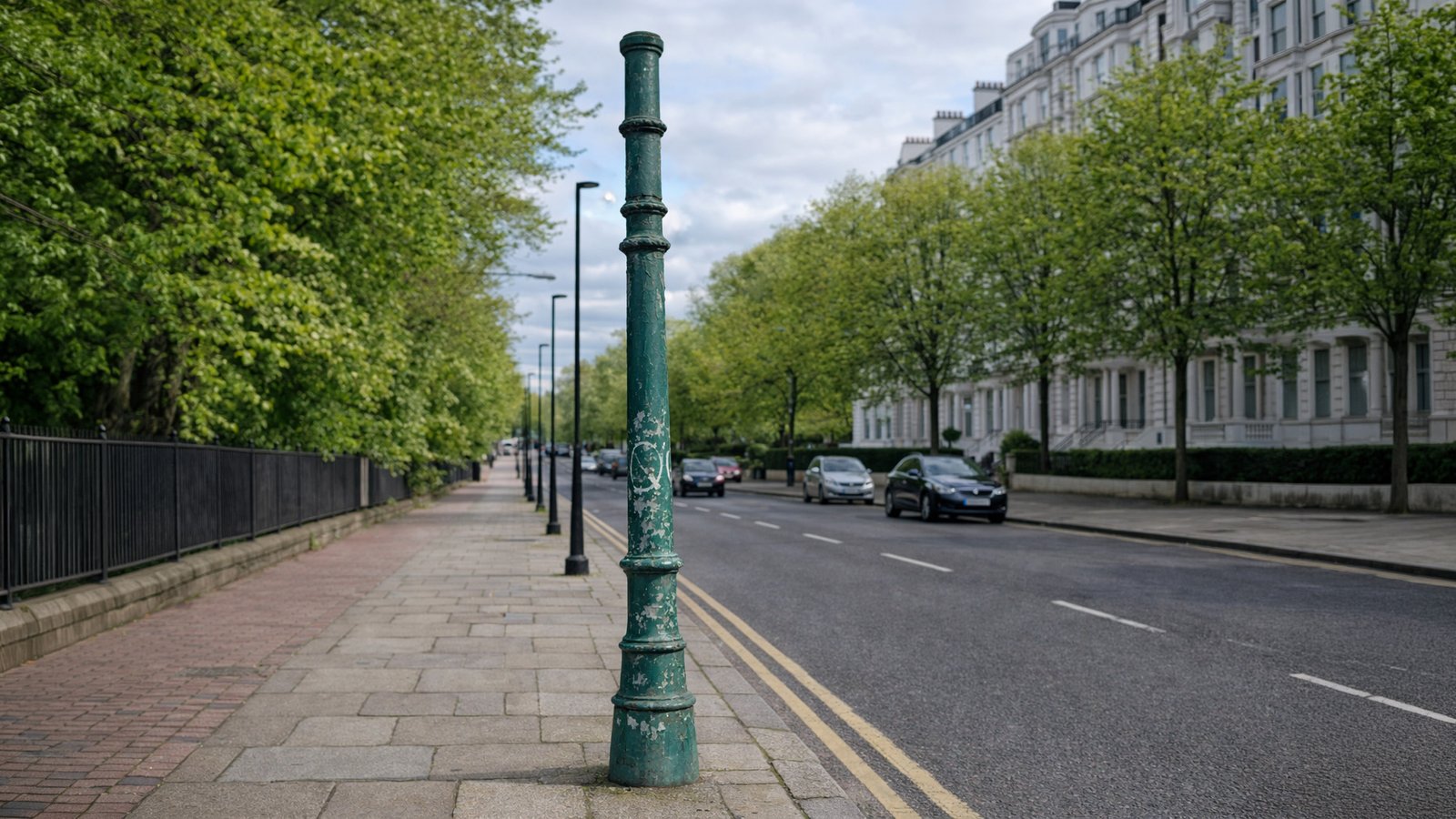
London has many landmarks that shout for attention. The towers glow. The bridges pose. Even the buses perform in red. Meanwhile, other objects do none of that. They stand quietly, bolted to walls, pretending to belong to the background. Stink pipes sit firmly in this second category. They are tall, metal, and faintly awkward, rather like Victorian gentlemen who wandered into the present day and decided not to draw attention to themselves.
A stink pipe is exactly what it sounds like, although far less dramatic in practice. Essentially, it is a vertical pipe connected to the sewer below, designed to let gases escape safely into the air above street level. It does not carry rainwater. It does not drain your sink. Instead, its sole purpose is to give the sewer somewhere to breathe. London has thousands of them, scattered across terraces, garden walls, and side streets, quietly doing their job without ceremony.
Most people walk past them for years without noticing. Then, one day, perhaps while waiting for someone or killing time before a meeting, you spot one. After that moment, you see them everywhere. They appear beside pristine stucco houses. They lurk behind iron railings. And they rise next to basement steps in neighbourhoods where property prices suggest nothing unpleasant has ever happened.
Their story begins with a smell so bad it forced Parliament to act. In the summer of 1858, the Thames turned into an open sewer during extreme heat. As a result, the stench drifted through Westminster, soaked into curtains, and made debates unbearable. This episode later became known, with Victorian understatement, as the Great Stink. London already knew it had a sanitation problem, but now it could no longer ignore it.
The response took the form of an enormous engineering project that reshaped the city below ground. New sewers intercepted waste before it reached the Thames and carried it eastward instead. This system worked, yet it created a new issue. Trapped underground, waste produced gases. Consequently, those gases needed somewhere to go. Without ventilation, pressure would build, forcing air back through household drains or cracking pipes altogether.
Stink pipes emerged as a practical answer. By giving sewer gases a vertical escape route, engineers reduced pressure, improved airflow, and limited the chance of foul air entering homes. Height mattered here. Pipes rose above ground-floor windows, often above first-floor level, so that gases dispersed into moving air rather than lingering at nose height.
At the time, medical thinking revolved around miasma theory. Disease, many believed, spread through bad air rather than contaminated water. Although the idea was wrong, it pushed engineers toward solutions that still improved public health. Cleaner streets, better drainage, and ventilated sewers helped reduce outbreaks of cholera even before germ theory took hold.
Importantly, stink pipes were never meant to be smelly. When they function correctly, you should not notice them at all. If a strong odour appears, it usually signals a blockage, a broken connection, or a dried-out trap somewhere underground. In that sense, a genuinely smelly stink pipe acts as a complaint, not a feature.
Their placement across London reveals quiet social patterns. In wealthier areas, stink pipes often look surprisingly elegant. Some are fluted. Others feature decorative collars or capped tops. Cast iron allowed for ornament, and Victorians rarely missed an opportunity to make even functional objects presentable. By contrast, in poorer districts, pipes tended to be plainer, shorter, and less carefully finished. Sewage infrastructure, like so many other things, followed class lines.
Colour played a role as well. Many pipes were originally painted to blend in with railings or façades, usually in black, dark green, or deep brown. Over decades, repainting stopped. Rust crept in. Gradually, layers flaked away. What remains now often looks raw and industrial, though that appearance reflects neglect more than intention.
One persistent myth suggests stink pipes were designed to release smells slowly so people would not notice. In reality, the opposite is true. They were built to release gas efficiently. The quicker sewer air escaped upward, the less likely it was to force its way indoors. Another myth claims they lower property values. In practice, most buyers either assume they are rainwater pipes or do not register them at all.
Confusion between stink pipes and rainwater downpipes remains common. They often look similar, especially when painted the same colour as the building. The difference lies at the top. Stink pipes usually end openly or with a vented cap, sometimes protected by a metal cage to keep birds out. Rainwater pipes, on the other hand, collect water from gutters and disappear into drains at ground level.
Birds have their own history with stink pipes. Early designs occasionally became nesting spots, which promptly blocked airflow. As a result, engineers added grilles and cages. These small adjustments remain visible today, offering clues to the trial-and-error nature of Victorian infrastructure.
There is also a safety angle that rarely enters the conversation. Sewer gases include methane, which is flammable. In the 19th century, poorly ventilated sewers sometimes exploded during maintenance or when sparks met trapped gas. Ventilation reduced this risk dramatically. Therefore, stink pipes were as much about preventing explosions as preventing discomfort.
Not everyone welcomed them. Homeowners occasionally complained about pipes being attached to façades, especially when symmetry suffered. Nevertheless, local authorities usually overruled objections on public health grounds. Over time, the pipes faded into the urban background, accepted if not admired.
Today, many original stink pipes remain in use. Others stand disconnected, acting as historical leftovers from earlier systems. In conservation areas, removing them can be restricted, as they form part of the historic streetscape. What once looked purely practical has quietly become heritage.
Modern sewer ventilation still exists, but it hides better. New buildings vent through roofs. Mechanical systems manage airflow. As a result, the old pipes feel exposed by comparison, reminding us of a period when cities solved problems in plain sight.
There is something oddly honest about stink pipes. They acknowledge the less glamorous side of urban life without drama. They do not pretend waste does not exist. Instead, they simply manage it, day after day, without applause.
Once you start noticing them, they become markers of continuity. The city above has changed beyond recognition, yet these pipes still perform the same task they did more than a century ago. In doing so, they link the polished present to a past that smelled worse but built carefully.
London’s stink pipes are not monuments. They were never meant to be admired. Yet they tell a story about fear, science, class, design, and the awkward reality that every great city depends on systems nobody wants to talk about. They stand there, patient and uncomplaining, holding up their end of the bargain so the rest of the city can pretend it never has to think about sewage at all.