Sailing Stones: Death Valley’s Most Mischievous Mystery
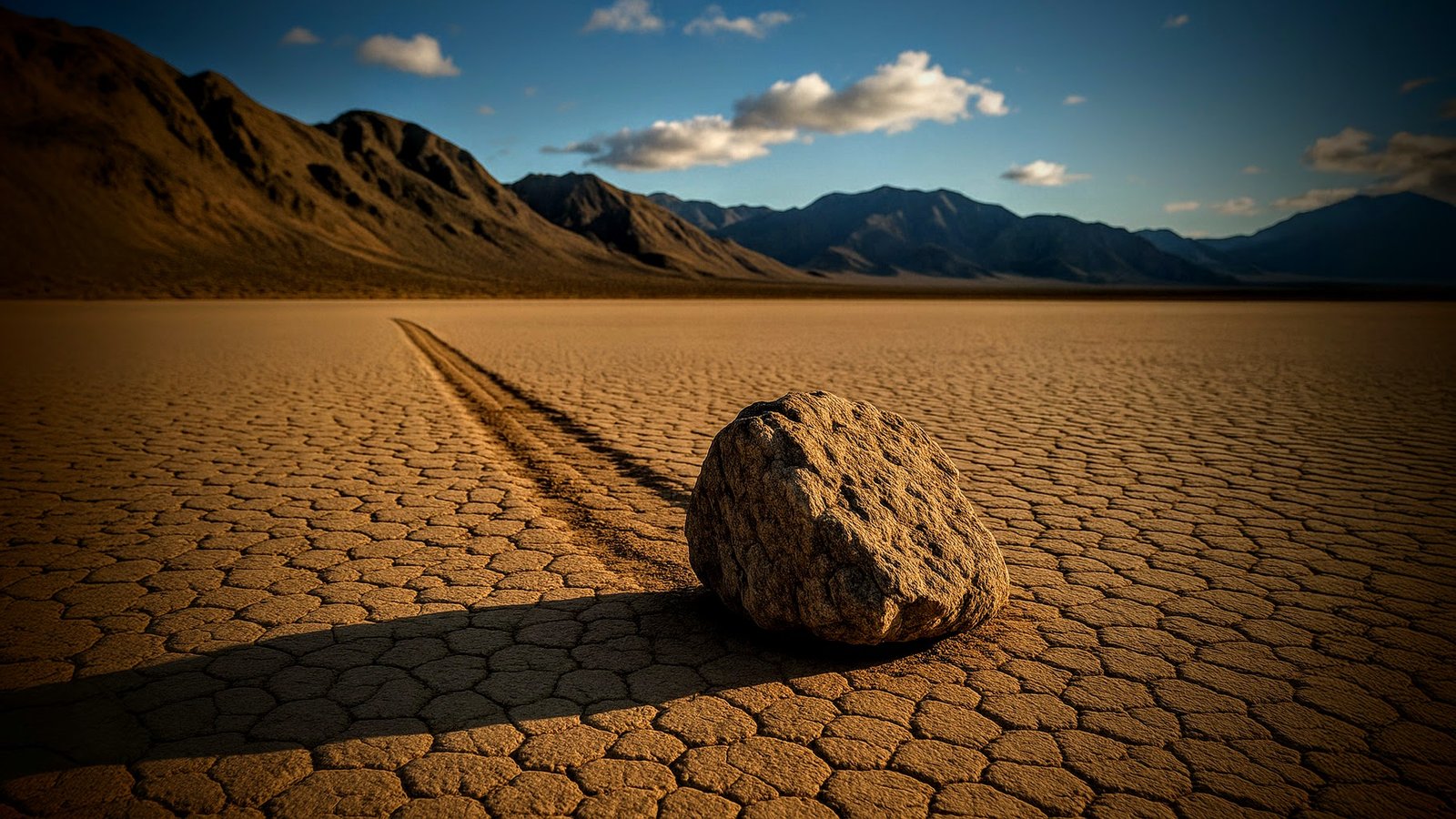
Sailing stones at Death Valley always give the impression that the desert is quietly plotting something. You stand there under the big sky, surrounded by miles of cracked playa, and suddenly a boulder behaves like it has somewhere to be. Not quickly, not dramatically, just enough to leave a confident track behind it like a drunk snail. The whole scene looks staged, as if nature decided to prank everyone and then kept a perfectly straight face.
Racetrack Playa feels like a place where nothing should happen. The landscape sits in a bowl of mountains, the ground lies flat like polished concrete, and the stillness betrays no hint of mischief. Then you look down and notice long ribbons scraped into the mud, each attached to a rock that seems far too heavy to have moved without a forklift. Visitors stare at these trails, scratch their heads and start inventing theories. The desert does not help them. It offers no windborne clues, no comforting explanations, only teasing silence.
Rangers have listened to everything: aliens with a flair for interior design, mini‑earthquakes that shove rocks around like impatient commuters, or mysterious magnetic forces lurking below. For decades nobody had ever witnessed the stones moving, so speculation grew like desert gossip. People arrived, saw fresh tracks and assumed something supernatural had popped by during the night. The playa encouraged the rumours. It holds water so rarely that each new trail seems like the handiwork of an invisible landscaper.
Scientists eventually grew annoyed with the mystery. One group wheeled in weather stations, GPS-tagged rocks and more cameras than a reality TV reunion. They waited through freezing nights, hoping the desert would finally give away its trick. It eventually complied, though in a slightly theatrical manner. After a particularly cold night, a thin ice sheet formed over shallow water. As the morning sun warmed the surface, the ice fractured into wide panes that drifted gently across the flood. Nothing dramatic, nothing cinematic. Yet the scene became quietly strange.
The ice nudged the stones as though performing a slow‑motion choreography. Those sheets acted like giant windowpanes sliding over a greased floor. A light breeze pushed them along, and the rocks obligingly moved with them. The effect looked almost polite. Instead of boulders tumbling or bouncing, they glided like pensioners on a cruise ship dance floor. A few metres here, a few metres there, each journey modest but decisive.
What caught everyone off guard was how fragile the setup needed to be. Too cold and the rocks froze in place; too warm and the water vanished before anything could happen. Too windy and the ice shattered uselessly. Too calm and nothing moved at all. Nature arranged a delicate sequence of overnight frost, thin ice, shallow water, a crisp dawn and a lazy breeze. The desert basically said, “I’ll do the trick, but only when I feel like it.”
People often imagine deserts as simple, predictable places. Yet Racetrack Playa runs on complex micro‑timing. Rain must fall at exactly the right moment. The freezing temperature must linger just long enough to harden the surface. The sun must strike at the perfect angle to loosen the ice panels without destroying them. Watching the stones glide feels like watching an orchestra play on instruments made from glass. One wrong note and the whole thing collapses.
What adds spice to the story is that the trails themselves vary wildly. One stone might carve a straight line like it is heading somewhere with purpose. Another meanders like it got distracted halfway through. Some split directions as if the stone changed its mind. A few trails simply stop without revealing where the rock eventually went. Occasionally the rock lies metres away from the end of the line, leaving visitors wondering whether it teleported. Small variations in ice thickness, wind direction or the shape of the stone can produce completely different effects. The result feels like a desert sketchbook filled with confident strokes and baffling doodles.
Even with cameras capturing the whole performance, the playa keeps some secrets. Not every stone moves during the same event. Two rocks lying side by side may behave differently. One glides, the other sulks. Researchers suspect this may come down to tiny differences in how each rock touches the ground. Some sit higher, some dig deeper, some end up caught on ice shards that act like tiny bumpers. The desert simply refuses to standardise its experiments.
The story grows stranger when you consider the weight of certain rocks. Some of them approach the size of a large dog or a small person. They look immovable. Yet those delicate ice sheets still persuade them to relocate. It’s the geological equivalent of watching a feather steer a brick. The mind rebels slightly, even after understanding the physics. Humans equate mass with stubbornness, but the playa teaches otherwise. Even the heavy ones move if the conditions whisper just right.
Despite the science, the place retains a whiff of mischief. You can know exactly how the stones move and still feel spooked standing in that empty expanse. The long tracks stretch across the ground like cryptic signatures. Some curve, some intersect, some appear to race. The silence amplifies everything. No engines. No footsteps. No water. Nothing stirring except your thoughts trying to rationalise the scene.
Visitors often expect to see something happening in real time, but most days the playa plays dead. The movements occur so rarely that catching them is as likely as spotting a ghost at a bus stop. You might spend a whole day under the blistering sky, marvelling at the emptiness and absorbing the quiet mystery, before driving away still wondering how the desert managed to shift such weight using tools made of ice and wind.
The playa forms part of a larger Death Valley ritual. People arrive seeking extremes: the hottest temperatures, the starkest landscapes, the most improbable natural tricks. The sailing stones reward that pilgrimage with a puzzle that feels both ancient and personal. You stand there reading the lines in the earth like someone trying to interpret handwriting from a forgotten friend.
Those lines carry history. Every track documents a moment when nature aligned its ingredients perfectly. Each path reveals a brief collaboration between cold air, desert sun, thin ice and patient wind. The resulting patterns stay visible for years until the next rare flood washes the canvas clean. Then the cycle resets and the stones wait for another chance to misbehave.
Even with clear evidence, people cling to the old legends. Part of the charm lies in the fact that the stones move when nobody is watching. Something about unseen motion awakens ancient instincts. Humanity once explained such mysteries with spirits, deities or mischievous forces. Now we use drones and time‑lapse cameras. Yet the emotional response remains oddly similar.
There’s also something poetic about heavy objects needing fragile forces to travel. It mirrors life more than we’d like to admit. Enormous changes often emerge from tiny nudges: a slight shift in temperature, a subtle tilt of the wind. The desert demonstrates how gentle pressure over time can leave bold, decisive marks.
The interplay between stillness and motion defines the scene. Racetrack Playa looks frozen in time, yet underneath that calm exterior lies the potential for beautiful, improbable movement. Those stones glide only a few centimetres deep into the mud, yet their presence shapes stories across continents. Entire communities of travellers plan their trips around the chance to stand where the rocks slid, half expecting the ground to stir again.
Park rangers often remind visitors not to disturb the stones. The tracks are delicate, and even one careless footprint can ruin a trail that took years to form. Some people feel tempted to reposition a rock for fun, but that would miss the whole point. The magic exists precisely because humans do not intervene. The stones act on their own terms, not ours.
When you look closely at the playa, you notice faint cracks shaped by cycles of freeze and thaw. The mud forms polygons, each separated by thin ridges. These patterns tell their own stories of the season: the rare rains that transform the lakebed, the chill nights that firm it up, the dry spells that turn the surface into a canvas. Everything depends on timing. The desert looks unforgiving, yet it hosts some of the most delicate natural processes anywhere on the planet.
Some rocks move only a few metres before stopping. Others travel surprisingly long distances. A few manage tight curves or sudden directional changes that seem almost intentional. Observers sometimes laugh at the apparent personality differences. One rock might appear bold and adventurous while its neighbour behaves like a couch potato. In truth, everything depends on how the ice sheet grips or releases them. Still, humour helps people process the surreal sight.
Nature rarely provides such clean visual evidence of motion. Most geological processes take thousands of years and leave subtle marks. Here, the desert hands you a thrilling exception. You can stand on a pristine sheet of cracked clay and observe lines drawn by an invisible force. It feels almost like time‑lapse graffiti created by the elements.
The desert’s quiet confidence leaves an impression. It never asks for attention, yet it draws people in from all over the world. The sailing stones remind visitors that even in barren landscapes, creativity thrives. Forces we see as mundane — air, water, sunlight — become exquisite sculptors when combined under special circumstances.
The mystery captivated minds for generations because it played with expectations. The desert looks too dry for ice, too still for motion, too warm for freezing. Then it reveals that everything depends on rare moments when winter briefly transforms the environment. Those fleeting hours carry enough power to reshape stones that may not move again for years.
Standing on the playa during one of those crisp mornings must feel surreal. The ice sheets drifting under the sun, the light breeze brushing your face, the slight creaking of thin glassy surfaces floating on shallow water. Somewhere out there, a rock begins its awkward glide, slow but confident. You might not notice until it has already moved a few centimetres. That subtlety gives the experience an almost supernatural edge.
Even though the camera footage solved much of the mystery, the playa never feels fully explained. It still whispers. It still unsettles a tiny part of the brain that wants everything to remain still. Rationality wins, but curiosity lingers. The desert refuses to give up its entire script.
Travellers leave Racetrack Playa with more questions than answers, which seems perfectly matched to the place. You cannot watch the stones move unless you camp there during the coldest weeks. The conditions must align, and luck must favour you. Most people settle for walking among the trails, admiring the artistry carved into the mud.
By the time you leave, the stones feel almost alive, not in a literal sense but in the way they interact with their environment. They respond to temperature, wind and water like a slow‑motion version of a living thing adapting to change. The desert transforms them into reluctant travellers.
Racetrack Playa teaches patience and humility. It invites observers to accept that not everything reveals itself immediately. Some answers require waiting. Some puzzles need the right season. The rocks remind visitors that nature has its own timeline, one that rarely aligns with human expectations.
The sailing stones remain one of the desert’s most delightful tricks. Knowing the mechanism does not diminish the experience. If anything, it deepens the appreciation. Thin ice and gentle winds guiding heavy stones across a barren lakebed sounds improbable, yet it happens with quiet certainty whenever all the variables cooperate.
Next time someone claims that deserts are monotonous, picture those boulders gliding under a winter sun. Picture the ice breaking into panes that slip across the playa like floating sheets of glass. Picture the tracks stretching into the distance like messages written for wandering travellers. The desert never meant to keep its secret forever. It simply chose to reveal it slowly, in its own elegant rhythm.