History, Music, and Madness of Royal Albert Hall
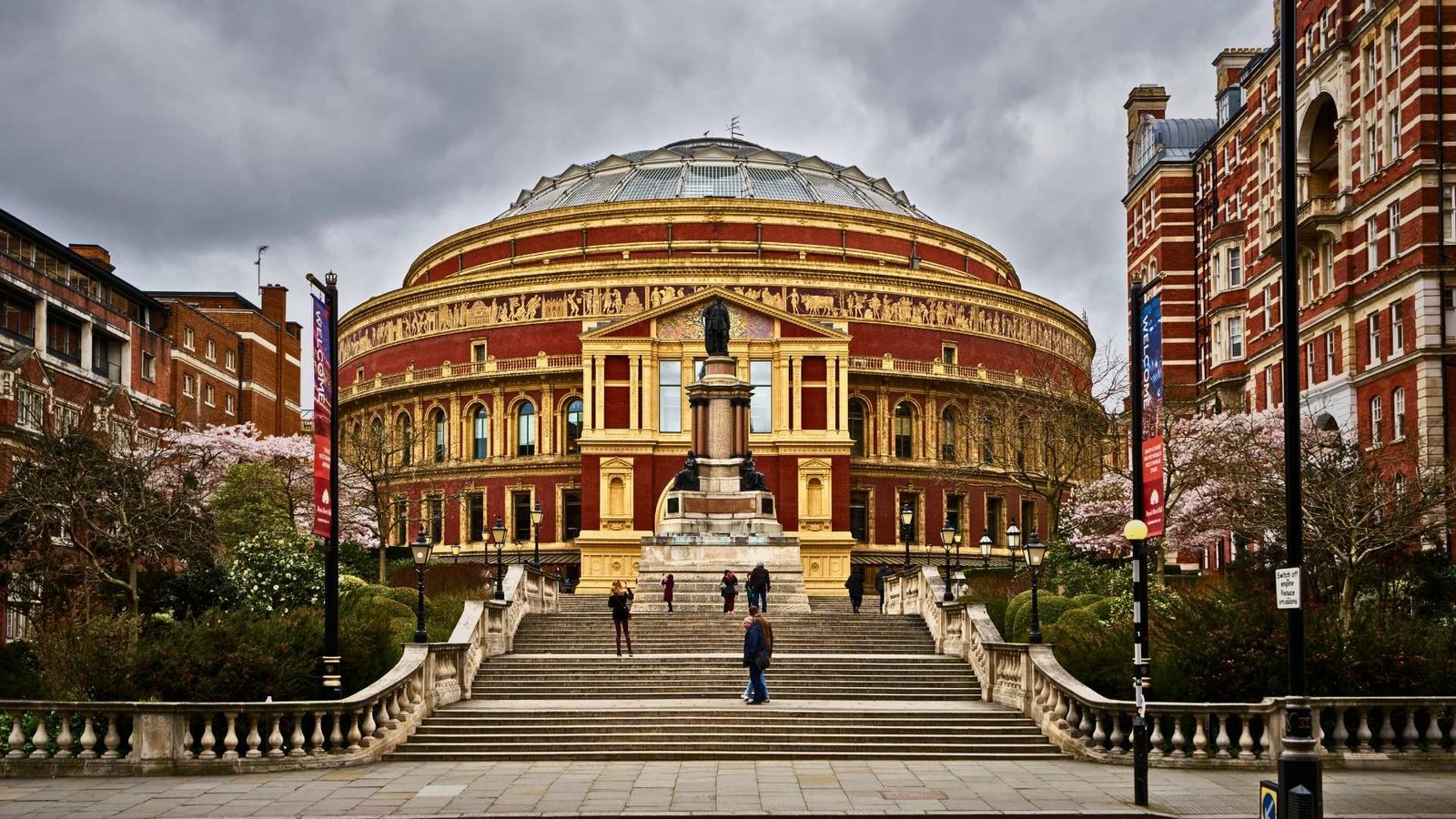
Royal Albert Hall carries stories in its bricks, confidence in its dome and a long record of behaving in ways no architect ever fully intended. It sits on the edge of Hyde Park like a grand Victorian promise, all terracotta curves and civic pride, while its history reads like a spirited tussle between ambition, improvisation and sheer determination. The building radiates poise on the outside yet hides a backstage life filled with engineering mishaps, strange experiments, rebellious audiences and traditions that refuse to retire. Perhaps that’s why people love it. It feels noble and chaotic at once, a cultural landmark that solves one problem and promptly invents another.
The idea for the Hall grew from the exuberance surrounding the Great Exhibition of 1851. London had dazzled the world with a glass palace full of international achievements and earned enough money to imagine an entire district dedicated to culture and learning. Prince Albert pushed for this vision, convinced Britain should celebrate human progress with a permanent home for science and the arts. His early death devastated Queen Victoria, who channelled her grief into completing the project. When she laid the foundation stone in 1867, the ceremony felt both ceremonial and personal. The Hall became a tribute to him and a monument to aspiration.
Victorian engineers approached the challenge with characteristic swagger. They designed an oval amphitheatre of unprecedented scale, crowned with a spectacular domed roof. That dome was constructed in Manchester, dismantled and transported south like an oversized puzzle. When the team reassembled it in Kensington, the structure slipped. For a brief moment it looked ready to collapse, giving the newspapers a field day. Reporters speculated gleefully on financial ruin and engineering humiliation. The builders regained control, braced the structure and carried on as though nothing unusual had happened. By 1871 the Hall opened, looking peaceful and refined despite its dramatic rehearsal.
The opening years brought an immediate revelation. The building dazzled the eye but baffled the ear. Its echo was legendary. Performers heard themselves repeating around the dome as though an enthusiastic impersonator stood behind them. Audiences joked that the Hall offered musical déjà vu. Management tried remedies with increasing desperation. They draped cloths, stretched canvas sails, fixed metal panels into place and tested arrangements that made the auditorium resemble an experimental laundry room. Nothing truly solved the problem.
Relief arrived in 1969 with the installation of fibreglass acoustic diffusers. The circular discs suspended from the ceiling became known as mushrooms, though some preferred flying saucers. They looked slightly surreal against Victorian arches, yet finally tamed the echo. After nearly a century of sonic misadventure, the Hall found its voice.
Throughout this period the Hall played its part in national life. It survived wartime with remarkable resilience. During the Second World War the dome acted unintentionally as a landmark for German pilots, a bitterly ironic twist for a venue symbolising cultural pride. Yet concerts continued, audiences gathered and the building became a reminder that London’s spirit remained intact.
Loads of people tend to forget that Royal Albert Hall also spent decades as a platform for argument, activism and disruption. The suffragettes used it as a rallying point. Emmeline Pankhurst filled the auditorium with calls for justice, and the authorities watched nervously as the movement gained energy. Later, anti-apartheid protests and political demonstrations echoed under the same dome. Even the Last Night of the Proms sparked fierce conversations about identity and tradition, turning an evening of celebration into a televised debate.
Some of the Hall’s most colourful moments came from its willingness to host almost anything. Boxing matches drew crowds. Circuses brought animals and acrobats. At one point a bullfight took place inside the Hall. The bull was imported specially from Spain, public outrage surged and the experiment ended quickly. The trustees learned that not every spectacle benefits from a London postcode.
The Rolling Stones contributed another chapter to the Hall’s unpredictable résumé. In 1966 fans grew so exuberant that seats were damaged and audience members attempted to climb into the organ loft. The management reacted decisively and banned the band for life. The story became rock folklore. Eventually the ban softened and the Stones returned, older and perhaps less inclined to cause structural anxiety.
Meanwhile, the Hall’s enormous organ developed a quieter crisis. Nicknamed the Voice of Jupiter, it should have been a crown jewel. Instead it accumulated decades of dust and city grime until a comprehensive and very expensive restoration became necessary. Fundraising revealed an awkward truth: one of the world’s most prestigious venues had allowed one of its core instruments to decline simply because nobody had taken ownership of its long-term care.
Another aspect of the Hall’s history still raises eyebrows. During construction, the institution financed itself by selling permanent seat rights to private subscribers. These seats could be inherited or sold indefinitely. Modern audiences occasionally find that prime locations belong to families or organisations rather than the Hall itself. Seat holders also elect part of the governing council, giving them influence over decisions in a charitable institution meant to serve the public. The arrangement feels unusual today but reflects the Victorian determination to combine idealism with practical fundraising, regardless of future complications.
By the late twentieth century, time had caught up with the building. It needed modern ventilation, new backstage spaces, improved seating and better accessibility. Renovating such an iconic space required delicacy. Engineers and designers tiptoed around mosaics, arches and terracotta, updating where necessary while preserving every historic flourish. The work took years and cost a fortune, but the Hall emerged refreshed and capable of hosting twenty-first-century productions without losing its Victorian heartbeat.
Spend an afternoon wandering its corridors and the building reveals itself as a living record of British cultural character. It is grand but not aloof, ambitious yet often hilariously impractical, and always ready to reinvent itself. Royal Albert Hall has welcomed monarchs, activists, schoolchildren, Nobel laureates, comedians, acrobats, scientists, pop stars and the odd runaway event idea. It has hosted solemn commemorations and noisy celebrations. It has embraced experimentation even when the results misfired.
Stand beneath the dome today and the atmosphere feels layered. Every performance seems connected to a century and a half of cheering crowds, political speeches, historic evenings and peculiar mishaps. The Hall endures because people want it to endure. They accept its quirks, admire its determination and return again and again to witness something larger than themselves.
Royal Albert Hall remains one of London’s proudest creations, not because it is flawless, but because it is endlessly alive. Audiences don’t just come for the music. They come for the sense that the building itself carries a pulse, shaped by triumphs, mistakes, eccentricities and moments that changed the country. It stands today not as a perfect monument but as a beloved one, confident in its place and constantly writing its next chapter.