Roman Funerary Lions and Why the Dead Needed Guardians
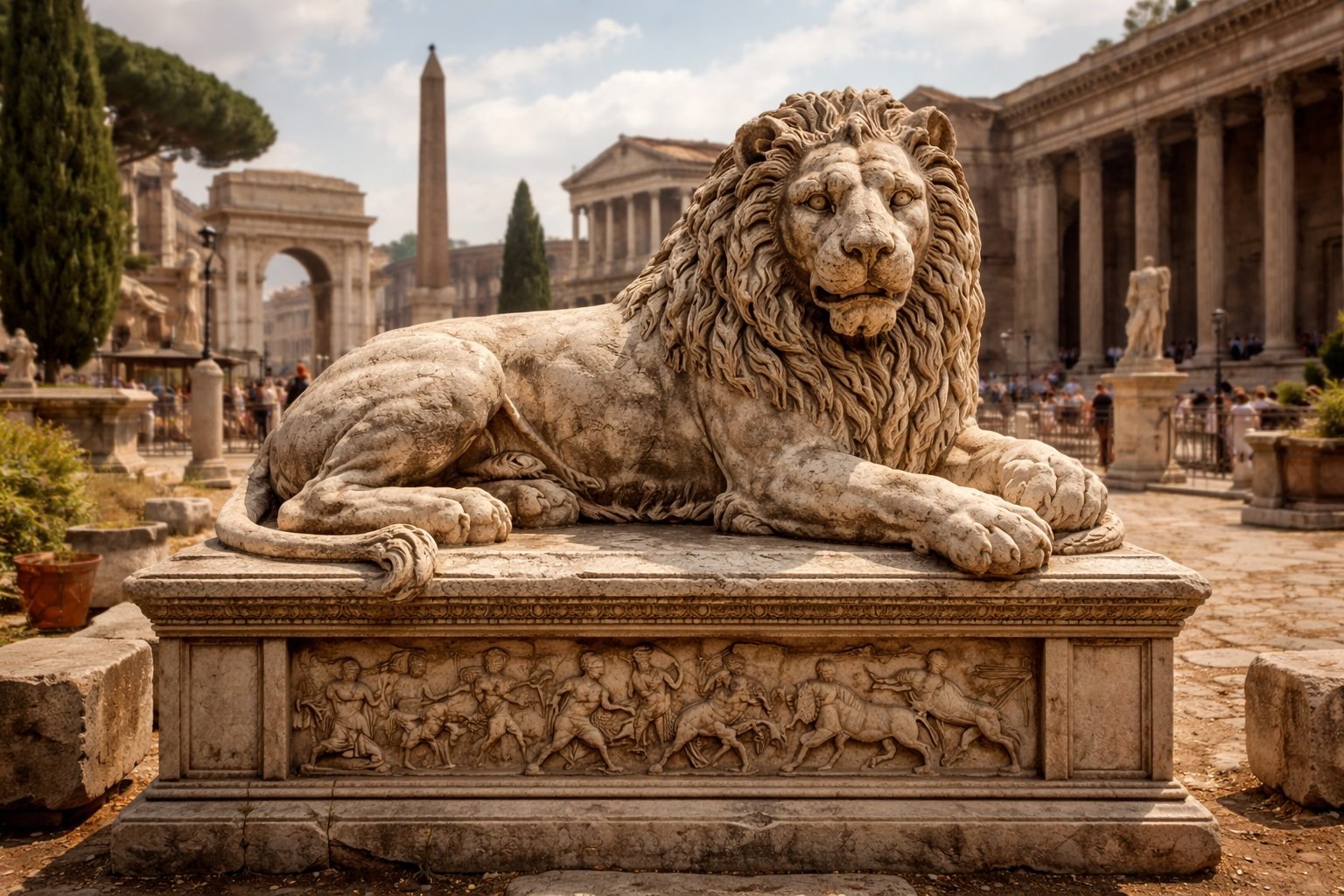
Roman funerary lions have a habit of staring straight through you. They sit stiff-backed on tombs, crouch beside inscriptions, or loom above burial chambers with an expression that never quite relaxes. Even when their noses chip and their manes wear smooth from centuries of weather, they still look busy. Alert. On duty. That effect was deliberate.
Across the Roman world, from the city of Rome to provincial cemeteries in Asia Minor, lions became dependable companions of the dead. Yet they did not whisper comfort or promise reunion in a neatly defined afterlife. Instead, they projected strength, vigilance, and control at the moment when control slipped away.
Rome did not invent the funerary lion. However, it refined its use with remarkable efficiency. By the early imperial period, a stone lion guarding the dead worked instantly, even for viewers who could not read the inscription it protected. That visual fluency mattered in an empire where Latin, Greek, and dozens of local languages collided daily.
The lion arrived in Roman funerary art with an impressive pedigree. In the ancient Near East, lions guarded palace gates and divine spaces. Meanwhile, in Greece, they marked the graves of fallen warriors and heroes. The Etruscans treated them as threshold creatures, mediators between worlds. Rome absorbed all of this with little concern for purity. As a result, the lion became flexible enough to survive everywhere from marble mausolea to roughly carved roadside tombs.
Roman funerary lions invite an obvious comparison with Chinese tomb guardians, yet the contrast is as revealing as the similarity. Both traditions place powerful animals at the edge of the grave to mark a boundary between worlds, but they express that anxiety in different ways. Chinese stone guardians, whether lions or hybrid creatures, actively confront the supernatural, mouths open, muscles coiled, ready to repel hostile spirits and cosmic imbalance. Roman lions, by contrast, rarely look mid-attack. They sit, watch, and endure. Their authority comes from composure rather than threat. Where Chinese guardians project an ongoing battle against unseen forces, Roman funerary lions suggest that order already exists and simply needs enforcement.
At first glance, many Roman funerary lions look similar. Most sit upright, front paws planted, chest pushed forward. Others recline yet keep their heads raised. Notably, sleeping lions are rare. The message stays consistent. This creature does not rest. Death has not dulled its senses. It is watching.
That posture mattered because Roman funerary culture revolved around boundaries. A tomb was not simply a container for remains. Rather, it marked a legal, religious, and social line between the living and the dead. Families visited it. Rituals took place there. Names appeared for public display. Lions belonged at such edges. Consequently, they functioned as visual bouncers, signalling that the space was occupied, protected, and not to be casually crossed.
Strength was the most obvious meaning, yet it rarely stood alone. Lions symbolised dominance over chaos and, by extension, a refusal to be diminished by death. Crucially, this did not require a firm belief in an afterlife. Romans held wildly different ideas about what followed death, ranging from vague survival of the soul to complete annihilation. Nevertheless, the lion worked regardless. It asserted dignity in the face of uncertainty.
The animal also carried heroic baggage. Greek myth lingered everywhere in Roman visual culture, and the shadow of the Nemean Lion never fully disappeared. Heracles’ victory over an invulnerable beast had long represented endurance triumphing over impossible odds. Even when stripped of explicit mythological reference, the lion retained that heroic aftertaste. As a result, it elevated the deceased without claiming divinity.
This quiet elevation explains why funerary lions appear beneath such varied names. Senators used them. Freedmen adopted them. Women and children appear beneath their paws. The lion did not belong to a single class. Instead, it offered a shared visual language of respectability and permanence.
In the city of Rome, funerary lions often behave politely. They flank inscriptions. They frame doorways. Rarely do they snarl. Their task focused on reinforcing order rather than threatening violence. Accordingly, the emphasis fell on control, composure, and authority. Even in death, Roman identity valued restraint.
The picture changes as you move east. In Asia Minor, funerary lions multiply rapidly and grow more expressive. Some bare their teeth. Others grip prey. Heads expand in proportion to bodies, while eyes widen dramatically. This shift does not signal declining skill so much as changing priorities.
In these regions, lions already carried religious meaning long before Roman rule. They guarded mountain sanctuaries, accompanied local gods, and symbolised protection against unseen dangers. When Roman funerary customs arrived, they fused rather than replaced these traditions. Consequently, the lion regained a more overtly apotropaic role. It no longer served only as a marker of status. Instead, it stood as a guardian against malevolent forces.
This fusion explains why many eastern funerary lions feel almost aggressive. They advertise local beliefs as much as Roman identity, continuing older conversations about death, danger, and protection through a Roman visual dialect.
Modern scholars often stress that Roman funerary lions functioned socially as much as spiritually. Tombs operated as public statements. They announced family continuity, legal ownership of burial plots, and social ambition. A lion handled much of this work silently.
In provincial towns, commissioning a lion signalled participation in imperial culture. It suggested that the deceased and their family understood Rome’s visual grammar. Even when inscriptions appeared in Greek or local languages, the lion translated status instantly.
This efficiency explains why the motif spread so easily. It required no explanation. Viewers did not need theology or myth. They only needed to recognise power when they saw it.
Several modern myths cling stubbornly to these sculptures. One claims that lions mark the graves of soldiers or gladiators. However, evidence does not support this idea. While some military tombs feature lions, many commemorate civilians with no martial connection. The animal symbolised strength, not profession.
Another assumption links funerary lions automatically to hero cults. This holds true in specific Greek contexts yet collapses under Roman diversity. Most Roman funerary lions were not invitations to worship. Instead, they functioned as statements of presence.
There is also a romantic tendency to read them as proof of belief in resurrection. Roman funerary culture resists such neat conclusions. Some inscriptions express hope of reunion. Others focus on memory, reputation, or legal fact. Once again, the lion accommodates ambiguity without complaint.
One detail that often puzzles modern viewers is the odd appearance of many lions. Heads seem oversized. Bodies look stiff. Manes resemble abstract patterns rather than fur. This is not always failure.
Roman workshops reused templates, while local stonecutters adapted styles to regional habits. Symbolic clarity often trumped naturalism. A lion needed to read as vigilant from a distance. Anatomical precision mattered less than expressive force.
In some cases, exaggeration helped. Enlarged eyes communicated watchfulness. Rigid posture suggested discipline. These were virtues Romans admired, even when rendered through imperfect stone.
Stepping back reveals not a single meaning but a durable visual solution. The funerary lion worked because it balanced contradiction. It appeared violent yet controlled, fearsome yet orderly. It looked alive in posture, yet remained frozen in stone.
The motif also solved a deeper Roman anxiety. Death disrupted social identity. Offices ended. Relationships dissolved. Legal standing vanished. The tomb attempted to repair this rupture by freezing a version of the deceased in place. Here, the lion assisted by projecting continuity. Something strong still stood guard.
That persistence explains why these sculptures linger in the landscape. Medieval builders reused them. Early modern collectors displayed them. Museums catalogue them. Even detached from their original graves, they retain an air of purpose.
Roman funerary lions were never meant to comfort the dead. Instead, they spoke to the living. They announced that a person mattered, that a boundary held, and that memory deserved protection.
Stone, muscle, and stare combined into one of Rome’s most effective symbols. Long after real lions vanished from Europe, their stone counterparts continued to guard the dead, unblinking, patient, and difficult to ignore.