The Rural Doctor Who Proved Germs Cause Disease
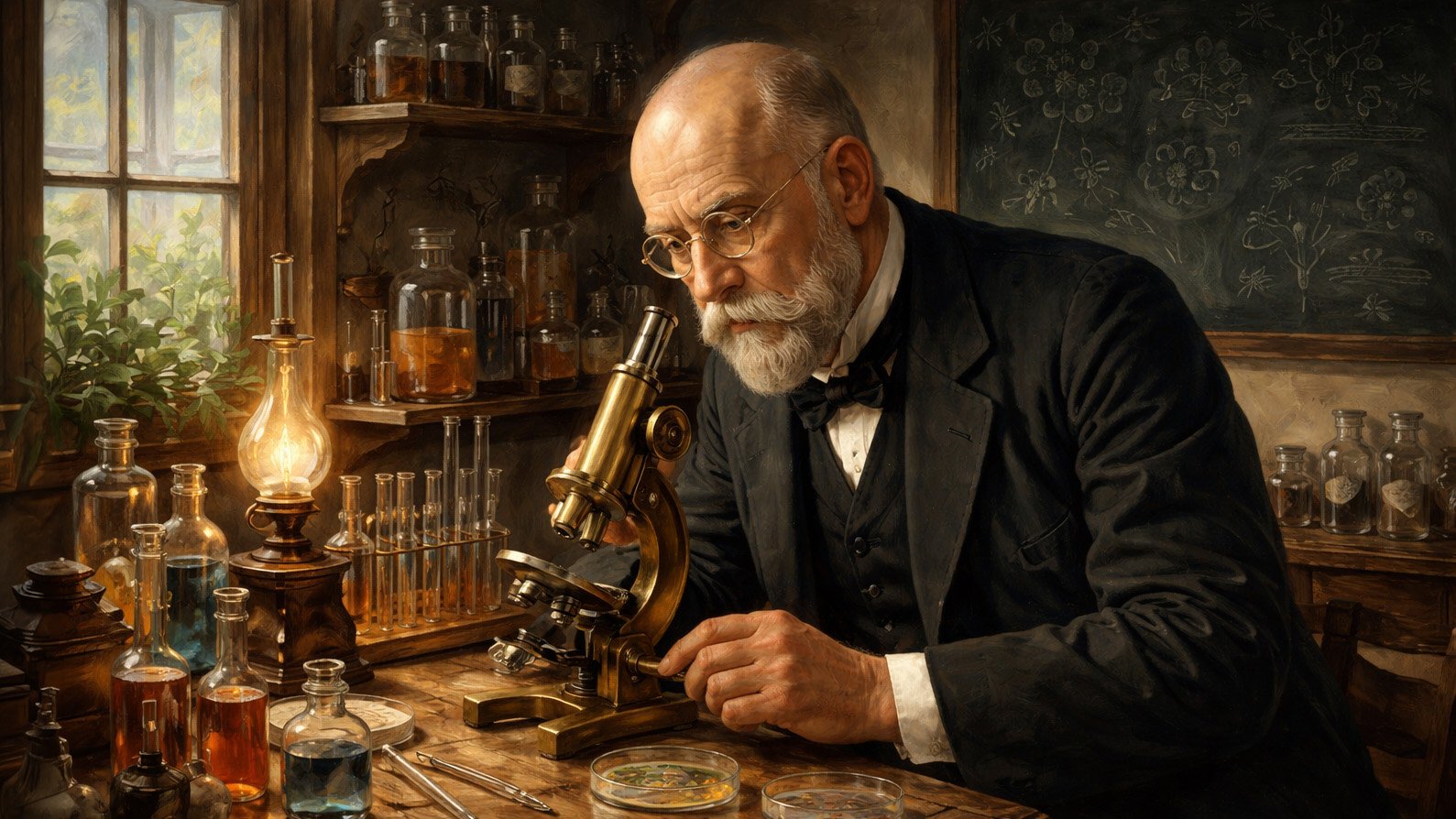
Robert Koch did not begin his career in a grand university laboratory surrounded by assistants and polished brass microscopes. Instead, he worked as a rural doctor in provincial Germany, treating farmers, labourers, and the occasional unlucky cow. His practice sat far from the intellectual centres of Europe, yet inside a modest room filled with improvised equipment he quietly reshaped medicine.
During the nineteenth century doctors argued endlessly about the causes of disease. Many still believed in miasma, the theory that invisible poisonous vapours drifted from swamps, rotting rubbish, or crowded streets. According to this view, illness floated through the air like an unpleasant smell. Meanwhile others suspected microscopic organisms played a role, yet the evidence remained frustratingly vague. Germs existed, certainly, but nobody could reliably prove which microbe caused which illness.
Medicine therefore lived inside a fog of suspicion rather than certainty. Koch disliked fog. Instead, he preferred evidence that one could see through a microscope, grow in a dish, and demonstrate beyond argument.
His unlikely research subject arrived courtesy of the countryside itself. Anthrax plagued cattle and sheep across Europe. Farmers feared it because it killed animals quickly and sometimes infected people who handled the carcasses. Consequently rural doctors encountered the disease often enough to notice patterns. Koch recognised an opportunity hidden inside the tragedy.
He began collecting blood samples from animals that had died of anthrax. Under the microscope he repeatedly saw the same rod‑shaped bacteria. At first that observation proved nothing. Critics could easily argue the microbes appeared because the animal was dying rather than because they caused the illness. Koch immediately understood that problem. Therefore he needed a chain of evidence.
Accordingly he transformed his home laboratory into a miniature experimental workshop. He prepared glass slides, built simple incubators, and experimented with ways to grow bacteria outside the body. Today such work sounds routine. However at the time the idea bordered on revolutionary because microbiology barely existed as a practical science.
Eventually Koch succeeded in growing the anthrax bacteria in pure cultures. For the first time he could observe their life cycle clearly. The microbes multiplied rapidly and then formed hardy spores that survived even when conditions turned hostile. Those spores finally explained something farmers had long puzzled over. Fields where infected animals died often remained dangerous for years because the bacteria did not vanish. Instead they simply waited.
Next Koch performed the decisive step. He injected the cultured bacteria into healthy laboratory animals. Soon the animals developed anthrax. When he examined their blood, the same rod‑shaped microbes appeared again. Afterwards he isolated them once more and grew them again in culture.
At that moment the fog lifted. The disease no longer looked mysterious because a specific bacterium caused it.
From this logic emerged what later generations called Koch’s postulates. The framework looked disarmingly simple. First, the suspected microbe must appear in every case of the disease. Second, scientists must isolate the organism and grow it in pure culture. Third, the cultured microbe must reproduce the disease when introduced into a healthy host. Finally, researchers must recover the same organism from the newly infected host.
These rules transformed germ theory from speculation into a testable scientific method. Anyone could follow the reasoning step by step. Either the evidence worked or it failed.
Before long Koch’s reputation began to spread across Germany. Universities noticed the meticulous rural physician who had quietly solved a deadly agricultural puzzle. Consequently he soon moved into larger laboratories where better equipment allowed him to tackle even greater medical mysteries.
The most formidable enemy of the age awaited him there. Tuberculosis ravaged nineteenth‑century Europe. In some cities it killed one out of every seven people. Families watched relatives fade slowly away while doctors offered little more than fresh air and vague advice. Clearly nobody understood the true cause.
Koch suspected a microbe hid behind the disease. The challenge lay in actually seeing it. Unfortunately the bacterium responsible for tuberculosis proved notoriously difficult to detect under ordinary microscopes. Stains that revealed other bacteria left this one almost invisible.
Therefore Koch experimented again. Gradually he refined chemical staining techniques until the elusive organism appeared as thin coloured rods against a contrasting background. In that instant the tubercle bacillus stood revealed.
However spotting the bacterium did not finish the argument. Koch followed his own rules with relentless discipline. First he isolated the organism. Then he grew it. Afterwards he demonstrated that infected tissues always contained the same microscopic culprit. Step by step he assembled the evidence.
In 1882 he presented the findings to the Berlin Physiological Society. The lecture stunned the audience. Tuberculosis, the great white plague of Europe, suddenly had a clear biological cause. Soon newspapers reported the announcement across the continent. Consequently physicians realised that the age of vague theories about bad air had begun to crumble.
Yet Koch’s work carried an even deeper implication. If a microbe caused tuberculosis, other diseases might also trace back to specific organisms. As a result the idea opened an entirely new frontier in medicine.
Soon afterwards Koch turned his attention to cholera. Epidemics had haunted cities for decades, spreading terror through contaminated water supplies. During an international investigation he travelled to Egypt and India, where outbreaks erupted with devastating speed.
There he isolated a curved bacterium thriving in the intestines of cholera victims. Under the microscope it resembled a tiny comma swimming energetically through liquid. Koch named it the cholera vibrio.
However this investigation proved more complicated than his earlier work. Some people carried the bacterium without obvious symptoms, which blurred the neat boundaries of the postulates. Nevertheless the evidence strongly connected the organism with the disease. Consequently public health officials realised that controlling contaminated water could dramatically reduce outbreaks.
Gradually a new picture of disease emerged. Illness no longer appeared as a mysterious imbalance or invisible poison drifting through the streets. Instead specific microscopic organisms invaded tissues, multiplied, and triggered the symptoms doctors observed.
Across Europe laboratories quickly adopted Koch’s methods. Scientists began isolating bacteria responsible for diphtheria, typhoid, plague, and numerous other infections. Therefore the late nineteenth century became a golden age of bacteriology.
Koch himself received the Nobel Prize in 1905 for his work on tuberculosis. By then his approach had reshaped medical research around the world.
Still the story contains a quiet irony. The famous postulates that brought clarity to bacteriology eventually encountered the messy complexity of biology. Some microbes refuse to grow in laboratory cultures. Others cause disease only under certain conditions or in specific hosts. Viruses complicate matters even further because they require living cells in order to reproduce.
Modern microbiologists therefore treat Koch’s postulates less as rigid commandments and more as guiding principles. Instead researchers combine them with genetic evidence, molecular biology, and epidemiological data. Yet the spirit of Koch’s reasoning remains unmistakable because evidence must demonstrate causation rather than merely suggest correlation.
The deeper legacy of Robert Koch lies not only in identifying particular microbes. More importantly he changed the intellectual culture of medicine. Physicians learned to demand proof. A disease required a cause that could withstand experimental testing.
One can easily imagine Koch working late at night in his improvised laboratory, adjusting the mirror of his microscope while the countryside outside settled into darkness. The room probably smelled faintly of chemicals and heated glass. On the table lay slides holding the invisible actors responsible for deadly epidemics. Piece by piece he assembled the logic that revealed them.
Consequently a new scientific habit formed. Instead of blaming bad air or vague environmental forces, medicine began asking sharper questions. Which organism causes this illness? How does it spread? How can the chain of infection be interrupted?
Today those questions underpin modern epidemiology, vaccination strategies, antibiotics, and infection control. Hospitals operate on assumptions that would have sounded radical before Koch’s era. The rural doctor who disliked fog left medicine with something far more powerful than a single discovery. He provided a method for clearing the fog entirely.
Post Comment
You must be logged in to post a comment.