Plough Invention: How a Stick in the Dirt Rewired Human History
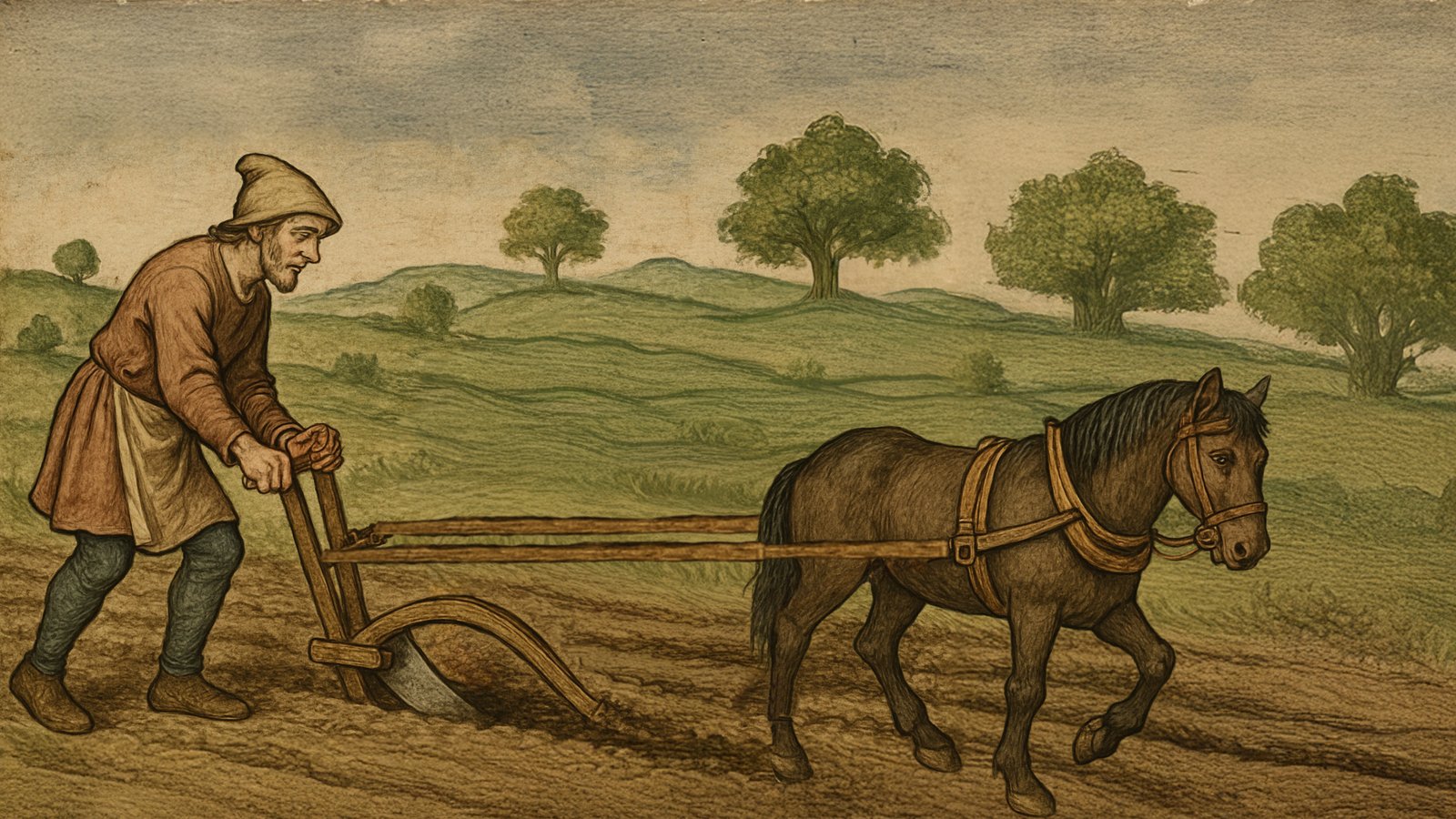
The plough invention didn’t arrive with trumpets or tablets from the heavens. It slipped quietly into human life as soon as we realised that poking the ground with a stick made it easier to grow dinner. Somewhere in the Fertile Crescent, long before anyone thought of writing things down, someone picked up a sturdy branch, dragged it through the dirt, and thought, well, this is easier than doing everything by hand. It wasn’t glamourous. It wasn’t complicated. Yet that scratched furrow set humanity off on a path where the simple act of turning soil became the foundation of towns, harvests, taxes, and every awkward office kitchen conversation over wheat prices.
Those first wooden tools came from communities moving from wandering lifestyles to settled farming. People wanted predictable food, even if that meant fewer leisurely strolls across river valleys. They scratched the ground with ards—primitive ploughs that barely cut the earth but did enough to let seeds fall into something resembling a groove. It was slow going. Oxen pulled the contraptions because someone had quickly realised that doing it manually was a terrible idea. Picture an early farmer staring at the endless field, gripping a wooden stick, and immediately deciding that the nearest cow would be drafted into service.
The itch to improve the plough started early. Wooden points snapped too easily. Hard soils laughed at them. So metal crept into the design—first bronze, then iron. A metal-tipped ard suddenly meant farmers could confront heavier ground rather than simply avoiding it. In regions like ancient China, Egypt, and across the Near East, these sturdier ploughs allowed larger yields and the confidence to cultivate more ambitious terrain. You can almost sense the pride of the first farmer who discovered that his new metal‑tipped tool didn’t immediately sulk and splinter when faced with compacted earth.
The next leap came when someone decided the plough wasn’t doing enough. Scratching lines in soil was helpful, but farmers craved deeper cuts and tidier furrows. They spent enough time on the field to know that a proper slice would help water distribution and give weeds something to worry about. The ploughshare arrived—a horizontal blade capable of slicing beneath the surface before the rest of the tool lifted the soil. This changed everything. Suddenly fields looked purposeful. Soil lifted more cleanly. Farming felt less like an argument with the earth and more like a negotiation.
Once people added a vertical blade—the coulter—the plough took on real personality. The coulter cut downward, the share cut forward, and together they formed a neat, efficient operation. It’s a bit like giving your plough a partner who always remembers the details you forget. Fields became straighter, deeper, and more uniform. A landscape that used to be at the mercy of improvisation began to look organised.
Northern Europe brought its own challenge. The soils of the region weren’t just heavy; they behaved like stubborn clay that refused to budge. Early ploughs groaned under the effort. Farmers groaned louder. Out of this battle came the mould-board, the curved wonder that didn’t just cut soil but rolled it over completely. This single addition made the plough capable of transforming landscapes. It allowed communities across Germany, Poland, Scandinavia and beyond to cultivate land previously dismissed as hopeless. Medieval population growth didn’t just appear from nowhere. It came from fields finally giving up their grudges.
The heavy plough of the medieval era became a symbol of transformation. It had wheels. It had depth. It had ambition. It cut deep into the ground and flipped soil with gusto. In many villages, owning one meant access not only to better harvests but also to political clout. Land became more productive, feeding more people, fuelling expansion across Europe, and helping towns evolve out of what were once small clusters of wooden houses that smelled perpetually of smoke.
Centuries later, Britain added its usual dose of innovation and practicality. The Rotherham plough, patented by Joseph Foljambe in the 1730s, wasn’t the flashiest invention to emerge from the British countryside, but it mattered enormously. It was lighter, made partly of cast iron, and far easier to operate than the hulking wooden beasts of previous eras. It sailed through farmland with new confidence. For farmers, it felt like trading in a lumbering horse for a sprightly one that didn’t try to bite them. The Rotherham model spread across the country with the kind of enthusiasm usually reserved for gossip at a village market. Agriculture had entered the modern era, whether it wanted to or not.
Then came the prairies. The soils of the American Midwest posed a new challenge. They clung viciously to cast iron. Traditional ploughs clogged almost immediately, forcing farmers to stop constantly, scrape off mud, and mutter unrepeatable things about the soil’s personality. In 1837, John Deere stepped in. He fashioned a polished steel blade from an old sawmill blade, attached it to a properly shaped mould-board, and created a plough that refused to clog. It sliced through the prairie like a confident newcomer at a village fete cutting straight to the buffet. Deere’s design went on to define American agriculture, enabling farms to expand dramatically and transforming entire economies.
From there, the world entered a phase where ploughs got bigger, more precise, and, eventually, more mechanical. Steam traction engines started pulling multiple ploughs at once, giving farmers the feeling that their fields were being tackled by a small industrial revolution. When petrol tractors arrived, they took on the plough with even more stamina. No more animals stopping halfway through because they’d spotted something interesting in the hedge. Machines brought predictability, though not necessarily charm.
By the twentieth century, the plough had reached its technical peak. It could be adjusted for depth, soil type and crop plan. Farmers could run several furrows at once. The plough had become a proud emblem of efficiency and modernisation. Yet at the same time, another whisper began circulating: maybe all this turning wasn’t entirely wise. The soil didn’t always appreciate being flipped over endlessly. Erosion increased in some areas. Carbon escaped into the atmosphere. The prairies suffered Dust Bowl misery. Conservationists wondered whether the plough had outgrown its role.
This sparked the no‑till and reduced‑till movements, where farmers experiment with leaving soil undisturbed. It’s an ironic twist: the very tool that defined agriculture for millennia is now, in some cases, deliberately avoided. Yet the plough’s legacy is undeniable. Every loaf of bread, every field of barley, every historical shift in population density owes something to that first wooden scratch in the soil.
The story of the plough isn’t a tale of one invention—it’s an evolving partnership between people, land and technology. It shaped civilisations long before skyscrapers or satellites existed. It moved populations, inspired innovations and fed entire worlds. Farmers still use versions of it today, even if they sometimes choose techniques that avoid disturbing the earth too much. The plough remains part of the human imagination—a symbol of effort, growth and the long, occasionally muddy march of progress.
In its quiet way, it transformed human destiny. A stick dragged through dirt grew into steel slicing through prairies. Fields that once resisted gave way. Populations expanded. Empires formed. And through it all, the plough kept advancing, reshaped by every generation that needed just a bit more from the land. It’s not glamorous, but it remains one of the most enduring tools we ever created, proving that sometimes the simplest ideas go the farthest.