Penitentes: When Snow Evaporates
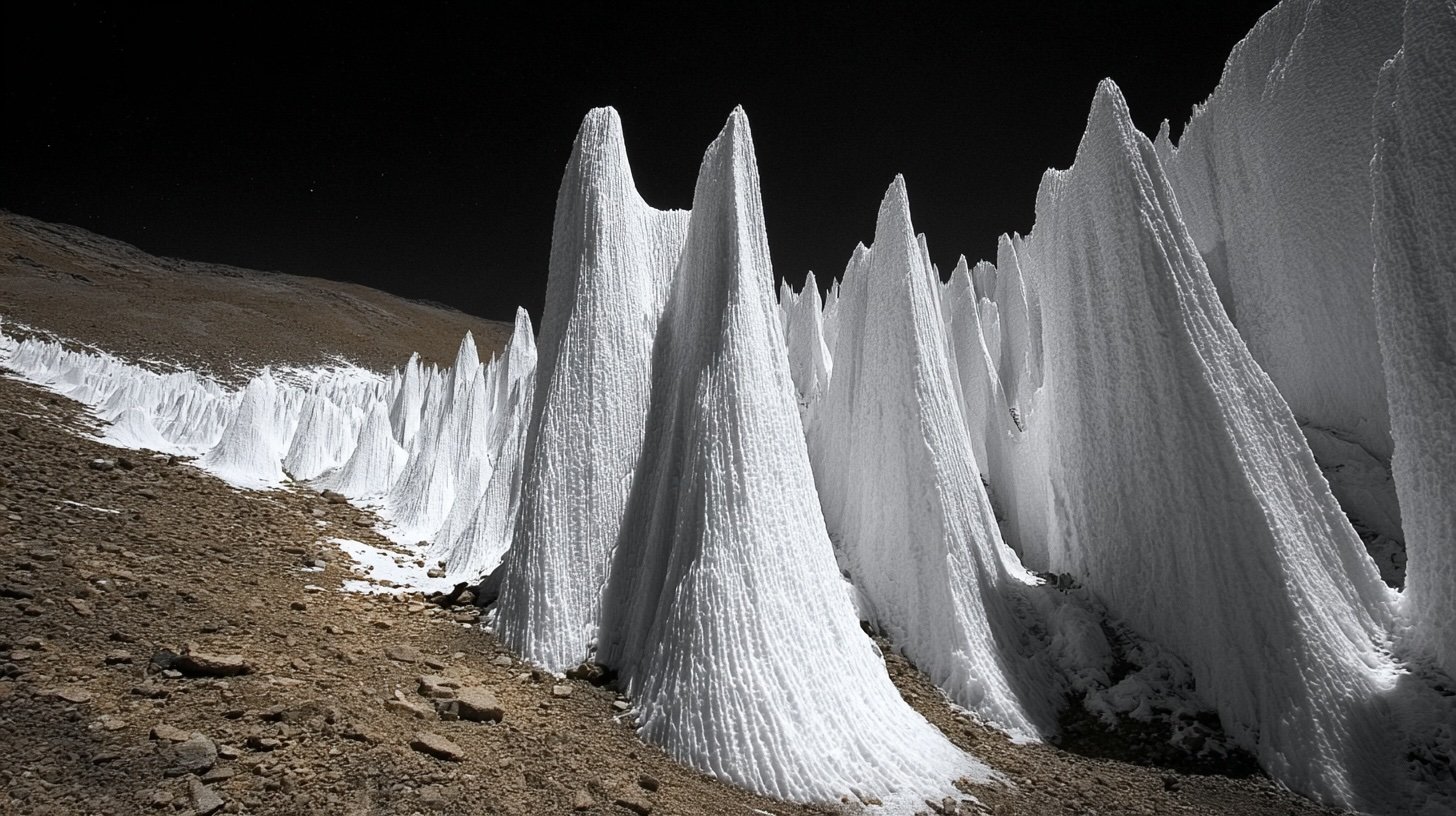
Penitentes appear in places where snow has no intention of behaving politely. High in the Andes, where air thins, skies stay brutally clear and the sun feels closer than it has any right to, the snowfield refuses to settle into gentle drifts. Instead, it rises into rows of blades. Some are tall. Others are sharp. All of them make you pause, stare, and briefly question why humans ever decided climbing mountains was a sensible pastime.
At first glance, the scene looks theatrical rather than natural. From a distance, entire fields resemble a frozen congregation, white figures leaning slightly, as if caught mid‑procession. Early Spanish explorers thought exactly that, which explains how the name stuck. Medieval penitents wore pointed hoods during public acts of repentance. The snow spikes looked similar enough, and the Andes offered a suitably dramatic backdrop for religious metaphor.
The real explanation, however, is far less mystical and far more elegant. Penitentes form through sublimation, a process in which snow skips the puddle stage and turns straight from solid into vapour. This only happens when sunlight is intense, humidity stays low, and temperatures hover just below freezing. Crucially, all three conditions align neatly at altitude in the dry Andes, particularly during winter and spring.
Everything begins unevenly, as most interesting things do. No snowfield is ever perfectly flat. Instead, tiny bumps, shallow dips and faint ripples left by wind or falling crystals introduce microscopic differences across the surface. When the sun hits, those small hollows trap light and warm slightly faster. As a result, sublimation accelerates there, while raised areas lose snow more slowly. What starts as barely visible texture gradually exaggerates itself.
Over days and weeks, shallow dips deepen into grooves. Gradually, those grooves sharpen into channels. Eventually, the channels isolate narrow ridges of snow between them. Meanwhile, the sun keeps working, carving downward and sideways, until the ridges stand tall and thin, sometimes several metres high. Wind plays a supporting role by sweeping vapour away and preventing moisture from settling back. Gravity, surprisingly, contributes very little. This is sunlight sculpting snow with obsessive patience.
The orientation of penitentes is not random. Most lean toward the midday sun, their blades aligned to maximise shade on their own sides while sacrificing their neighbours. It becomes a strange form of frozen competition. Each spike survives by allowing the troughs beside it to vanish faster. In that sense, penitentes offer a quiet lesson in ruthless efficiency.
Altitude matters enormously. Below a certain height, snow prefers to melt rather than sublimate. Water forms, flows, refreezes, and rounds everything off. Penitentes need dryness and thin air. That requirement explains why the Andes produce them so reliably. Clear skies dominate, moisture remains scarce, and solar radiation punches hard. Elsewhere, other mountain ranges only manage penitente‑like structures occasionally, and usually on a much smaller scale.
For climbers, admiration quickly gives way to irritation. Walking through penitentes feels nothing like crossing a normal snowfield. Every step demands detours, high kicks, awkward lunges and occasional muttered swearing. The troughs between spikes can be knee‑deep or worse. At the same time, the blades feel alarmingly solid when a shin collides with one. Progress slows to a crawl, and route planning turns into optimistic guesswork.
On popular Andean routes, entire days disappear inside penitente fields. Climbers aiming for major summits often underestimate them, assuming snow is snow and distance is distance. Then reality intervenes. Camps are reached late. Energy drains faster than expected. Carefully timed itineraries unravel. Penitentes have earned their reputation for humbling confidence.
Despite the inconvenience, they remain scientifically fascinating. Penitentes alter how glaciers interact with sunlight. A flat snow surface reflects light efficiently but absorbs heat evenly. By contrast, a forest of spikes creates shade, angles and self‑shadowing. Some studies suggest penitentes can actually slow overall ice loss by reducing direct solar exposure. In a warming climate, that detail matters.
Because of this, researchers watch them closely. Their size, density and altitude range provide clues about shifts in radiation, snowfall, humidity and temperature. If penitentes start appearing lower down, or vanish from places where they were once common, something fundamental has changed in the local climate balance.
There is also a broader curiosity at play. Sublimation dominates in environments with thin atmospheres, which naturally draws the attention of planetary scientists. Similar processes could shape ice on other worlds, particularly where sunlight is strong but air is scarce. As a result, the idea that penitente‑like structures might exist beyond Earth has moved from science fiction into serious academic discussion.
Back on Earth, their beauty remains undeniable. Photographs rarely capture the experience properly. From ground level, penitentes tower overhead like frozen bamboo forests. Light ricochets between blades, while shadows stretch and twist unpredictably. Consequently, the snowfield turns into a maze rather than a surface. Sound behaves oddly too, absorbed by the uneven terrain, creating a muffled, almost reverent quiet.
They also feel strangely permanent, even though they are anything but. In reality, penitentes are seasonal. Over time, they grow, sharpen, lean and eventually collapse or melt away as conditions shift. Summer warmth softens their edges. Storms bury them. Fresh snowfall resets the surface. By the time most people encounter photographs, the formations themselves may already be gone.
That fleeting nature adds to their appeal. Penitentes are not landmarks you reliably revisit in the same form year after year. Instead, they are events. Temporary sculptures created by a precise balance of light, cold and dryness. Miss that balance, and the snow behaves normally again, which in this context feels oddly disappointing.
Culturally, penitentes sit at an interesting crossroads. Early explorers wrapped them in religious language. Modern climbers curse them like adversaries. Scientists measure them like data points. Photographers treat them as abstract art. All of these responses make sense. Penitentes invite projection.
There is also something quietly instructive about how they form. No violence, no dramatic weather, no obvious force. Just sunlight doing what it always does, day after day, interacting with matter in a slightly unusual context. It serves as a reminder that extreme landscapes do not always require extreme events. Sometimes consistency is enough.
Standing among penitentes sharpens your sense of scale in a peculiar way. Individually, each spike feels solid and threatening. Yet collectively, the field feels delicate, as if it might vanish the moment you look away. Above it all, the mountain looms, indifferent. Meanwhile, the sun keeps shining. The snow keeps evaporating.
In a world obsessed with speed and spectacle, penitentes feel almost old-fashioned. Rather than rushing into existence, they take their time. Their appearance depends on conditions quietly aligning instead of chaos erupting. As a result, patience gets rewarded while haste gets punished. Even so, they still look dramatic, despite arriving through subtlety rather than force.
That may be why they linger in memory long after the cold fades from your boots. Penitentes are snow refusing to be smooth, light refusing to be gentle, and mountains reminding visitors that beauty does not need to be comfortable. Sometimes it prefers to grow teeth instead.