Pax Romana: How Mankind Lived in Peace for Two Centuries
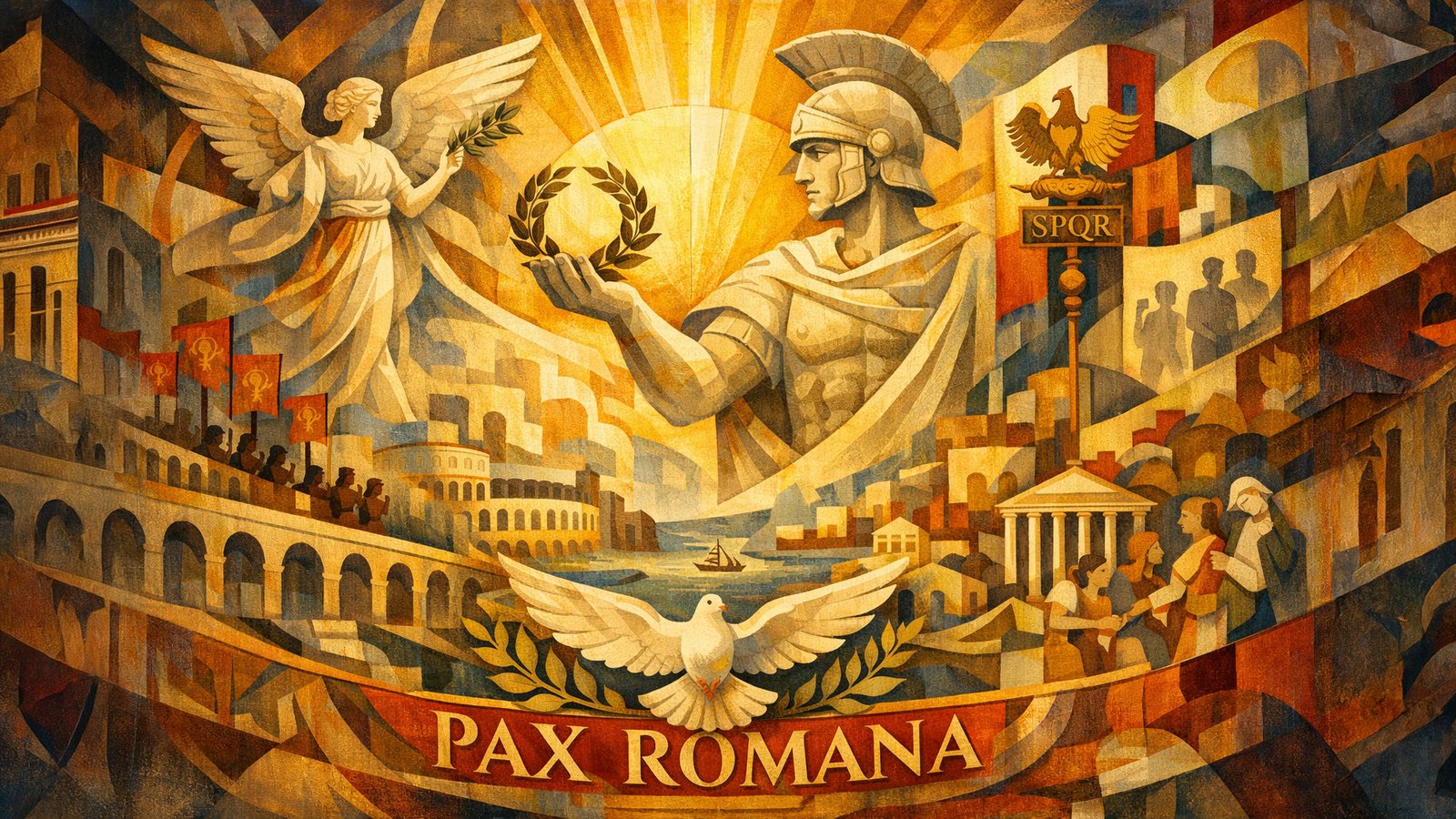
Stand in the Roman Forum early in the morning and imagine the noise fading. For centuries the place echoed with speeches, riots, elections, and occasional assassinations. Then, rather suddenly by historical standards, the shouting stopped. The Republic had exhausted itself through civil wars and political feuds, while armies marched on Rome again and again. Eventually one man tidied the chaos, locked the doors, and called the arrangement peace. Historians later gave that calm a name: Pax Romana.
At first glance the phrase sounds serene, almost pastoral. In reality it described a political system of astonishing scale. From the rise of Augustus in 27 BCE to the death of Marcus Aurelius in 180 CE, the Roman Empire managed something rare. A territory stretching from the Atlantic Ocean to the deserts of Syria functioned with relative stability. Consequently roads carried merchants instead of marching armies, cities expanded rather than burned, and administrators collected taxes with dull efficiency.
Naturally the world had not become gentle. Rome still fought wars at its frontiers and punished rebellions brutally. However within imperial borders daily life gained a rhythm that earlier generations never knew. Markets reopened, ships sailed safely across the Mediterranean, and travellers moved between cities with surprising confidence. For many inhabitants the most remarkable feature of the era was not glory but predictability.
The transformation began after decades of chaos. Once the Roman Republic had prided itself on balanced institutions, yet ambition gradually outgrew those mechanisms. Senators chased prestige while military commands became ladders to personal power. Julius Caesar eventually crossed the Rubicon with his legions, and Rome learned that political disputes could be settled with soldiers. Soon afterwards the Republic tore itself apart as rival factions fought across the Mediterranean.
Caesar himself fell to assassins in the Senate, although the violence did not end there. Alliances formed and collapsed with exhausting speed while armies marched through Greece, Italy, and Egypt. Finally the decisive confrontation occurred at the Battle of Actium in 31 BCE. There Octavian defeated Mark Antony and Cleopatra, and after that victory the Roman world suddenly had a single master.
Romans, however, hated kings. The ancient monarchy still haunted their political imagination, so Octavian avoided crowns and thrones. Instead he performed careful political theatre. Publicly he announced that the Republic had been restored and that authority returned to the Senate and the Roman people. Everyone recognised the script, yet few complained because stability mattered more than constitutional purity.
In 27 BCE the Senate granted him the title Augustus, a word carrying religious overtones rather than royal ones. Meanwhile Augustus quietly controlled the army, the treasury, and the most strategic provinces. Thus the Republic survived on paper while imperial authority guided everything important. Soon Augustus advertised the new era with confident symbolism by constructing the Ara Pacis, the Altar of Peace.
The monument spoke through imagery rather than speeches. Marble reliefs showed orderly processions, prosperous families, and lush vegetation curling across the stone. Vines overflowed with fruit while children played beneath symbolic figures representing abundance. The message remained clear even without inscriptions. Under Roman guidance the world had become fertile again, and after generations of turmoil that promise felt almost miraculous.
At this moment the empire stretched across enormous distances. Roman authority covered Britain, Gaul, Spain, North Africa, Egypt, Greece, Anatolia, and parts of the Middle East. Tens of millions of people lived inside this political framework. Different languages filled the streets and diverse customs shaped festivals and temples. Yet Roman administration quietly stitched the regions together through taxation, law, and infrastructure.
Roads performed much of that stitching. Roman engineers treated infrastructure as strategy, carving routes across mountains, marshes, and plains with stubborn determination. The famous Via Appia ran south from Rome like a ruler drawn across the landscape, while thousands of other routes linked distant provinces. Consequently travellers noticed the difference immediately because journeys that once required weeks of uncertainty became predictable stages along paved roads.
Merchants benefited enormously from these networks. A trader could leave Spain carrying olive oil, cross Gaul by road, board a ship in Italy, and sell the cargo in Alexandria. Imperial couriers followed similar routes with official letters while fresh horses waited at relay stations. Therefore information travelled faster than most ancient observers believed possible.
Because of those connections the empire behaved like a single economic organism. Egyptian grain fed the crowded population of Rome, Spanish mines produced silver for imperial coinage, and Syrian workshops crafted delicate glassware that reached tables in Gaul. Meanwhile pepper and spices arrived from India through Red Sea ports, travelling along maritime routes guided by seasonal monsoon winds.
Not everyone admired this luxury. Pliny the Elder complained that eastern trade drained Roman wealth every year, calculating enormous sums leaving the empire for exotic goods. His irritation sounds surprisingly modern, almost like a senator criticising global imports. Yet the demand never disappeared because Roman elites loved displaying rare objects gathered from distant regions.
Cities flourished under these conditions. Urban life formed the backbone of Roman civilisation, and across the Mediterranean similar architectural patterns appeared. Forums hosted political gatherings and markets, baths attracted crowds every afternoon, theatres entertained citizens with drama, and temples honoured local gods alongside imperial patrons. Even modest towns developed impressive civic spaces.
Bathhouses proved particularly central to daily routine. Steam rose above marble pools while citizens exercised, discussed business, and exchanged gossip. Philosophers argued in quiet corners while merchants negotiated deals beside warm water. As a result the bath complex became the social heart of Roman towns, combining leisure, hygiene, and conversation in a single architectural setting.
Law created another invisible framework linking distant regions. Roman legal principles gradually standardised contracts, property rights, and civic obligations across the empire. Consequently merchants could trade across provinces with confidence because familiar rules governed transactions. A trader from Antioch might sign agreements in Athens or Marseille without facing entirely new systems each time.
Greek observers sometimes marvelled at this administrative order. The orator Aelius Aristides praised Rome for transforming geography itself, describing rivers bridged, mountains cut with roads, and deserts filled with cities. According to him travellers could move safely across enormous distances while commerce flowed steadily between regions.
Behind this calm stood the Roman army. Around twenty eight legions guarded imperial frontiers while professional soldiers lived in fortified camps along rivers such as the Rhine and the Danube. Their steady presence discouraged ambitious neighbours because few tribes wished to test Roman patience repeatedly.
Interestingly the soldiers themselves often came from distant provinces. An auxiliary archer recruited in Syria might serve in rainy Britain, while a cavalryman from Spain could patrol forests in Germany. Military life therefore mixed cultures beneath identical armour, creating communities where Latin commands echoed among men from very different backgrounds.
Frontiers rarely looked like neat lines on maps. Instead they formed broad zones of interaction where traders crossed borders, diplomats negotiated with tribal leaders, and occasional Roman raids reminded neighbours who dominated the region. These frontiers behaved less like walls and more like controlled membranes between worlds.
One famous border project nevertheless appeared under Emperor Hadrian. During a tour of the provinces he ordered construction of a massive wall across northern Britain. Hadrian’s Wall stretched roughly seventy three miles from coast to coast, dotted with forts and watchtowers that monitored movement across the frontier.
Contrary to modern imagination the wall did not simply stop invasions. Instead it regulated travel and trade while allowing merchants and travellers to pass through guarded gates. Soldiers inspected goods, collected taxes, and monitored traffic. In effect the structure worked like a giant imperial checkpoint marking the edge of Roman administration.
Within the empire the second century produced remarkable political stability. Later historians grouped several rulers under the label Five Good Emperors because their reigns avoided catastrophic succession crises. Each ruler inherited the system created by Augustus and maintained it with reasonable competence.
Nerva restored balance after turbulence, Trajan expanded Roman power to its greatest territorial reach, and Hadrian later preferred consolidation over conquest. Antoninus Pius governed quietly for decades, while Marcus Aurelius combined military leadership with philosophical reflection during challenging frontier wars.
Marcus Aurelius left behind personal notes later known as the Meditations. In those reflections he reminded himself that external events escape human control while personal character remains within one’s power. The writings reveal a ruler attempting calm discipline while governing an enormous and complicated empire.
Even peaceful centuries produced strange stories about imperial life. Roman historians loved recounting eccentric episodes, including one involving the emperor Claudius. According to several writers he once fell asleep during a legal hearing and woke to discover the defendant had already been acquitted. Claudius supposedly ordered execution anyway, a tale that illustrates the absurd scale of imperial authority.
For ordinary citizens Pax Romana felt far less dramatic. Farmers planted wheat, olives, and grapes while craftsmen produced pottery, textiles, and metal tools. Sailors carried amphorae filled with wine across the Mediterranean, and travellers moved between cities with reasonable safety compared with earlier centuries.
Religion flourished within this environment of relative stability. Roman authorities usually tolerated local cults as long as they did not challenge imperial order. Egyptian, Greek, and regional gods all received worship, and temples dedicated to the emperor appeared across many cities. Consequently spiritual diversity quietly characterised everyday Roman life.
Among numerous religious movements circulated a small sect following the teachings of Jesus of Nazareth. Initially Roman officials barely noticed these communities. Ironically the empire’s own infrastructure later helped them grow because missionaries travelled along Roman roads and preached in Roman cities. Gradually the message spread through the empire’s communication networks.
Yet the peace rested firmly on discipline. Whenever rebellions erupted Rome responded harshly. Jewish revolts in the first century ended with the destruction of Jerusalem’s temple, demonstrating how quickly imperial stability could turn violent.
During the late second century deeper strains emerged. Plagues swept across provinces and reduced populations, while Germanic tribes pressed harder against the Danube frontier. Marcus Aurelius therefore spent long campaigns in muddy military camps rather than comfortable palaces in Rome.
Despite these pressures he preserved philosophical composure. His writings repeatedly reminded him that power, fame, and even empire itself eventually fade because the universe moves according to larger patterns.
When Marcus Aurelius died in 180 CE he left power to his son Commodus, a decision that quietly ended the tradition of adopting capable heirs. Commodus soon developed a taste for theatrical behaviour, fighting staged battles in gladiatorial arenas and renaming months of the calendar after himself.
Ancient historians reacted with alarm. Cassius Dio later wrote that Rome had descended from a kingdom of gold to one of iron and rust, suggesting the balanced machinery of Pax Romana had begun to creak.
Within a few decades rival emperors fought for control while invasions increased and trade weakened. Stability eventually returned, yet the effortless confidence of earlier decades never fully recovered.
Looking back Pax Romana resembles a rare pause in the turbulence of ancient history. Two centuries allowed cities to grow, trade routes to expand, and cultures to interact across enormous distances. Roman law and engineering left marks still visible today in bridges, roads, and legal traditions.
Admittedly the peace remained imperfect and sometimes brutal. Nevertheless millions of people lived within a structure that felt predictable. Farmers knew where to sell harvests, merchants trusted the roads, and administrators filled archives with tidy records. For a civilisation accustomed to upheaval that quiet routine may have felt like Rome’s greatest luxury.
Post Comment
You must be logged in to post a comment.