Pamir Glaciers: From Frozen Fortress to Melting Memory
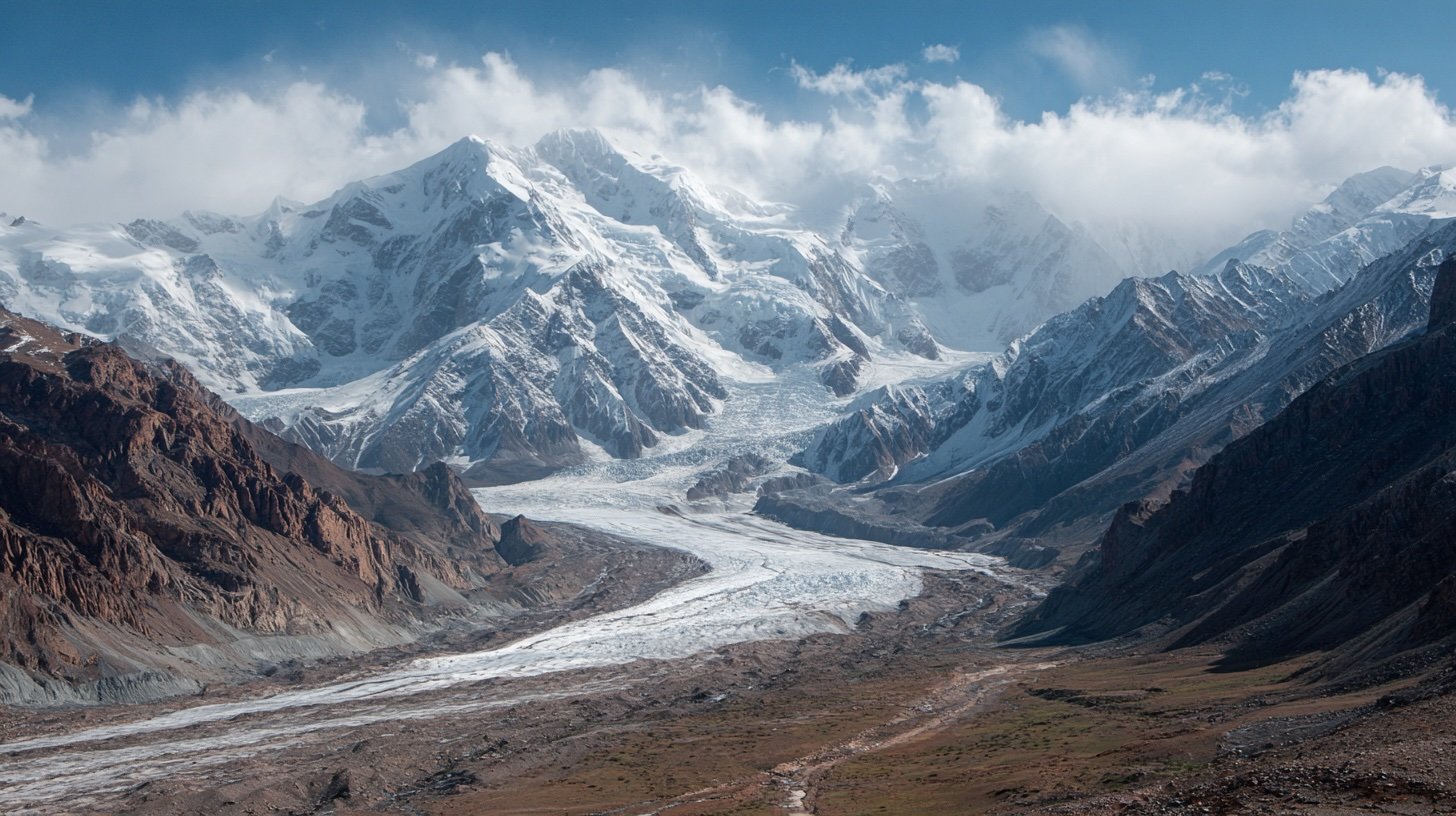
The Pamirs like to pretend they’re eternal. Jagged peaks, sweeping ridges, a kind of granite permanence that makes even seasoned mountaineers feel tiny and irrelevant. For decades, one part of this stubborn mountain theatre gave scientists a reason to scratch their heads: the glaciers. While the rest of the world’s ice retreated as if someone had left a hair dryer on, the glaciers in this corner of Central Asia seemed to defy the script. They were meant to shrink, and yet they held their ground. It was given a suitably mysterious name, the Pamir–Karakoram Anomaly. Sounds glamorous, doesn’t it? Like a Bond film set somewhere between goat pastures and Soviet‑era weather stations.
The Kyzylsu Glacier became the poster child of this icy stubbornness. Researchers trekked up there year after year, noting how it shrugged off the warming climate like an old Tajik shepherd refusing to buy a smartphone. While Alpine glaciers collapsed like soggy soufflés, Kyzylsu clung on. Locals liked to joke that their glaciers were immune, blessed by some mountain spirit, or maybe just frozen Soviet nostalgia.
Then, around 2018, something shifted. Not a dramatic avalanche that sent tourists running, not a sudden Hollywood crack and crumble. More like a quiet betrayal. The snow simply stopped turning up in the same quantities. What had been a dependable metre‑plus blanket thinned down. At one monitoring station, snow depth fell from an average of 1.3 metres to barely 0.9. The snow also melted two weeks earlier, like a lazy employee handing in notice before the season had even begun. For a glacier, that’s catastrophic. Snow doesn’t just look pretty—it acts as insulation, protecting the ice underneath. Without it, the glacier bakes under the summer sun. And so, after decades of resilience, Kyzylsu began to melt faster than before.
The irony is painful. As the ice melted, it gave the rivers downstream an unexpected bonus. About a third of the water deficit caused by weaker snowfall was patched up by the very ice that should have been kept safe. Imagine raiding your savings account to pay for weekly groceries. It works for a bit, but you know the account will empty sooner rather than later. The Amu Darya River, which begins its life near the Pamirs and travels all the way to what remains of the Aral Sea, gratefully took the extra water. Farmers downstream probably noticed stronger flows, enough to irrigate their cotton or wheat. But the glacier can’t keep that generosity going forever.
Researchers like Francesca Pellicciotti and her international team knew something big was happening. They set up climate stations in 2021, placed sensors, modelled historical data back to 1999, and the graphs told the tale with cruel precision. 2018 was the tipping point. The last “stable” glaciers in Central Asia had lost their halo. The Pamir–Karakoram Anomaly, once paraded at scientific conferences, now looks like a footnote. Stability has given way to collapse, and the glaciers are following the same fate as their Alpine, Andean, and Himalayan cousins.
One could almost laugh at the timing. Just as global climate summits spent years trying to find silver linings—“Look, at least the Pamirs are holding up”—those linings have melted along with the snowpack. The glaciers aren’t exceptional anymore. They’re ordinary in the worst possible way.
What happens when the ice that feeds whole valleys, villages, and nations goes? Central Asia knows the answer already. Water disputes flare up between neighbours like Uzbekistan, Kyrgyzstan, and Tajikistan. Irrigation canals turn into political tools. And the spectre of the Aral Sea, once the world’s fourth‑largest lake, now a sad, salty wasteland, hangs over every water policy discussion. The Pamirs used to serve as a reliable bank of frozen wealth. Withdraw a little every summer, watch the rivers swell, water the fields. Now, the vault is emptying. Once it’s gone, no government grant or international NGO can conjure the ice back.
There’s something both majestic and tragic about watching a glacier die. Stand near Kyzylsu in late summer, and you’ll hear the rush of water, not the creak of ice. Blocks of frozen history collapse into melt streams. The glacier, thousands of years in the making, is cannibalising itself to keep rivers alive. Short‑term gain, long‑term ruin. The villagers downstream don’t have the luxury to romanticise it, of course. They need water. If a bit more flow comes from a glacier’s death throes, so be it. But in a few decades, when the glacier is a bare rock valley, their crops won’t care about the tragic poetry.
The science confirms this isn’t just a local quirk. Remote sensing across the Pamirs shows the same downward trend. It’s as if the whole range made a collective decision: no more resisting. Even glaciers that once inched forward or remained steady have started their retreat. The climatic ingredients that allowed them to resist—steady snowfall, colder summers—are no longer reliable. Climate models warn that precipitation patterns in Central Asia will keep shifting. In other words, don’t expect a miraculous return of the snowpack. The glaciers’ fate has been signed, even if the execution drags out for a few more decades.
The geopolitical implications are just as chilling as the meltwater. The Amu Darya and Syr Darya rivers have always been contested lifelines. Soviet engineers once carved their courses into irrigation networks so ambitious they drained the Aral Sea. Independent states have since bickered over dams, reservoirs, and water rights. Throw collapsing glaciers into that cocktail, and you have a recipe for conflict. Cotton still demands its share of irrigation, cities still need drinking water, and energy grids rely on hydroelectric power. When the mountain ice reserves vanish, scarcity will bite. And history shows that Central Asia doesn’t handle scarcity gracefully.
For scientists, the collapse of Kyzylsu offers both despair and opportunity. The despair is obvious: another reminder that climate resilience can evaporate overnight, or at least over one unlucky decade. The opportunity lies in the rare long‑term data set. By cross‑referencing on‑the‑ground measurements with satellite imagery and climate models, they can piece together not just what happened but why. The culprit isn’t simply warmer air—it’s the complicated dance of snowfall, timing, and depth. Without enough snow, even the hardiest glacier becomes a puddle in waiting.
Local communities face a cruel dilemma. Celebrate the extra meltwater now, or mourn the loss later? Most don’t get the choice. A farmer in southern Tajikistan cares little for climatological anomalies. He cares if the irrigation canal fills in July. A herder wants his animals watered, not a lecture on glacial retreat. And yet, these communities will carry the burden first. Their voices rarely make it to climate summits. By the time the glaciers are reduced to tourist brochures, they’ll already have paid the price.
The bigger picture should unsettle us all. The Pamirs are not isolated. They feed rivers that cross borders, sustain millions, and shape economies. If the glaciers there collapse, it’s not just a Tajik problem, or a Kyrgyz headache. It ripples outward, destabilising an entire region already juggling enough challenges. Climate change doesn’t respect cartographic lines, and neither does glacial meltwater.
Standing on the moraines near Kyzylsu today, one might feel the same helplessness as watching a loved one fade. You can measure, you can record, you can photograph, but you can’t stop the decline. Nature isn’t sentimental. It doesn’t care that we once called these glaciers stable. They will melt, stone will replace ice, and the rivers will run thinner each summer. What’s left for us is the messy task of adapting—building smarter water policies, investing in efficiency, and maybe rethinking the crops that guzzle up more than their fair share.
The story of the last stable glaciers of the Pamirs isn’t one of heroic survival anymore. It’s the story of inevitability catching up. For years, scientists thought they had stumbled on a miracle of resilience. In reality, it was just a lucky pause before the same relentless decline. The mountains always win in the end, but not in the way we imagine. They win by outlasting us, not by keeping our glaciers intact. And as the Kyzylsu proves, even the most stubborn ice eventually admits defeat.