Ovid: Love as Strategy, Not Emotion
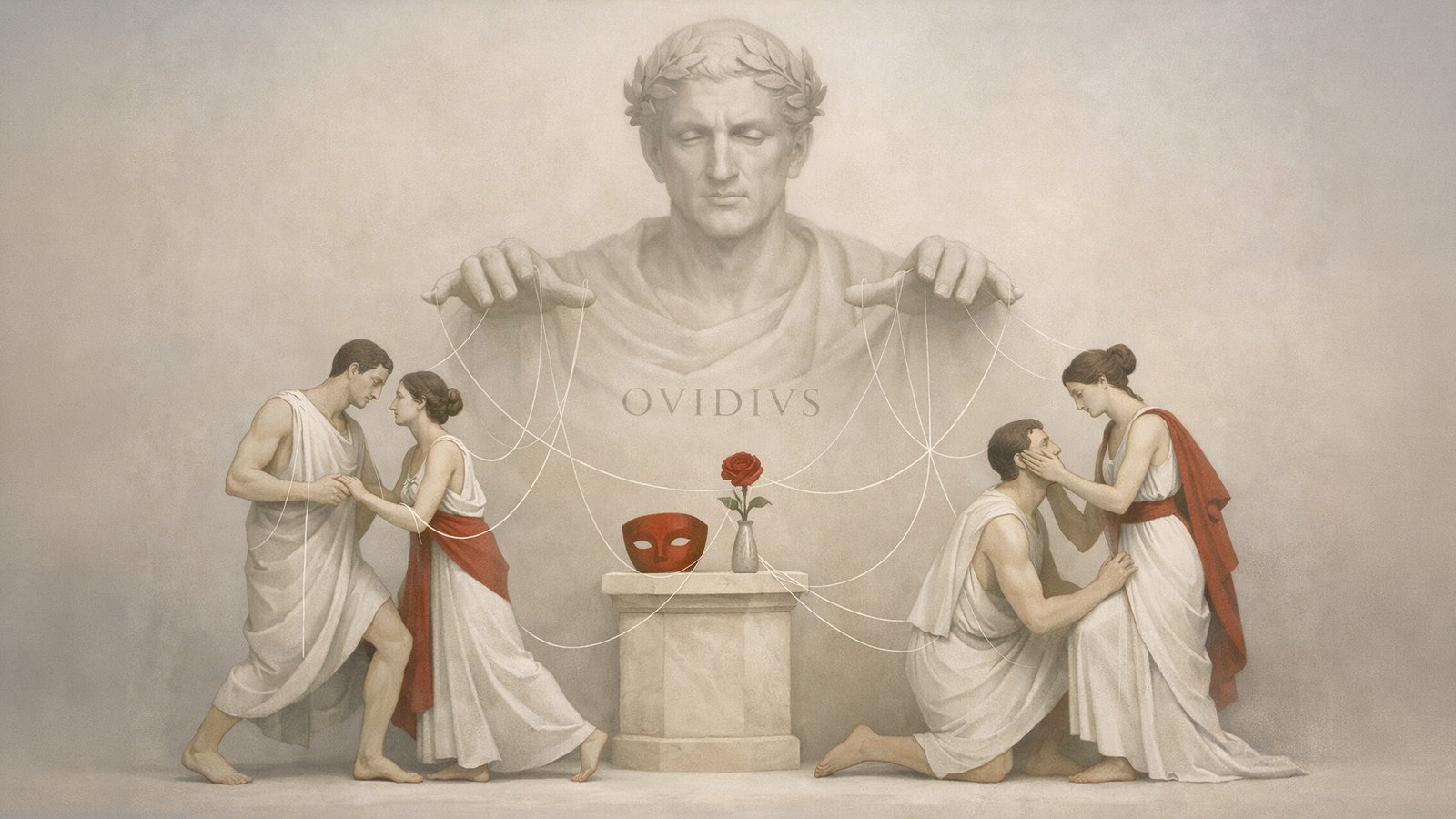
Love poetry usually pretends to be about feelings. Ovid looked at Rome, watched people flirting in theatres and squeezing together at the Circus, and decided to write something much less sentimental. Ars Amatoria was not interested in destiny, soulmates, or the trembling purity of the heart. It treated love as technique. Better than technique, really. It treated love as urban strategy.
That was the brilliance of it, and also the problem. Ovid did not write like a moral philosopher worrying about virtue. He wrote like a smooth operator who had studied the city map. Where should you meet someone? At the races. At the theatre. At dinner parties. How should you keep them interested? With letters, flattery, timing, and careful self-presentation. What should you avoid? Clumsy honesty, visible desperation, and the sort of behaviour that made desire evaporate faster than cheap perfume in August.
So this was not Rome’s great hymn to eternal devotion. Instead, it was a manual. A witty, elegant, deeply unserious-seeming manual that turned courtship into a game of positioning, persuasion, and performance. Naturally, Roman elites were not thrilled.
Ovid knew exactly what he was doing. He cast himself as a teacher, a so-called expert in love, and borrowed the tone of serious instructional poetry. Earlier Roman poets had written about farming, astronomy, and statecraft in elevated didactic style. Ovid pinched that voice and used it to explain seduction. The joke landed because the form sounded grand while the content cheerfully wandered into flirtation, secret signals, grooming, jealousy, and how not to bore your lover. It was mock-instruction, but only partly mock. The advice was playful. The ambition was real.
For men, the first lesson was brutally practical: stop waiting for fate. Go where women are. Ovid’s Rome was a social machine full of opportunities, and Ars Amatoria reads at times like a field guide to public space. The theatre mattered because people sat close together. The Circus mattered because crowds created excuses for conversation. Festivals helped. Banquets helped. Even legal and civic spaces could become part of the hunt. In other words, Ovid transformed the capital into a dating map long before anyone invented the phrase.
Then came the tactics. Use letters. Learn patience. Do not demand too much too quickly. Win over the maid if needed. Notice details. Adapt your style to the woman in front of you rather than worshipping some fantasy version of love. Ovid’s lovers do not collapse into emotion and hope for the best. They observe, calculate, improvise, and manage impressions. That is why the poem still feels strangely modern. Strip away the togas and chariots, and parts of it read like a cynical guide to messaging strategy, personal branding, and social intelligence.
However, the book becomes more unsettling the longer you sit with it. Ovid often treats deception as normal. He assumes performance belongs to romance. He praises persistence, strategic compliments, and selective presentation of the self. At times, the tone is so airy that readers almost miss the harder edge underneath. This is not love as mutual vulnerability. It is love as influence.
That quality explains both the fascination and the scandal. Augustus, Rome’s first emperor, had spent years promoting moral reform. He pushed legislation on marriage and adultery, presented himself as a restorer of public virtue, and tried to discipline elite behaviour. Ovid then arrived with a bestselling poem that effectively winked at adultery, glamorised intrigue, and taught readers how to navigate desire without much concern for official morality. That was awkward, to put it mildly.
Ovid tried to defend himself later by implying that the poem was light entertainment and by insisting that he had not targeted respectable married women. Yet this was not exactly convincing. Ars Amatoria drew its sparkle from sophisticated Roman society, and sophisticated Roman society included the very elite whose conduct Augustus wanted to regulate. The poem may have sounded playful, but it also made the emperor’s moral programme look faintly ridiculous. Rome was being told to behave; Ovid was handing out tips.
Then came the exile, the great Roman literary drama. In 8 CE Augustus banished Ovid to Tomis on the Black Sea. Ovid himself blamed a carmen et error — a poem and a mistake. Most scholars think the poem was Ars Amatoria. The mistake remains murky. Maybe he knew something compromising about the imperial family. Maybe he became entangled in one of its scandals. Maybe the poem had already made him inconvenient, and the mysterious error finished the job. The exact cause still tempts speculation because Ovid never explained it clearly, which was either prudent or wonderfully theatrical.
That uncertainty keeps the book alive. People love a banned-work story, and Ars Amatoria comes wrapped in one. Yet the real reason it endures is simpler. Ovid understood that desire is rarely just feeling. It is theatre, timing, vanity, competition, and self-invention. He saw romance as something people perform in public before they ever experience it in private. That idea feels embarrassingly contemporary.
Even so, it would be too easy to call Ovid merely cynical. He was funny, but he was not stupid. He knew performance does not cancel emotion. Quite the opposite. People perform because emotion matters and because they fear failure. His lovers scheme because they care about being chosen. They edit themselves because attraction is fragile. They strategise because desire creates risk. Under all the polished advice sits a very old human panic: how do I make someone want me, and how do I stop them leaving once they do?
Book 3, addressed to women, makes the whole poem even more interesting. Ovid did not reserve strategy for men alone. He also offered women advice on presentation, timing, behaviour, and concealment of flaws. That widened the poem’s audience, but it also widened the offence. Now Ars Amatoria was not simply a male fantasy of pursuit. It became a broader social script for mutual performance. Everyone, apparently, was in on the game.
There is, admittedly, a less glamorous side to all this. Some of the advice sounds manipulative because it is manipulative. Some of it reflects the gender assumptions of Roman elite society. Some of it turns charm into technique with unnerving ease. Modern readers do not need to admire that. Still, they can recognise it. Ovid’s great trick was to expose the machinery without pretending the machinery did not exist.
That was the scandal. Roman elites liked desire well enough in practice. What they disliked was seeing its mechanics written down with such style. Ovid made aristocratic flirtation visible. He turned private games into literature. Worse still, he made it all look clever.
So Ars Amatoria was never just dating advice from the ancient world. It was a social x-ray. It showed how love could operate inside a competitive city, among status-conscious people, under a regime loudly advertising morality. No wonder it caused trouble. Ovid did not insult Rome by describing lust. He insulted it by describing how efficiently lust could be managed.
Post Comment
You must be logged in to post a comment.