Mummy Unwrapping Parties: How the Victorians Turned Archaeology into Entertainment
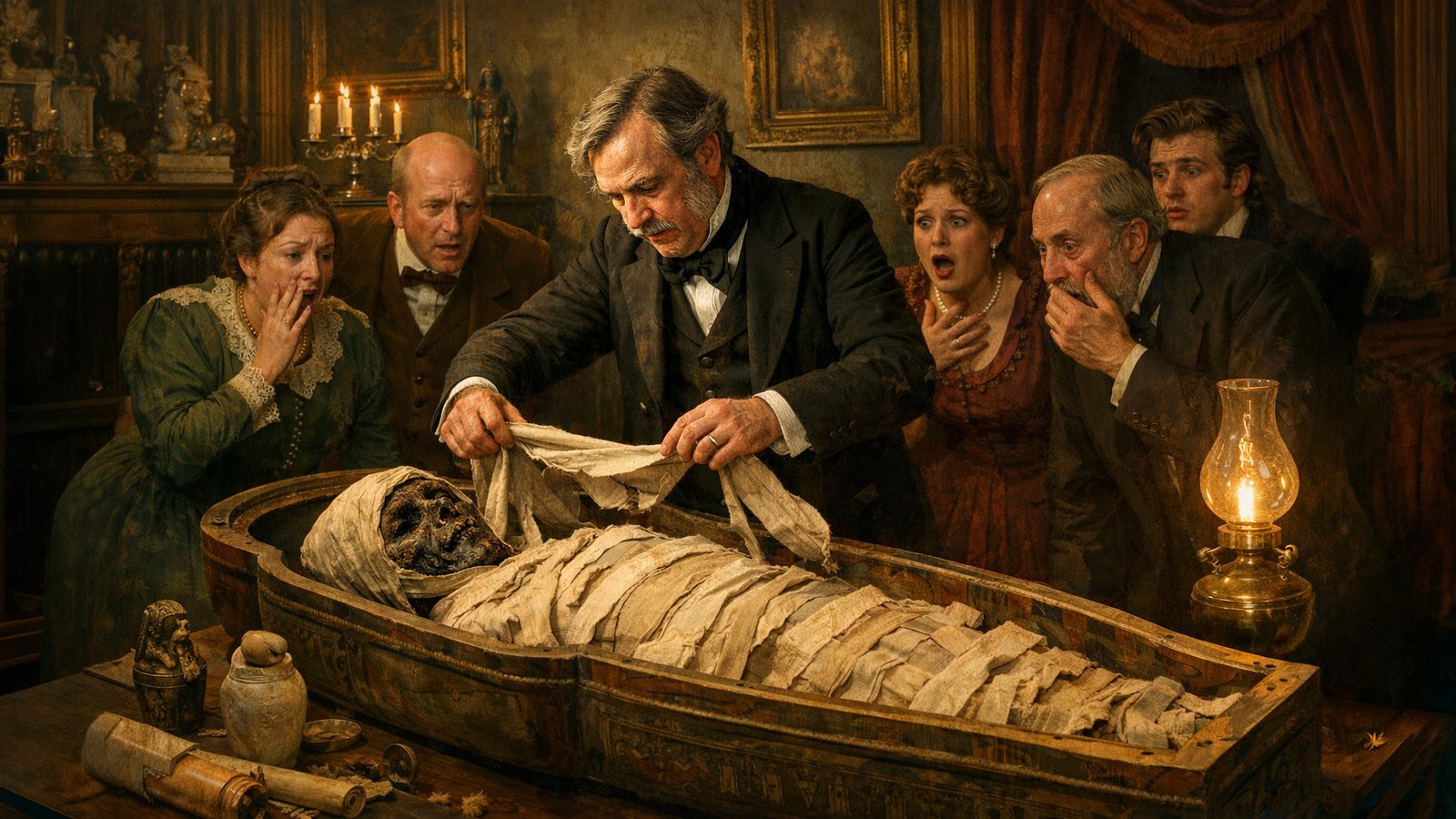
The Victorians liked to think of themselves as sensible people. They built railways, standardised time, catalogued plants, and invented entire professions devoted to order and progress. Yet, at the same time, they spent several decades buying ancient Egyptian corpses, laying them out on tables, and peeling them apart in front of invited guests. They called it education, and they charged admission.
Mummy unwrapping parties emerged in Britain during the early nineteenth century, precisely when science, empire, and spectacle began to overlap in uncomfortable ways. They did not happen in secret. On the contrary, they unfolded in lecture halls, private salons, medical theatres, and, on occasion, grand drawing rooms. Well-dressed audiences gathered to watch linen bandages sliced away from bodies that had already been dead for thousands of years. Sometimes, applause followed.
Egypt sat at the centre of this fascination. After Napoleon’s campaign at the end of the eighteenth century, a European obsession took hold and never quite loosened its grip. Hieroglyphs appeared on wallpaper. Obelisks rose in cemeteries. Sphinxes guarded suburban gardens. As a result, mummies flowed into Britain in alarming numbers. Some arrived as museum pieces. Others entered private collections. Many appeared simply because someone with money wanted one.
At first, mummies functioned as curios. Guests pointed at them while hosts boasted about their acquisitions. Conversation drifted between ancient rituals and modern travel. However, curiosity soon demanded action. What lay beneath the wrappings. What secrets did the body hold. Victorians believed knowledge required exposure. Therefore, the bandages had to come off.
Public unwrapping quickly evolved into a hybrid event. It borrowed the authority of medicine, the drama of theatre, and the social cachet of the salon. Usually, a respected figure led proceedings, often a surgeon or antiquarian. One of the most prolific was Thomas Pettigrew, a London surgeon who turned unwrapping mummies into his calling card. From the 1820s onwards, he hosted dozens of events, attracting aristocrats, scholars, and curious onlookers who trusted his steady hand and confident narration.
These evenings followed a loose structure. The mummy lay on a table, sometimes elevated for visibility. The lecturer explained its supposed age, origin, and status in ancient Egyptian society. Then the cutting began. Layer by layer, linen came away. Amulets appeared. Resin cracked. Occasionally, jewellery emerged to appreciative murmurs. Meanwhile, guests leaned forward, notebooks opened, and glasses clinked softly.
Despite the modern horror this provokes, many Victorians saw nothing grotesque in the process. They viewed the body as an object of study rather than a person. In their minds, the dead Egyptian belonged to history, not to a living community. Moreover, unwrapping felt progressive. It replaced superstition with observation. It turned mystery into fact.
Science helped justify the spectacle. This was an era when anatomy lectures drew crowds and dissections formed part of public education. Medical schools invited observers, and surgeons demonstrated techniques in packed theatres. Against that backdrop, a mummy seemed like an especially exotic specimen rather than a moral boundary.
Death also played a peculiar role in Victorian culture. Mourning rituals stretched on for months or years. Post-mortem photography flourished. Hair jewellery preserved physical fragments of the dead as keepsakes. Spiritualist séances promised communication across the veil. In this environment, spending an evening with a three-thousand-year-old corpse did not feel outrageous. Instead, it felt meaningful.
That said, not all unwrapping events maintained a scholarly tone. Some leaned heavily into performance. Gaslight flickered dramatically while hosts teased revelations. Accounts describe audible gasps when faces emerged intact, as though the mummy might suddenly open its eyes. Consequently, the line between lecture and entertainment blurred with ease.
Authenticity posed another problem. Demand for mummies soared faster than supply. As a result, the market grew messy. Dealers exaggerated ages. Bodies from later periods masqueraded as ancient royalty. Animal mummies appeared where humans were expected. In some cases, wrappings concealed little more than fragments held together with resin and hope.
Ironically, the act of unwrapping often destroyed the very information scholars hoped to preserve. Once linen was cut, context vanished. Placement of amulets, layering of textiles, and traces of ritual disappeared under Victorian scissors. What remained satisfied curiosity but erased evidence.
Unwrapping parties did not exist in isolation. They formed part of a broader European habit of consuming Egyptian bodies in less visible ways. For centuries, powdered mummy circulated as medicine, prescribed for ailments ranging from headaches to internal bleeding. Apothecaries sold it, patients swallowed it, and few questioned its origins. Artists even used pigments derived from mummified remains, producing a warm brown paint colour that lingered in studios into the nineteenth century.
By the time public unwrappings peaked, these practices were fading. Yet they shared a worldview. Ancient Egyptian bodies counted as resources. They could heal, educate, decorate, or entertain. Consent never entered the conversation.
Criticism did exist, although it grew louder later in the century. As archaeology professionalised, scholars began to argue for preservation rather than destruction. Museums shifted towards classification and display. Gradually, the idea of slicing open a mummy for an audience started to feel crude.
Colonial realities underpinned the entire phenomenon. Egypt had limited control over its antiquities during this period. Foreign powers extracted artefacts with ease, often under unequal agreements or outright looting. Therefore, the mummy on the table represented not only ancient death but modern imbalance, even if Victorians rarely acknowledged it.
Today, museums treat mummies very differently. Non-invasive imaging has replaced knives. CT scans reveal bones, organs, and amulets without disturbing wrappings. Digital reconstructions allow scholars to study faces and injuries without touching the body. In many cases, institutions now choose not to unwrap mummies at all.
The damage inflicted during the nineteenth century remains irreversible. Countless mummies lost their context forever. Some survive only as disarticulated skeletons. Others disappeared entirely once their novelty faded. Modern curators often inherit the consequences of Victorian enthusiasm.
Popular culture tends to exaggerate these events. Films depict rowdy crowds, drunken laughter, and casual cruelty. Reality was usually quieter and more controlled. However, restraint does not soften the ethical problem. Polite applause can still accompany destruction.
It is tempting to dismiss mummy unwrapping parties as a bizarre footnote. Yet they reveal something larger. They show how easily curiosity outruns respect when power goes unquestioned. Ultimately, they illustrate how science slips into spectacle when accountability lags behind discovery.
The Victorians believed they were unlocking secrets. Instead, they often silenced them. The linen fell away, the room applauded, and history, once again, paid the price.