Marylebone: A Beautiful Village in the Heart of London
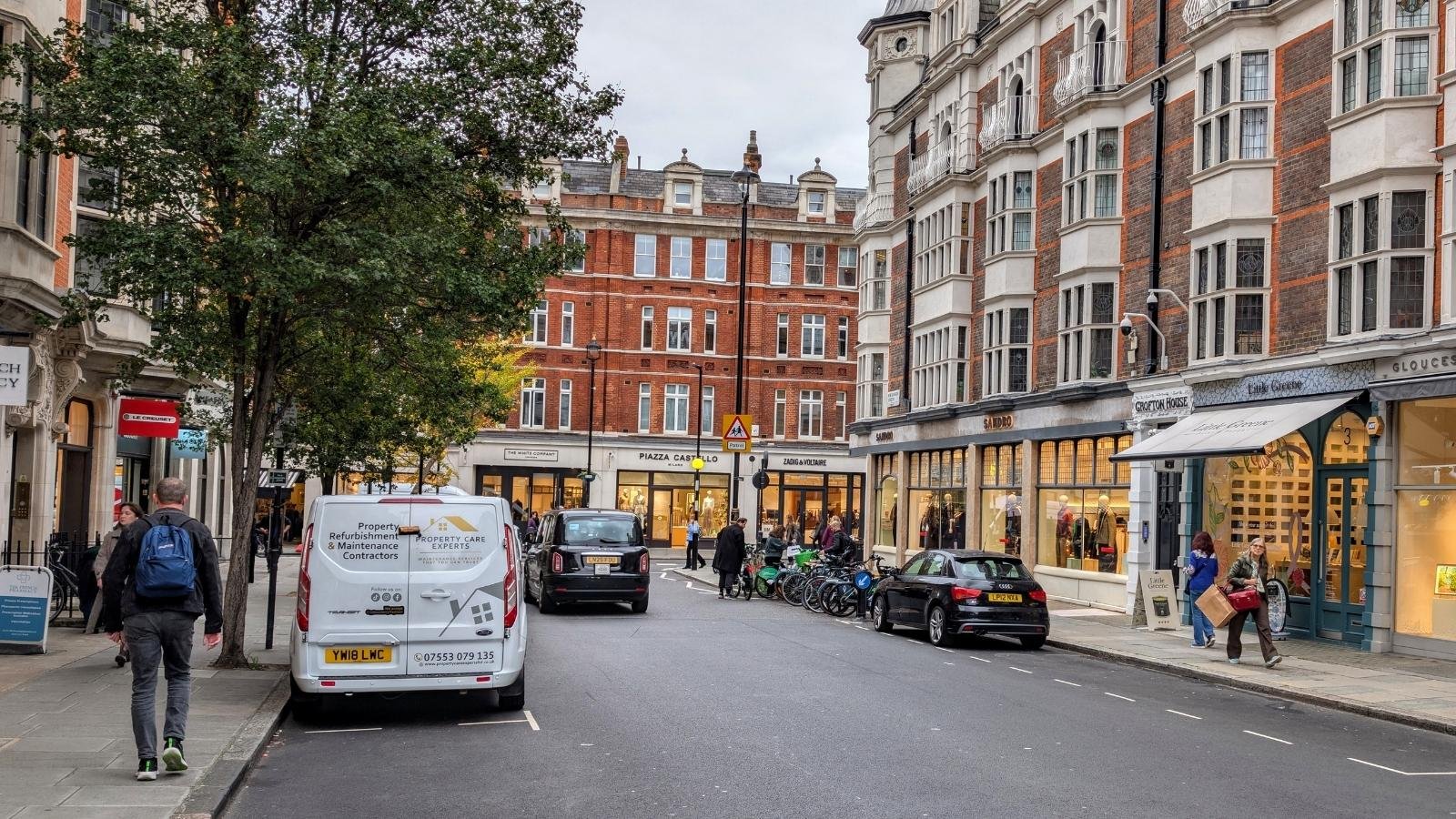
Marylebone charms people long before they learn how to pronounce it properly. The name looks like it belongs to a Victorian duchess, yet its roots go straight into medieval mud, a small lost stream, and a parish church that started the whole story. The neighbourhood sits calmly between Regent’s Park and Oxford Street, pretending it has nothing to do with either chaos or crowds. It has been doing this for centuries, and it does it remarkably well.
The curious tale begins with a modest church. Londoners who enjoy a bit of etymology already know this, but Marylebone owes its name not to a French noblewoman or a poetic accident, but to St Mary and an unassuming watercourse called the Tyburn. The old English word for a stream, bourne, got attached to St Mary’s church, which stood next to it. In time the phrase St Mary by the Bourne slurred and softened its consonants until it became Maryburne, then Marybone, then the somewhat theatrical Mary-le-bone. Londoners eventually settled on Marylebone because consistency is overrated.
The Tyburn stream itself behaved like every London stream: it started innocently, crossed fields, caused the occasional nuisance, and disappeared underground once the city grew tired of dealing with it. Its path survives as Marylebone Lane’s gentle curve, which feels deliciously out of place among the obedient Georgian grid around it. That bend is the last physical memory of the village that once clung to that stream. People walk it daily without realising they are following medieval hydrology.
In the days when the area was still the countryside, the land belonged to two manors. The medieval scribes recorded the Manor of Tyburn and the Manor of Lileston in the Domesday Book, noting little more than their modest value, a few households and patches of arable land. No one could have predicted that this quiet patch would become one of London’s most desirable districts, though if any medieval monk had said so, he would have been ignored as usual.
The manors changed owners many times. They endured royal quarrels, religious upheavals, and the general chaos of English medieval life. The Tyburn manor passed through church hands, then into aristocratic collections. The Lileston manor eventually became the foundation of the Portman Estate. These estates turned out to be the engines that shaped Marylebone’s transformation. It took them a while, though. Estate owners often had more patience than entrepreneurial vision.
Everything changed in the early eighteenth century. The West End started pushing north, and landowners finally noticed they were sitting on prime real estate. The Harley family took the lead with the Tyburn manor lands. They hired surveyors and dreamers who looked at the fields north of Oxford Street and saw neat streets, elegant squares, townhouses for prosperous Londoners, and rents that would pay for several lifetimes of aristocratic comfort. Cavendish Square rose first. Then came the broad sweep of Portland Place, an avenue so wide and rational that it still looks like an architectural deep breath amid the city’s tight corners.
The Portman Estate joined in by shaping the western side of Marylebone. Their developments carved out generous residential streets, creating the backbone of what people now call Marylebone Village. The geometric layout of the neighbourhood was no accident. It was a grand, organised effort to bring a respectable rhythm to the growing city. The result is still visible today: a patchwork of graceful Georgian and Regency façades that give the district its unmistakable composure.
The eighteenth century didn’t only bring townhouses. It brought entertainment. Long before Instagram cafes and organic delis arrived, Marylebone had pleasure gardens. These were lively, slightly chaotic parks where Londoners enjoyed music, fireworks, acrobatics and, occasionally, activities that made the authorities nervous. The Marylebone Gardens hosted everything from concerts to boxing matches. Gentlemen in wigs and ladies in towering hairstyles strolled along paths while musicians played, duellists settled arguments, and vendors sold drinks of dubious quality.
The area’s genteel reputation today hides just how rowdy it once was. After all, the name Tyburn rings bells for a reason. The famous Tyburn gallows stood not far from Marylebone, at the junction now known as Marble Arch. Crowds gathered there for centuries to watch executions, which functioned as both legal process and public entertainment. While the gallows belonged more to the larger Tyburn story than to Marylebone specifically, the shadow of that history stretched close. It’s a reminder that even the most refined London districts grew from soil enriched by rather dark fertilizers.
By the nineteenth century, Marylebone settled into its current personality. London grew around it, but it held on to its pockets of quiet charm. The aristocratic estates maintained tight control over architectural standards, which helped preserve the handsome terraces and townhouses. The neighbourhood became home to professionals, artists, writers and the comfortably well-off. It avoided the industrial sprawl that transformed other parts of the city. Instead, hospitals, schools, museums and specialist institutions began filling the area. The Royal Academy of Music moved in. So did various medical colleges. Wimpole Street blossomed into a hub of doctors and specialists.
One of Marylebone’s most iconic contributions to British culture stood barely two fields away from the old parish church. The Marylebone Cricket Club, founded in 1787, began life in this district before relocating a short distance to its now legendary home at Lord’s. Anyone who ever critiqued cricket as a mysteriously slow game can gently blame Marylebone for giving it a modern organising body.
Even as the city around it became noisier and denser, Marylebone nurtured its slightly village-like ambience. The high street evolved into a graceful ribbon of bakeries, boutiques, bookshops and restaurants. The weekly farmers’ market arrived later, reinforcing the idea that Marylebone prefers civilisation with a smile, not intensity with a scowl. People come for the atmosphere because it feels curated, almost handwoven. It’s central London without central London’s usual ambition to exhaust you.
The neighbourhood wears its history lightly. Portions of the old manorial estates remain under the stewardship of families and trusts whose lineage stretches back centuries. The parish church still stands proudly on Marylebone Road, though the original medieval structure has moved, collapsed, rebuilt and reimagined itself several times. The curve of Marylebone Lane still traces the Tyburn’s lost course. The street names still carry aristocratic echoes: Harley, Wimpole, Wigmore, Bentinck.
Marylebone demonstrates how London reinvents itself without forgetting its earlier selves. Walk its streets and you encounter layers: medieval village under Georgian elegance under Victorian ambition under modern refinement. Each era left its mark, but none erased the previous one completely. The result is a district that feels coherent yet strangely timeless.
People who move here do so for reasons that go beyond convenience. They fall in love with the architectural calm, the bookshops, the proximity to Regent’s Park, the cafes where coffee comes with perfectly judged irony. They like the fact that, in the middle of one of the busiest cities in the world, they can hear themselves think. The area offers the rhythm of a slower, more measured London that somehow kept its dignity intact.
The name itself acts like a whispered reminder of everything buried beneath the pavement. Say Marylebone and you are repeating a medieval phrase that bundled a church with a stream. The modern neighbourhood might feel polished, but its identity comes from a watercourse that no longer sees daylight. There’s something poetic about a place whose elegance rests unnoticed on the path of a vanished river.
Londoners often argue about the correct pronunciation. Some resolve it with confidence. Others say it with the exaggerated caution usually reserved for French wines or unfamiliar opera titles. In truth, the name has been pronounced every possible way throughout history. Pepys used Marybone. Locals once said Marrowbone. Tourists attempt Mary-lee-bone and Mary-la-bon. The modern version works perfectly well, but the history proves there’s no single correct answer. The area has never bothered to correct anyone.
Today the neighbourhood balances heritage and modern city life with enviable skill. New shops pop up, but the estates curate tenants with surprising care. Restaurants change, but never too many at once. Residents stroll more than they rush. Even the buses seem to slow down with respect. Marylebone looks like London but feels like a pocket universe stitched inside it.
Its history explains everything: the layered development, the estates’ consistent stewardship, the winding lane, the elegant squares, the refined high street, the name that carries echoes of a vanished stream. All these ingredients make Marylebone one of those rare London districts that wears age with style and treats change as a polite negotiation, not a takeover.
People often describe Marylebone as a village, and they’re not wrong. It functions like one, even though it sits in the dead centre of a global metropolis. That contradiction is precisely what gives it such character. It is both completely London and slightly apart from London. A neighbourhood shaped by a church, a stream, a handful of estates and several centuries of gentle evolution.
This is why the place still feels distinct. Marylebone never reinvented itself loudly. It only refined what it already had. It grew carefully around its core, keeping a continuity that many parts of London lost along the way. The name might have begun as a medieval convenience for a patch of land by the water, but it became the banner of a district that learned how to stay graceful while everything around it shifted.
The next time you wander down Marylebone High Street or drift through the curve of Marylebone Lane, remember the invisible river under your feet and the parish that named the whole area. The neighbourhood stands today because those early foundations set the tone. Marylebone carries its past not as a burden but as a quiet strength. That may be why the area still feels like a place where history didn’t happen long ago. It feels like a place where history simply continued living.