Marie Tussaud and the Strange Art of Turning History into Wax
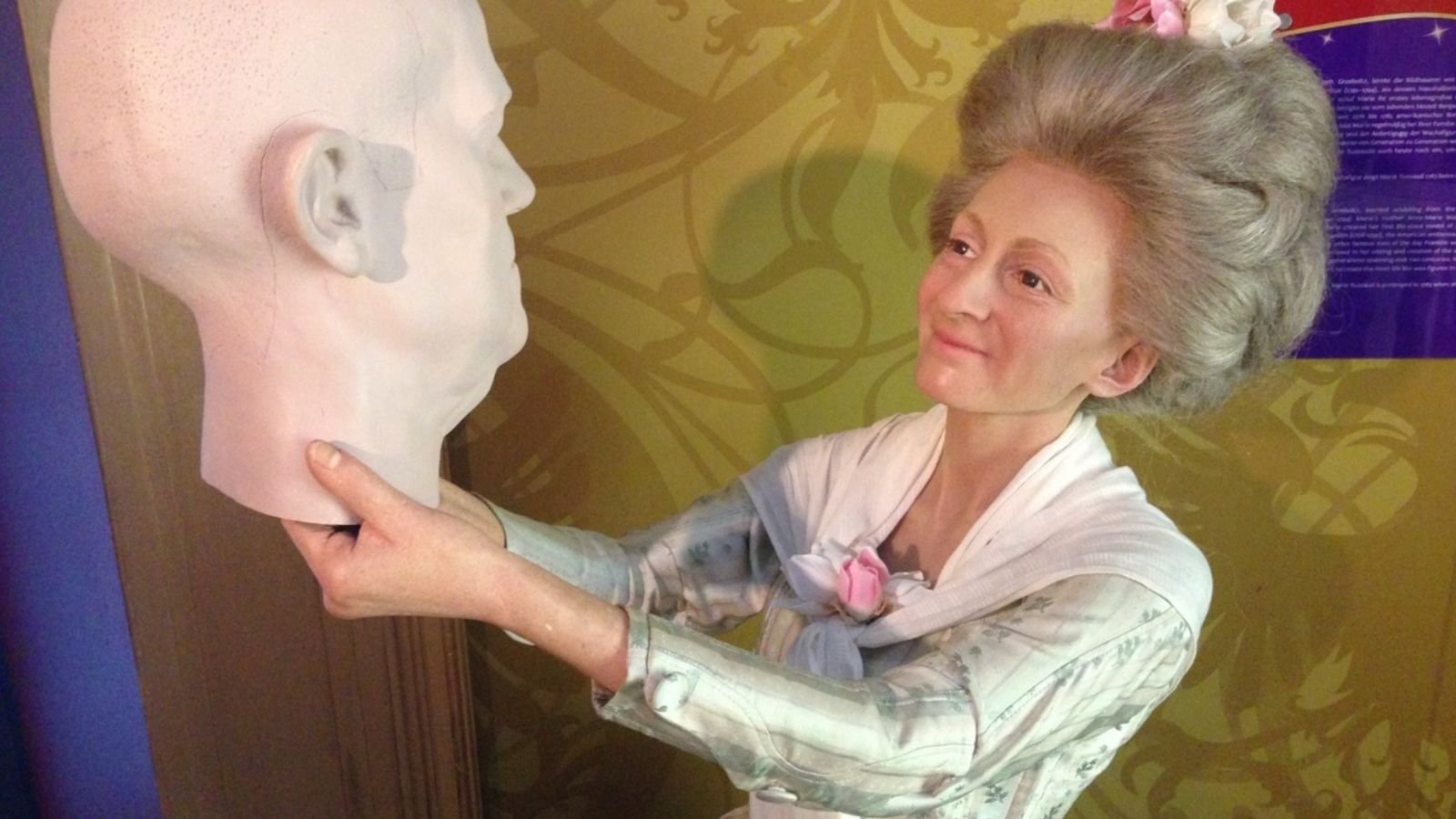
Marie Tussaud’s story begins with a misunderstanding. People assume she spent her life sculpting celebrities and basking in glamour, yet the truth looks more like a survival tale stitched together with wax, wandering roads, and a spectacular amount of Revolution‑era chaos. She became famous for giving us lifelike figures of royalty and pop icons, but she earned her craft by moulding the faces of the newly dead while mobs screamed in the streets of Paris. Anyone imagining she lived a gentle artistic life will have to recalibrate quickly.
Her journey starts in Strasbourg, where she arrived in the world as Anna Maria Grosholtz, already missing a father lost to the Seven Years’ War. She grew up not in France but in Bern, in the home of Dr Philippe Curtius, a physician with an unusual hobby that soon became a profession. Curtius worked in wax, sculpting fashionable gentlemen, philosophers, and occasionally, depending on the mood of Paris, people who had annoyed the wrong crowd. Young Marie watched him melt, shape, carve and tint the material until faces stared back with unnerving clarity. Curtius didn’t treat wax as a toy; he treated it as a language. Marie learned it fluently.
Paris pulled Curtius into its orbit, and the Grosholtz household followed. Marie moved from the calm of Switzerland to the beating, unpredictable centre of pre‑Revolutionary Paris. She created her first known figure, an image of Voltaire, around the age when most teenagers worry about spots. Her wax portraits of Rousseau and Benjamin Franklin earned her an early reputation, the sort that placed her in circles where both candles and political tempers burned too brightly for comfort.
The Revolution arrived like a thunderstorm someone had been predicting for decades, and Marie found herself in the middle of it. Crowds seized her wax figures of Jacques Necker and the duc d’Orléans, carrying them through the streets as political symbols, which must have been a bewildering experience: imagine crafting something delicate, only to watch it become a rallying prop for thousands of furious strangers. Her talent attracted admirers at court as well, and her memoirs later claimed she served as tutor to the king’s sister, Princess Élisabeth. This association soon became dangerously inconvenient.
The Reign of Terror swept people away with grim enthusiasm. Marie was arrested, her head shaved in preparation for execution, and only narrowly escaped the guillotine. The authorities decided her skills were more useful than her absence, so she received grisly assignments. She sculpted the death masks of the famous and the infamous, from violent revolutionaries to doomed aristocrats. No one truly knows which masks she made with her own hands, because the Revolution blurred truth and myth with equal passion. Yet the image of her walking out of the morgue with a fresh cast as Paris rioted outside carries the kind of narrative weight she never tried to dispel.
Curtius died in 1794 and left her his entire collection. It offered both inheritance and burden, because Paris no longer promised peace or profit. Europe’s political storms pushed her towards a decision: she packed the wax figures, took her young son, and sailed for Britain in 1802. She expected a temporary stay. Wars and politics made sure she never returned.
London greeted her with the peculiar mix of curiosity and reserve for which it remains famous. She exhibited her work at the Lyceum Theatre, sharing space with lantern shows and other amusements. When things grew unstable again on the Continent, she packed her collection into crates and began touring. Hundreds of towns later, she became a familiar presence across Britain and Ireland, dragging wagons full of heads, limbs, torsos, tools and candles over miles of unreliable roads. People flocked to see the likenesses of figures they’d only read about. The nation travelled less than she did, but through her exhibitions they felt oddly cosmopolitan.
Touring built both her finances and her stamina. She survived thefts, poor weather, miserable inns, and the general chaos of operating a mobile wax enterprise in the early nineteenth century. Anyone building a brand today might flinch at the thought of marketing without the internet; she did it while literally carrying her product on wooden wheels. By the time she settled permanently in London, she’d earned every visitor who queued to see her work.
In 1835 she opened a permanent exhibition on Baker Street. Visitors paid to wander through rooms filled with wax figures staring back with unsettling familiarity. The experience fused artistry, theatre and something a little darker. She displayed monarchs and philosophers, but the crowd favourite became the section she christened the “Chamber of Horrors”. It showcased murderers, political villains and executed Revolution figures. Some accused her of sensationalism. She did not deny it. Sensation kept the doors open.
Marie understood timing better than most artists. She offered the public what fascinated them, whether that fascination leaned towards admiration, curiosity or morbid thrill. Her figures captured the atmosphere of an age obsessed with spectacle, celebrity and scandal. People queued to see the likenesses of those who shaped their world, or who tried to tear it apart. She transformed wax into a mirror reflecting the anxieties and amusements of the nineteenth century. It wasn’t just art; it was entertainment — one that played on familiarity and shock in perfect balance.
Her museum quickly became a London fixture. Visitors loved the way the figures blurred the line between illusion and reality. Even the critics who sniffed at the theatrics admitted the craftsmanship was impressive. Marie herself remained a presence in the business well into old age, carving, repairing, and negotiating the practical demands of a growing institution. She died in 1850, leaving behind not only her sons but also a brand already heading towards legend.
Her name survived because the museum survived. Over the following decades it moved, expanded, modernised and multiplied. Electrical lighting arrived. New techniques for moulding and colouring faces appeared. Eventually the museum spread across continents, transforming into a global franchise that kept her surname on every marquee. What began as a single woman’s craft in the volatile streets of Paris turned into an international industry.
Her legacy now lives in cities from London to Sydney, from New York to Dubai. The figures changed from Enlightenment philosophers and guillotined nobles to Hollywood stars and athletes, yet the strange appeal remains intact. People still lean close to check whether the eyelashes are real. They still pose beside their favourite personalities, suspending disbelief for the duration of a photograph. The entire enterprise makes visitors complicit in a theatrical illusion, and Marie would likely enjoy that.
Her life illustrates how fragile the line is between artistry and commerce, as well as how necessity pushes talent into unexpected directions. She didn’t plan to sculpt history’s victims or tour muddy roads for decades. She didn’t imagine running a museum visited by millions. Circumstance shaped her as much as wax shaped her figures. The Revolution forced her to adapt or vanish. Britain offered security but demanded stamina. She navigated all of it with a mixture of skill, intuition and sheer insistence on survival.
Modern audiences stroll through the museum thinking they’ve entered a spectacle of celebrity. They rarely imagine the woman behind it, shaving curls into doll heads by candlelight or hauling crates from one hostile inn to another. Yet the entire enterprise rests on her resilience. She built something that outlived her, not by accident but by years of relentless labour.
There’s something beautifully ironic about her story. She preserved the likenesses of the powerful, the celebrated and occasionally the wicked, while she herself remained somewhat shadowy to the public. Her museum turned fleeting fame into something almost permanent. Actors fade, monarchs fall out of fashion, politicians become footnotes, yet their wax doubles keep receiving visitors. Marie understood that physical likeness could outlast reputation.
People love her museum for reasons that haven’t changed much since her lifetime. It satisfies curiosity without demanding too much contemplation. It offers proximity to icons without requiring introductions. It blurs the line between admiration and spectacle, which suits a world that often confuses the two. And it invites everyone to become part of the show by posing beside someone who will never blink.
Marie Tussaud earned her place in cultural history because she recognised early what fascinated people and gave it to them in a form they could not resist. She captured the faces of an age filled with turmoil, genius, vanity and fear. She transformed wax into narrative. She turned a craft into a career, a career into a brand, and a brand into an institution.
Her story remains worth telling because it reveals how brilliance sometimes hides in practical craft, how survival can shape courage, and how the most unexpected lives leave the strongest fingerprints. A woman who moulded the dead gave future generations a way to confront the living. That is quite a legacy for someone who began life in the kitchen of a wax modeller and ended it as the most famous name in the world of imitation life.
Photo: Av Luke Rauscher