Louis Pasteur and the Death of “Bad Air” Biology
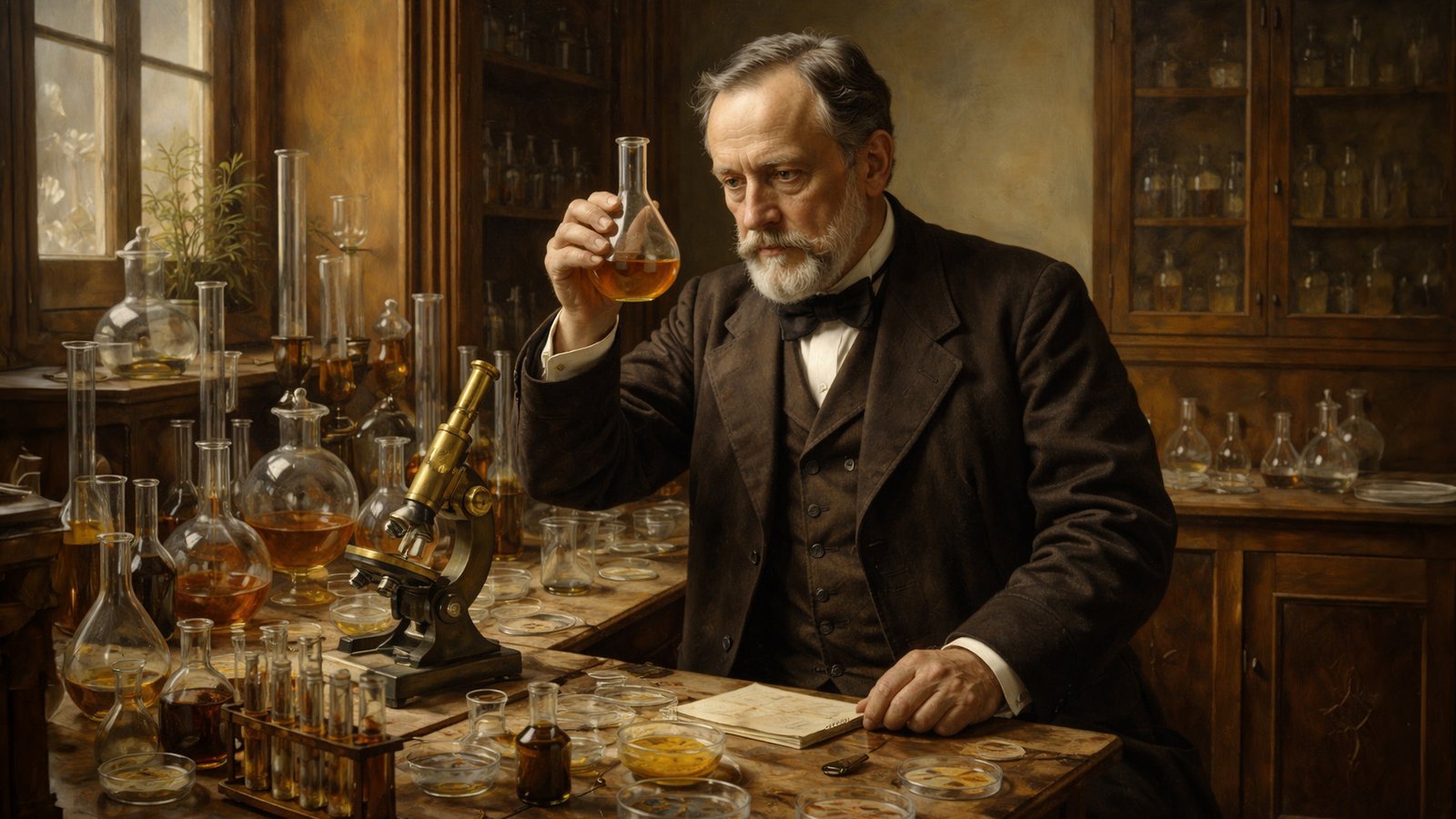
Louis Pasteur did not begin his battle with spontaneous generation in a dramatic laboratory duel. Instead, the story started with a quiet but persistent question that had troubled scientists for centuries. Could life appear from nothing? For generations people believed it could. Rotting meat seemed to produce maggots. Muddy puddles filled with frogs. Decaying broth turned cloudy with invisible creatures. The world appeared to create life the way bread dough creates bubbles. Something mysterious, perhaps the air itself, seemed to animate matter.
Ancient philosophers had already tried to explain the phenomenon. Aristotle proposed that living things could arise spontaneously from non‑living material under the right conditions. His idea travelled comfortably through the centuries because it matched everyday observation. Leave grain in a barn long enough and mice appeared. Leave meat outside and flies arrived, followed by maggots. To observers without microscopes the explanation felt obvious. Nature simply generated life when materials started to rot.
However, early experimenters slowly began to question the assumption. In the seventeenth century the Italian physician Francesco Redi carried out a simple but revealing test. He placed meat into several jars. Some jars remained open while others were sealed. Maggots appeared only in the open jars where flies could reach the meat. The sealed containers stayed clean. Redi concluded that flies laid eggs on the meat and those eggs became maggots. Life came from life rather than from decay itself.
Nevertheless, the argument refused to disappear. Critics insisted that Redi had merely blocked some mysterious life‑giving property of air. Perhaps air contained a vital force that could create organisms if it touched rotting material. If the jar prevented air from entering, then the experiment proved nothing. Consequently the debate continued, and for two centuries scientists argued about invisible processes they could barely observe.
Meanwhile, the microscope began to reveal an entirely new world. By the eighteenth century observers such as Antonie van Leeuwenhoek had reported tiny moving creatures swimming through droplets of water. These organisms appeared everywhere. They inhabited ponds, rainwater, teeth, and fermented liquids. People soon wondered whether these tiny beings emerged spontaneously from the liquids that contained them.
During the early nineteenth century several scientists tried to test the idea using heated broths. Heating killed existing microorganisms. If new life later appeared in the broth, some researchers argued, then spontaneous generation must have occurred. Unfortunately the experiments produced confusing results. Sometimes microbes returned after heating. Sometimes they did not. Laboratories lacked sterile techniques, and contamination often slipped in unnoticed.
Into this messy intellectual landscape stepped Louis Pasteur, a chemist with a stubborn curiosity about fermentation. French winemakers had complained that their wine sometimes spoiled unpredictably. Beer makers faced similar problems. Fermented liquids occasionally turned sour, cloudy, or foul‑smelling. Pasteur suspected that tiny living organisms caused these changes. If microbes controlled fermentation, then the origin of those microbes mattered enormously.
Pasteur examined fermentation under the microscope and noticed different shapes of microorganisms appearing in different spoiled liquids. Some produced alcohol. Others produced lactic acid. Still others caused putrefaction. Each transformation seemed linked to a specific microbe. The pattern fascinated him because it suggested that microbes behaved like specialised workers rather than random chemical accidents.
However, the defenders of spontaneous generation remained confident. Many scientists still believed microorganisms formed directly from decaying material. If that idea proved correct, then microbes did not require parents. They simply emerged whenever organic matter decomposed.
Pasteur suspected otherwise. Nevertheless, he needed an experiment that could silence the argument about air carrying a mysterious life force. If air truly created life, then exposing sterile broth to air should generate microbes. Yet if microbes travelled through the air as particles, then blocking those particles would keep the broth clear.
His solution looked deceptively simple. Pasteur designed glass flasks with long curved necks shaped like swan necks. The elegant curve allowed air to enter the flask freely. At the same time dust particles carried by the air settled in the bend of the neck instead of falling into the liquid below.
Pasteur then filled the flasks with nutrient broth and boiled them to destroy existing microorganisms. After boiling he left the flasks open to the surrounding air. According to spontaneous generation theory, the broth should soon teem with life because air could reach it. Days passed. Nothing happened. The broth remained perfectly clear.
Meanwhile dust gradually accumulated in the curved necks of the flasks. Pasteur demonstrated the importance of that dust with a small theatrical gesture. He tilted the flask so the broth touched the dusty bend. Soon afterward the once‑clear liquid turned cloudy with microbial growth. Life appeared only after the dust entered the broth.
The result stunned many observers because the experiment preserved air while removing contamination. Air could circulate freely, yet microorganisms did not appear unless dust reached the liquid. Pasteur argued that microbes travelled through the air attached to microscopic particles rather than emerging spontaneously from the broth.
To strengthen the case he performed variations of the experiment in different environments. Flasks opened in dusty city streets quickly developed microbial growth. Flasks opened on mountain slopes remained sterile for far longer. Cleaner air carried fewer microorganisms. The pattern repeated again and again.
Pasteur also broke the necks of some flasks entirely. Once the protective curve disappeared, airborne particles fell directly into the broth. Cloudiness followed soon after. Meanwhile intact swan‑neck flasks stayed clear for months.
These demonstrations slowly dismantled the centuries‑old belief in spontaneous generation. Life did not arise from decaying matter alone. Instead microscopic organisms reproduced and travelled through the environment like seeds drifting in the wind.
However, the scientific drama involved more than glassware. The debate had become fiercely personal among nineteenth‑century scholars. One prominent defender of spontaneous generation, the French naturalist Félix‑Archimède Pouchet, insisted that microbes could still arise naturally under certain conditions. He conducted his own experiments and reported positive results.
The French Academy of Sciences decided to settle the matter with a formal prize competition. Researchers submitted experimental evidence addressing spontaneous generation. Pasteur entered the contest with his swan‑neck flask experiments and detailed observations.
His presentation impressed the judges with its clarity and repeatability. Pouchet’s results appeared inconsistent by comparison. Eventually the academy awarded the prize to Pasteur in 1862, marking a symbolic victory for the germ theory perspective.
The consequences extended far beyond a philosophical argument. Once scientists accepted that microbes came from other microbes, a cascade of practical discoveries followed. If microorganisms caused fermentation, then brewers could control the process by managing contamination. If microbes caused spoilage, then heating liquids could kill them.
Pasteur soon demonstrated this principle with milk and wine. Gentle heating destroyed harmful microorganisms while preserving flavour. The process later became known as pasteurisation. Although the technique now appears routine, it transformed food safety and industrial fermentation.
Moreover, the rejection of spontaneous generation laid the foundation for modern microbiology. Scientists began searching for specific microbes responsible for specific diseases. This approach eventually led to the work of Robert Koch, Joseph Lister, and many others who established connections between bacteria and illness.
Hospitals gradually adopted sterilisation practices. Surgeons cleaned instruments. Laboratories developed sterile culture methods. Vaccines emerged from controlled studies of microbial behaviour. The chain of progress traced back to a simple but decisive insight: microorganisms have ancestors.
Nevertheless, the story still contains a touch of irony. Pasteur never completely eliminated every philosophical form of spontaneous generation. The deeper question of how life originally appeared on Earth remains unsolved even today. Modern scientists investigate chemical pathways that might have produced the first self‑replicating molecules billions of years ago.
However, that cosmic puzzle differs profoundly from the nineteenth‑century debate. Pasteur demonstrated that everyday microbes do not spring into existence from rotting soup. Instead they belong to biological lineages that reproduce and spread through the environment.
In retrospect the swan‑neck flask looks almost poetic. Air flows freely through the graceful curve while invisible dust settles quietly out of sight. Inside the flask a clear broth waits patiently. Life appears only when another life form arrives. The experiment transformed a philosophical argument into an observable process.
Today laboratories use sterile hoods, autoclaves, and sealed culture plates. Yet the principle remains the same as Pasteur’s simple glassware demonstration. Microorganisms travel, multiply, and colonise new environments. They do not materialise from nothing.
For centuries people believed that rot itself generated life. After Pasteur, rot became something different. It became evidence of microbial activity already in progress. Decay did not create life. Instead life caused decay.
That subtle reversal reshaped biology. It also reshaped medicine, agriculture, brewing, and public health. A curved piece of glass helped close one of science’s oldest arguments. Meanwhile the invisible world of microbes finally stepped onto the stage as a community of living organisms with parents, descendants, and surprisingly busy lives.
Seen from a modern perspective the debate feels almost quaint. Yet the struggle reminds us how easily observation can mislead when hidden processes remain invisible. Rotting meat really does produce maggots. Cloudy broth really does fill with microbes. Without careful controls the world appears to generate life spontaneously.
Pasteur’s genius lay not in complicated machinery but in experimental clarity. By letting air enter while trapping dust he separated two possibilities that had remained tangled for centuries. The broth stayed clear until something living arrived.
In science such moments rarely look dramatic. A flask sits quietly on a laboratory bench. Days pass. Nothing grows. Yet sometimes that quiet emptiness carries the weight of a revolution.
Post Comment
You must be logged in to post a comment.