London’s Crystal Dream: The Great Exhibition of 1851
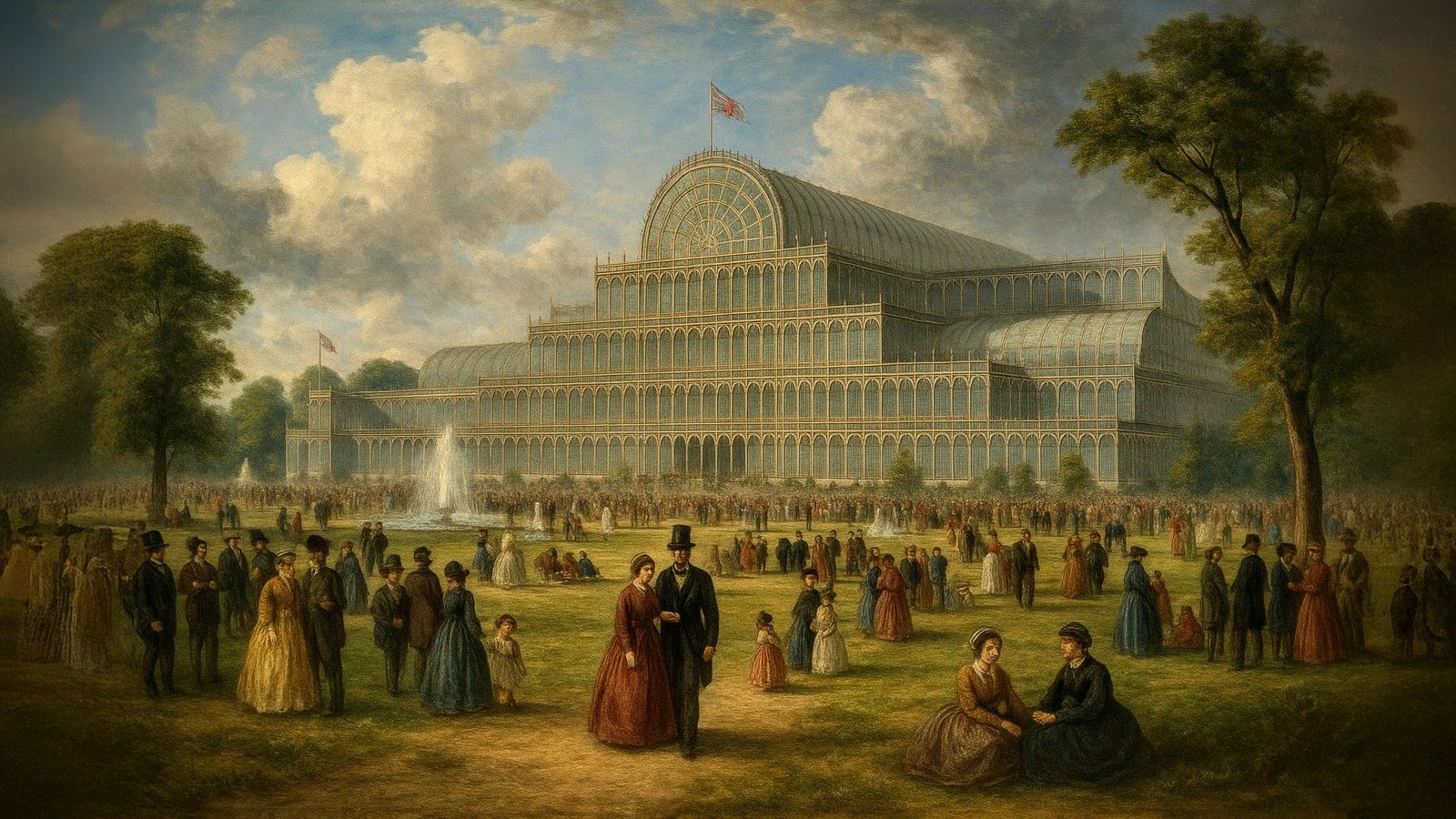
The Great Exhibition of 1851 burst into London like a Victorian fever dream made of iron, glass and unshakeable optimism. Everyone expected a polite trade fair full of respectable drapery and well‑behaved gentlemen. Instead, the city woke up inside what looked like a greenhouse the size of a cathedral, buzzing with machines that growled, inventions that belonged in nightmares, and visitors rushing around convinced they were witnessing the future. Londoners queued outside Hyde Park from dawn, adjusting their top hats and shawls, wondering whether any of this was truly safe. After all, nobody had tried hosting the entire world under one roof before.
The moment people stepped inside the Crystal Palace, the sunlight pouring through the glass roof hit them like a revelation. Nobody had imagined a space so vast, so glittering, so strangely cheerful. The atmosphere felt different from other Victorian gatherings, less rigid, more open. Aristocrats wandered beside railway clerks, factory hands strolled next to bankers, and children dragged their parents toward whatever shiny thing caught their eye. Language barriers dissolved into the universal sound of amazement. Even the stern doormen softened their expressions as they watched crowds gasping at the glass fountain in the central nave, its 24-foot height spraying prismatic droplets into the air as if it were performing.
Machine displays became the loudest corner of the palace. Engineers loved creating dramatic moments, so visitors watched enormous steam hammers striking iron with the showmanship of circus performers. The American section took this performance spirit even further. Their machines roared as though they wished to drown out the rest of the world. The McCormick reaper sat gleaming like a promise of unstoppable agricultural change. Colt revolvers rested in neat rows, whispering a different sort of promise altogether. British newspapers grumbled that the Americans were showing off, which of course they were, and everyone enjoyed it.
In stark contrast to the muscular machines, the Indian Court shimmered with elegance. It felt like stepping into a jewellery box. Visitors crowded around displays of carved ivory, mirrored textiles and a magnificent elephant-shaped teapot that instantly became a darling of the London chatter circuit. The diamond that stole the most breath belonged to a different case: the fabled Koh‑i‑Noor. People queued for hours expecting blinding brilliance. They arrived at the display and frowned. The glass case swallowed the light, leaving the stone looking suspiciously like a lump of polished quartz. Disappointment rippled through the crowd. Still, nobody missed the chance to claim they had seen it.
Food stalls and refreshment halls tucked themselves into the corners of this giant wonderland. The French delegation turned bread into a patriotic instrument by offering a colossal loaf stretching nearly twenty feet. British bakers attempted to respond with similarly flamboyant displays, though none quite equalled the French spectacle. Children wandered around holding pastries while telling complete strangers about the giant canoe from Canada that three men could lift with one hand. The canoe fascinated naval officers who attempted to study its construction while pretending not to be enchanted.
Artists and designers filled another enormous section. Furniture makers brought their wildest ideas, hoping notoriety might translate into sales. John Webb’s Trophy Chair climbed to new heights of creative excess. Lions, eagles, shields, spears, vines and other decorative chaos erupted from it as if the chair were experiencing a heroic identity crisis. Punch magazine sketched cartoons of it for weeks, while visitors debated whether it represented triumph or madness. People lined up simply to point at it and laugh.
Some of the oddest objects belonged to the category loosely known as scientific curiosities. Nothing drew more gleeful attention than George Merryweather’s Tempest Prognosticator. Imagine a polished metal frame arranged like a strange bridal crown, supporting a circle of glass bottles, each containing a single leech. Merryweather believed that leeches sensed storms before humans did. Whenever they wriggled upward, they would ring tiny bells, announcing incoming bad weather. Crowds adored it, even if the scientific community quietly backed away from further comment. The Prognosticator embodied the Victorian spirit beautifully: equal parts imagination, engineering and unshakeable confidence.
Taxidermy added another layer of delightful oddity. Victorian taxidermists had a flair for artistic drama, so visitors discovered squirrels positioned as dinner guests, birds reading miniature books and frogs clutching violins. Children found them hilarious. Adults pretended they admired the skill while secretly wishing they owned a few. These small, strange tableaus made the Exhibition feel like a museum curated by a mischievous storyteller.
The Crystal Palace itself became an unofficial exhibit. Visitors strolled slowly and stared upward at the arched roof as if they feared missing a moment of sunlight. Many came from smoky industrial towns, unused to interiors bathed in natural light. They marvelled at how the iron beams curved into graceful ribs, holding the glass panels securely while allowing the sky to remain visible. People spoke quietly under the main transept, almost reverently, as though the building had transformed into a secular cathedral dedicated to progress.
Queen Victoria loved returning to this glowing monument. She visited more than thirty times, recording her impressions in surprisingly warm diary entries. And she marvelled at the crowds from all backgrounds. She also worried a little. Britain had never seen such an open mix of classes and nationalities in one place. Yet the visitors behaved magnificently, proving that people could gather peacefully to admire human achievement rather than crowd into political rallies. Shilling days opened the gates to working families, and the railways carried them in from distant towns with fares tailored for the occasion. The Exhibition became the most democratic public event the country had ever hosted.
Not everyone embraced the enthusiasm. Richard Wagner arrived, took a slow walk through the aisles and rejected the entire experience. He complained that the focus on machines suggested society worshipped industrial noise rather than beauty. His opinion generated little sympathy. Most visitors adored the sight of gears grinding and valves hissing. They felt they were watching the future stretch before them, messy and loud but unstoppable.
Scientists took a different approach, wandering the palace like careful observers of nature. Charles Darwin inspected manufacturing displays with intense interest. He noticed how small variations in machine components influenced efficiency and reliability. These observations echoed patterns he had begun identifying in nature. The Great Exhibition of 1851 offered him a unique way to view human innovation through the lens of variation and selection. This industrial mirror fascinated him.
Medical and safety demonstrations sprinkled humour through the event. Firefighters showed off a manually powered engine that shot water in theatrical arcs across a courtyard. The cheering crowds ignored the fact that the poor men operating it would collapse after a few minutes if ever asked to use it seriously. A life-size mechanical miner hacked endlessly at a rock, powered by steam. Children adored it so much that parents struggled to drag them away. Adults whispered anxiously about machines replacing people. The future felt exciting and slightly alarming.
Public conveniences made their own historic entrance. George Jennings installed flushing toilets inside the Exhibition, charging a penny for each visit. The novelty appealed to visitors who delighted in the unusual comfort. The phrase “to spend a penny” lodged itself firmly in British vocabulary. People queued for this remarkable luxury almost as eagerly as they queued to see the Koh‑i‑Noor, which says much about Victorian priorities.
Foreign delegations treated the Exhibition as a stage on which to showcase identity and prestige. The Russian section displayed heavy metalwork and intricate crafts. The Egyptian Court presented statues and exotic artefacts. Japan sent lacquerware that shimmered under the sun-filled hall, delighting crowds who had never seen such elegance. Each country turned its allocated space into a miniature world, complete with narratives designed to impress and persuade.
Crowd behaviour became a story of its own. People entered shy, almost overwhelmed. Within minutes they became bolder, wandering freely, chatting with strangers, leaning over rails to watch machines thump away. Every day offered a new rumour: a lost child reunited with her parents after following the sound of a steam organ; a man claiming he had walked twelve miles inside the building without seeing everything; a group of schoolboys convinced that a stuffed beaver winked at them.
Artists sketched furiously. They filled notebooks with mechanical shapes, decorative motifs, unusual faces and architectural arcs. The Exhibition generated enough artistic material to fuel decades of Victorian design. Many ideas that later appeared in wallpapers, ceramics and furniture began life inside the Crystal Palace. It functioned not only as a showcase but as a workshop for imagination.
Despite the occasional overcrowded day, the Exhibition ran with remarkable smoothness. Hyde Park hosted it without major incident. Authorities worried about political trouble, but nothing materialised. London became a city filled with visitors who carried maps and stared upward with wonder. Newspapers announced record attendance figures, which delighted Prince Albert, whose vision had inspired the entire undertaking. Those profits later funded museums and institutions across South Kensington, shaping a cultural district that still thrives.
Stories multiplied long after the palace closed its doors. When the structure moved to Sydenham, it transformed into a permanent pleasure palace of exhibitions, concerts and gardens. People continued to associate it with the joy and awe of 1851. Schoolchildren learned about it as a moment when Britain declared itself ready for the world. Writers described it as a glass city of dreams.
Looking back, the Great Exhibition of 1851 feels like a Victorian snapshot of ambition, curiosity and charming eccentricity. It offered a glimpse of a world propelled by innovation, where nations competed through creativity and spectacle rather than through conflict. It showed that ordinary people could step forward as participants in global progress, even if only for the price of a shilling. Its spirit lives on in every museum wing born from its profits and in every grand exposition that followed.