Less Is a Lot: How Bauhaus Quietly Took Over Your Living Room
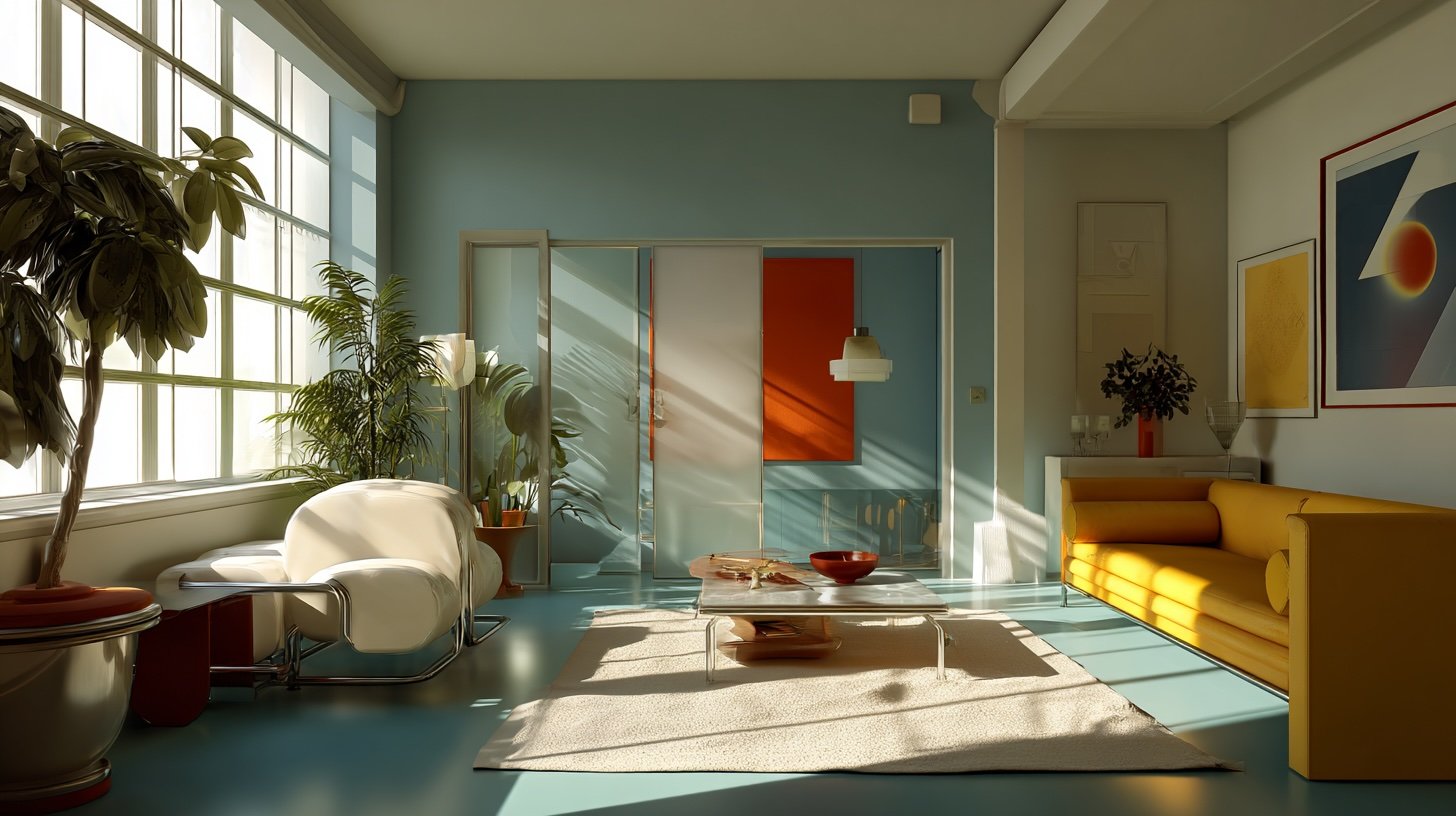
So there you are, lounging on your sofa, pretending to read a book but mostly scrolling through your phone, when it hits you. Why does your living room look like a design student’s final project that accidentally became stylish? Why are there so many rectangles, muted colours, and suspiciously practical chairs? The answer, whether you realise it or not, sits somewhere between 1919 and 1933, in a German art school that decided to change the way humans live with furniture. The Bauhaus may have closed its doors nearly a century ago, but it’s still very much alive in your living room, quietly rearranging your cushions.
The story begins in Weimar, where architect Walter Gropius had the audacity to ask: what if art, craft, and industry stopped pretending to hate each other? Germany had just survived a war, everything was in tatters, and people were desperate for a fresh start. Gropius’ idea was simple, almost irritatingly so: make design honest, functional, and beautiful in equal measure. In other words, stop gluing cherubs onto chairs and start thinking about how to sit comfortably.
The Bauhaus movement’s motto, form follows function, sounds like something you’d find printed on an influencer’s tote bag now, but back then it was revolutionary. Imagine a world where furniture didn’t shout for attention but quietly served its purpose. Gone were the carved lion legs and gold leaf patterns of previous centuries. In came tubular steel, clean lines, and shapes that looked like geometry homework.
Fast forward to your living room, and the ghosts of Bauhaus are everywhere. That minimalist lamp with its bare bulb? Bauhaus. The glass coffee table that seems to float? Bauhaus. The open shelving unit that makes you feel oddly virtuous about your stack of unread books? Definitely Bauhaus. Even your IKEA side table, mass-produced and no-nonsense, carries the DNA of the Bauhaus dream: good design for everyone, not just those with castles.
It’s strange, isn’t it, that a movement born from post-war austerity now defines luxury? Back in the day, the Bauhaus didn’t want to create “designer” furniture—it wanted to democratise design. Chairs by Marcel Breuer, lamps by Wilhelm Wagenfeld, and the clean-lined architecture of Gropius himself were all meant to be accessible, industrial, practical. The irony now is that a genuine Wassily chair costs more than a week in Ibiza, and you’re terrified to spill coffee near it. Still, the idea of furniture being both useful and beautiful stuck. We just found a way to make it expensive again.
Walk into any contemporary flat, and you’ll find the Bauhaus aesthetic playing hide and seek. The open-plan living space that merges kitchen, dining, and lounging zones? That’s the Bauhaus notion of adaptability. The use of neutral tones, interrupted by a bold splash of primary colour—a red chair here, a yellow cushion there—is straight out of the Bauhaus playbook. The emphasis on honest materials—wood, glass, steel—feels refreshing in an age of plastic everything. The movement’s obsession with light and openness fits neatly into our Instagram-filtered world. You could say Bauhaus invented the aesthetic minimalism that social media later monetised.
But beneath the style, there’s a philosophy that still resonates. Bauhaus asked us to strip away the unnecessary, not for the sake of purity, but to focus on the essentials. It was design therapy before design therapy existed. The idea that your living space should support your life, not complicate it, feels more relevant than ever. After all, our modern homes have to multitask harder than we do: they’re offices, gyms, cinemas, and occasionally, places to rest. The Bauhaus way of thinking—clear lines, open space, objects that earn their keep—feels like an antidote to the chaos of modern life.
Picture your ideal living room. There’s light streaming in from a big window (curtains optional), a sturdy armchair that invites reading but also scrolling, and perhaps a plant or two that hasn’t yet given up. The colour palette is calm—whites, greys, the odd pop of cobalt blue or mustard yellow. Nothing feels cluttered. Everything has a reason to exist. That’s not minimalism for minimalism’s sake. That’s Bauhaus whispering in your ear: keep it honest, keep it simple, keep it human.
The Bauhaus school didn’t just teach furniture design. It trained an entire generation to think differently about how we live. Architecture, textiles, typography, and even kitchenware got the same functional treatment. It wasn’t about uniformity; it was about harmony. Every object in your space should contribute to the whole, like instruments in a band. And just like that, your humble lamp isn’t just a light source—it’s a piece of design philosophy.
Of course, not everyone adored this new clarity. Critics accused Bauhaus of creating soulless spaces, too sterile, too mechanical. And yes, a room that’s all steel and glass can feel like an airport lounge if you’re not careful. That’s why even Bauhaus disciples learned to balance function with comfort. A wool rug, a wooden chair, a hint of imperfection—these soften the hard edges. Bauhaus never wanted homes to look like factories; it wanted factories to learn from homes.
Then came the great irony: when the Nazis closed the Bauhaus in 1933, its ideas travelled further than they ever could have in Germany. The designers scattered across the world, bringing their gospel of simplicity to new continents. They landed in the United States, in Tel Aviv, in London, where the International Style began to take shape. Skyscrapers, office blocks, suburban homes—all bore the Bauhaus mark. By the 1950s, the modernist dream was mainstream, and by the time IKEA arrived in 1943, it was practically a global religion.
Look closer, and you’ll find that Bauhaus thinking sneaked into more than just design. It shaped how we think about efficiency, productivity, and creativity. Open-plan offices? Bauhaus logic gone corporate. Co-working spaces with exposed pipes and minimalist desks? Bauhaus with beanbags. Even your smartphone, sleek and intuitive, owes a conceptual debt to Gropius’ insistence that beauty and utility must coexist.
So, why does Bauhaus still rule your living room? Because it’s adaptable. It plays nicely with other styles. Scandinavian hygge borrows its warmth from Bauhaus minimalism. Mid-century modern owes its entire existence to it. Even industrial chic—those loft conversions with visible brick and steel beams—is basically Bauhaus wearing hipster glasses. It’s the design equivalent of a good pair of jeans: timeless, flattering, and endlessly remixable.
But there’s also something psychological about its endurance. Bauhaus gives us permission to edit. In a world of excess, the idea of keeping only what matters feels soothing. There’s no need to impress anyone with an overdecorated mantelpiece or a chandelier that looks like a crystal octopus. Bauhaus says: breathe, simplify, appreciate the quiet dignity of a well-made chair. It’s the anti-clutter revolution that never went out of fashion.
If you’ve ever wondered why flat-pack furniture feels so right (until you lose the Allen key), it’s because the Bauhaus dream was always about accessible design. The pieces we assemble ourselves, the modular systems that fit into small spaces, the idea that good design shouldn’t require a trust fund—all of this traces back to Gropius’ egalitarian vision. The fact that you can buy a sleek, functional lamp for twenty quid and not feel deprived is a Bauhaus victory.
There’s another reason we still crave that look: it photographs beautifully. Bauhaus design was made for natural light, for contrast, for composition. A well-arranged Bauhaus-style living room is basically a ready-made Instagram grid. No wonder interior influencers keep rediscovering it every six months as if they invented simplicity. The movement was doing “content creation spaces” before hashtags existed.
Let’s be honest though, it’s easy to mess up Bauhaus-inspired decor. Go too far, and you end up living in what looks like an Apple Store. The trick is balance. Add warmth to all that metal and glass with texture—linen curtains, wool rugs, a plant that looks like it’s trying its best. Use geometry as a framework, not a religion. And remember: Bauhaus was never about showing off. It was about making life easier, more rational, more beautiful. Your living room should feel like a place you live in, not a museum of modernism.
Even the small details matter. A lamp cord that’s deliberately visible. A shelf bracket that doesn’t pretend to be invisible. These design quirks nod to the Bauhaus principle of honesty. Don’t hide the mechanics; celebrate them. It’s a strangely comforting idea in a world obsessed with hiding imperfections.
So next time you’re sipping tea on your neutral-toned sofa, take a look around. The open space, the balance of form and function, the subtle geometry—it’s all part of a century-old rebellion against clutter and ornament. You’re not just sitting in your living room; you’re participating in a quiet design revolution that started in a Weimar classroom. The students who once bent metal and sketched chairs would probably grin if they saw how far their ideas travelled. Or maybe they’d roll their eyes at the price tags.
Either way, the Bauhaus spirit lives on, even if it now comes flat-packed and requires assembly. Your living room, stripped of excess and full of purpose, is the modern descendant of that radical vision. Every clean line and clever storage solution whispers the same message: less really can be more, if you do it right.