Leadenhall: The Market That Outlived Fires and Empires
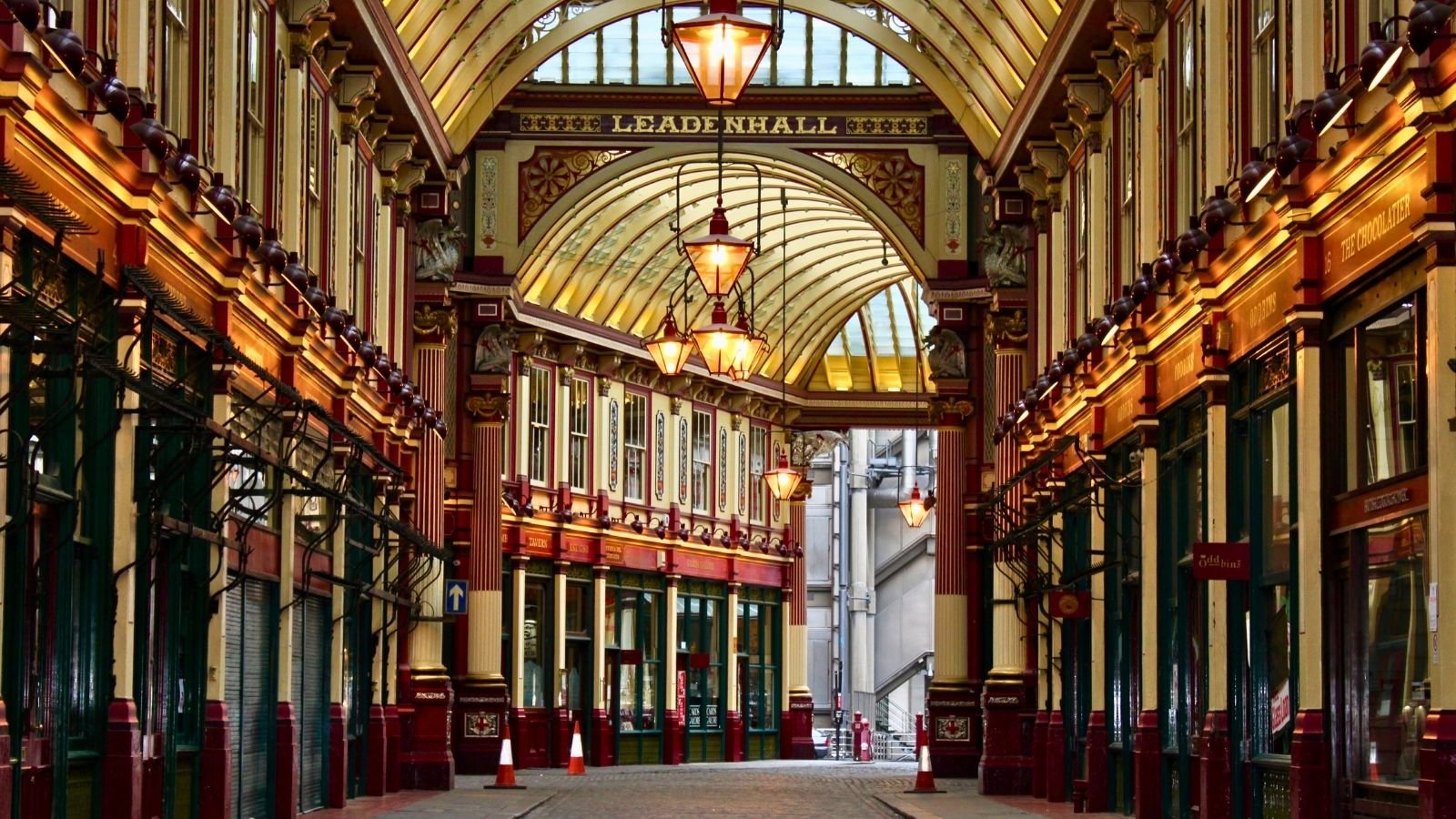
Leadenhall Market likes to pretend it has always looked this polished, but its past tells a different story. On most weekdays you’ll find office workers power‑walking through its arches, clutching flat whites or dashing towards a glass box in the sky. Tourists hover around with their cameras, waiting for someone to shout a spell because the place doubled as Diagon Alley. Meanwhile, the market quietly sits on two thousand years of urban drama, proudly wearing its ornamental Victorian ironwork as if that alone explained its survival. It doesn’t, of course. The full tale begins with Romans, medieval geese, and the sort of butchery that would make today’s lunchtime crowds drop their bao buns.
The ground beneath Leadenhall once formed the heart of Roman Londinium. Not a gentle edge, but the epicentre: the basilica, the forum, the administrative stomach of the city. Bureaucrats and traders strutted about where bankers now queue for oat milk. No arches painted maroon and cream, no designer sandwich shops, just stone, sandals and the eternal smell of civic paperwork. Two millennia later, no one walking through the market gives that a moment’s thought. The cobbles hide the ruins and the ruins hide the stories, but the bones of the Roman grid still lie beneath the market’s feet.
After the Romans moved on, the area slipped into the next phase of its identity crisis. By the medieval period, the site belonged to a mansion with a lead‑covered roof. Medieval naming wasn’t exactly poetic, so the mansion became known as Leaden Hall, which then morphed into the name for the surrounding area. Imagine owning a house so distinctive everyone ends up using it as a locational anchor for centuries. The owner, Sir Hugh Neville, probably didn’t predict that his choice of roofing material would outlive both his family and the entire building. Yet here we are, still saying “Leadenhall” in honour of some fifteenth‑century lead sheets.
The market begins to appear in documents from 1321. Records point to tenants trading on the site, but what they were selling varies depending on which century you’re looking at. Meat was everywhere. Poultry too. Game birds, herbs, grain, eggs, butter, cheese. Try to picture the smell on a warm medieval afternoon. Today’s traders would set up a scented‑candle stall strictly for self‑defence. But back then it was simply London life: loud, messy, full of energy, and carrying a vague tang of animal parts.
A pivotal moment arrives in 1408 when the land was purchased by Richard Whittington. Yes, that Whittington. The man whose cat has overshadowed his actual political accomplishments. Whittington bought the manor and in 1411 gifted it to the City of London Corporation. That single gesture created the civic backbone that still governs the market today. All of London remembers him as the cat man; meanwhile, Leadenhall exists because he decided it should. One imagines his feline companion receiving no credit whatsoever.
As the market grew, so did its ambitions. It became one of the most prominent commercial hubs of medieval London, collecting monopolies as if they were decorative badges. Wool came first. Then leather. Then cutlery. It is genuinely charming to imagine a place that once hosted the city’s first cutlery trade now selling cocktails under fairy lights. Urban evolution can be wonderfully ironic.
Disaster arrived in 1484 when a fire tore through the original stone mansion and its surrounding buildings. The City used the opportunity to reorganise everything. Out went the old structures, in came a granary, a chapel and even a school. Leadenhall was not just a marketplace anymore; it became a little civic ecosystem. This wasn’t a modern “mixed‑use development” with a glossy brochure. It was simply medieval pragmatism: build what people need, where people already gather.
Fast forward to the seventeenth century and the Great Fire of London sweeps across the city like a furious landlord demanding renovations. Leadenhall wasn’t completely levelled, but it suffered enough damage to warrant another redesign. The post‑fire layout divided the market into three courtyards: beef in one, fish and cheese in another, herbs and vegetables in the third. It was tidy, structured, and very unlike the chaotic bustle that had characterised earlier centuries. But do not romanticise it too much; it still reeked. The financial district would not have tolerated that aroma today unless someone labelled it an “artisanal sensory installation.”
By the nineteenth century the City of London had ambitions that didn’t sit well with carcasses and hides. The market’s old identity clashed with the self‑image of a modern commercial powerhouse. The narrow medieval alleys turned into bottlenecks. The smells remained defiantly non‑corporate. Traders carried on as they always had, but the City wanted elegance, order and something that wouldn’t terrify visiting bankers. The hide trade, in particular, came under fire. Hides do not come with a pleasant scent profile, and proximity to newly respectable financial institutions became a contentious topic.
Enter Sir Horace Jones in 1881, the Victorian architect responsible for the kind of urban beautification that turns practicality into ornament. Jones took the old stone market and replaced it with an iron‑and‑glass wonder: airy roofs, maroon and cream paintwork, decorative arches and cobbles. The result looked nothing like the market’s earlier incarnations. It was cleaner, grander and far more Instagrammable, had Instagram existed. The redesign suited Victorian London’s desire for order wrapped in elegance, and the new aesthetic remains more or less intact today.
The twentieth century saw Leadenhall navigate a different challenge: relevance. The market drifted away from meat and produce towards boutiques, florists, cafés, wine bars and places selling things that no medieval resident would recognise. Yet the bones of the medieval street plan stayed. No bulldozers arrived to flatten the narrow passages; instead, City planners preserved the alignment as a heritage asset. Leadenhall survived by changing its skin while keeping its skeleton. That may be the most London trait imaginable.
In the twenty‑first century the market enjoys a double identity. On one hand, it’s a functioning cluster of eateries and independent shops that serve locals and office workers. On the other hand, it’s a cinematic postcard of London. Film crews descend whenever someone needs a Victorian‑esque space with enough atmosphere to convey magic, mystery or at least a sense of elaborate detail. Harry Potter fans wander through the market looking for the entrance to the Leaky Cauldron. Staff at the nearby shops have probably perfected the polite smile used exclusively for pop‑culture pilgrims.
Speaking of legends, one resident deserves special mention: Old Tom. He was a gander who, during the eighteenth century, quite literally avoided becoming dinner. While thousands of birds were slaughtered around him, he apparently wandered through the market untouched, befriending traders and receiving scraps as tribute. He lived an improbably long life and became a kind of unofficial mascot. London is full of statues of generals, monarchs and naval heroes. Only in this city would one of the most celebrated local icons be a goose who simply refused to be roasted.
The market’s story also features a quieter but notable social detail: women worked here long before they gained access to many other trades in the city. Leadenhall operated as a place where sellers and service workers could carve out livelihoods regardless of gender. The market didn’t market itself as progressive; it simply functioned that way by necessity. When food must be sold, people do the selling, and sometimes society moves forward not through manifestos but through sheer logistical pragmatism.
Yet even success creates tensions. Preserving historic architecture comes with compromises. Leadenhall’s conservation status guards its Victorian ironwork and medieval footprint, but it also limits how traders can adapt their spaces. A market is meant to feel alive, not embalmed, and maintaining that balance isn’t easy. Some critics argue the modern market feels too curated, too tidy compared with its ancestors. Others appreciate the charm and believe the preservation has protected one of London’s most photogenic corners from the architectural monotony that plagues many business districts.
Another undercurrent runs through its history: resentment from traders displaced during its nineteenth‑century sanitisation. Moving from traditional butchery to restaurant culture wasn’t a smooth transition for everyone. Many livelihoods disappeared as Victorian planners reshaped the City according to new ideals. Modern visitors rarely think about those costs while sipping a Negroni under the painted roof, though the echoes of those transitions still linger in archival documents and the occasional heritage plaque.
Despite all of this, Leadenhall remains persistently alive. Walk through on a weekday afternoon and the market buzzes with conversations spilling out of wine bars. A violinist might perform under the central dome. Office workers cluster outside pubs, reviving a centuries‑old tradition of ending the workday with something strong and socially acceptable. The architecture frames it all like a stage set. The light filters through the glass roof in a way that flatters even the most hurried passer‑by. It feels curated without feeling artificial, lived‑in without feeling worn.
On quieter weekends, the market shifts personality again. The cobbles echo. You smell whatever nearby bakery has decided to open. The arches seem larger without crowds, and the Victorian colour palette looks particularly smug in the morning light. It becomes possible to imagine the previous centuries layered beneath your feet: the Roman forum, the medieval mansion, the Tudor market chaos, the Victorian pride. The market doesn’t try to hide those identities. It simply stacks them, politely waiting for you to notice.
Perhaps that’s why Leadenhall endures so well. It offers a condensed version of London’s entire urban arc: ancient beginnings, medieval enterprise, Tudor expansion, Victorian reinvention, modern rebranding. A place that has sold feathers, hides, herbs, cutlery, flowers, finance‑district lunches and cinematic fantasies. A place where a goose became a celebrity, where monopolies were granted, where fires reshaped the skyline, and where every century left a small fingerprint on the next.
You can wander into Leadenhall without thinking about any of that. Most people do. They glance at the ceiling, snap a photo, buy a pastry and continue their day. But the market rewards those who linger. Look closely at the ornate ironwork and you see the Victorian desire for beauty in everyday infrastructure. Look at the narrow passageways and you read the stubbornness of medieval street planning. Look at the market’s ability to reinvent itself every few centuries and you start to understand how cities survive. They adapt, they compromise, and occasionally they get very lucky with architects.
So Leadenhall stands today not just as a shopping arcade, not just as a film location, not just as a lunchtime escape for offices bursting with spreadsheets. It stands as proof that history thrives when it feels useful, beautiful or simply too interesting to demolish. Markets come and go. Buildings rise and fall. Yet this one keeps its grip on the city’s imagination. Perhaps it’s the colour scheme. Perhaps it’s the cobbles. Or perhaps it’s Old Tom, still waddling somewhere in London’s collective memory, refusing to go quietly into the roasting pan of history.