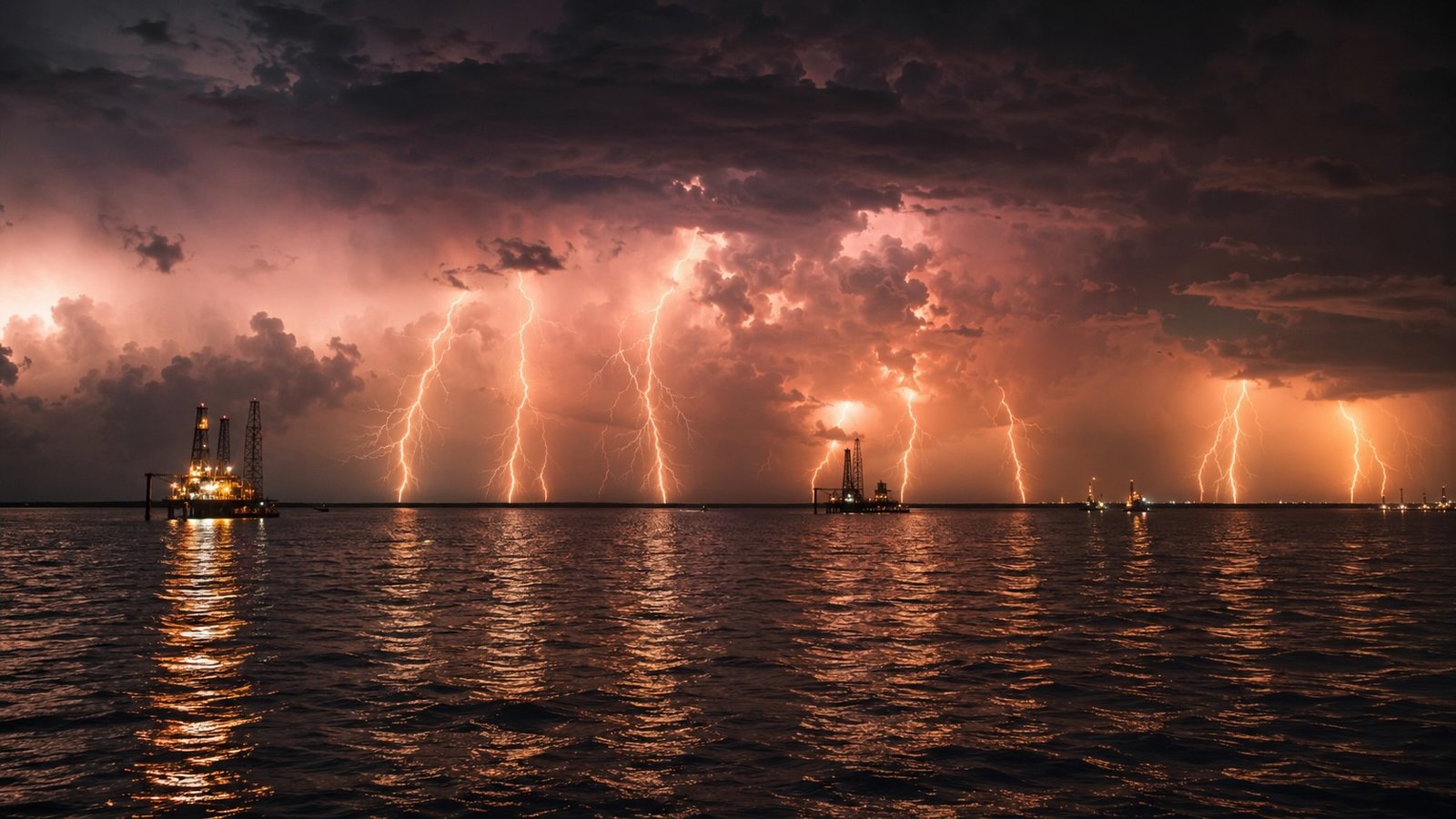
Lake Maracaibo does not do subtle. It sits in north-western Venezuela like a huge, restless mirror, linked to the Caribbean by a narrow strait, fed by rivers, watched by mountains, and repeatedly illuminated by one of the strangest weather shows on Earth. Above it, the sky can flash hundreds of nights a year. Below it, the water carries another story entirely: oil, rust, algae, sewage, and the long aftertaste of a nation that built part of its modern economy on what lay beneath the lakebed.
So, yes, Lake Maracaibo is spectacular. It is also wounded. Nature gave it theatre. Humans added industry, neglect, politics and, because apparently we cannot resist making things complicated, a pollution crisis that now competes with the lightning for attention.
The first thing to understand is that Lake Maracaibo is not quite an ordinary lake. It is often called one of the largest lakes in South America, yet it behaves partly like a brackish lagoon because it connects to the Gulf of Venezuela and, through that, to the Caribbean Sea. Fresh water flows in from rivers, especially the Catatumbo River, while salt water can also enter from the north. That mix gives the place a slightly confusing identity, which feels appropriate. Lake Maracaibo has always been difficult to place neatly in one box.
Then comes the lightning. The famous Catatumbo lightning forms near the point where the Catatumbo River enters the lake. Warm, moist air rises from the water. Cooler air slides down from the surrounding Andes and nearby mountain ranges. These air masses collide, build towering storm clouds, and create the kind of electrical drama that would look exaggerated in a disaster film. NASA has identified the Lake Maracaibo region as the world’s lightning capital, with an average of roughly 233 flashes per square kilometre per year. Some storms can flicker across the sky for hours.
Local people have long treated this lightning as more than weather. It appears on the flag of Zulia state, which tells you something about its cultural status. It has also earned the nickname “the lighthouse of Maracaibo”, because sailors supposedly used the repeated flashes as a natural beacon. There are older stories too, some half-history and half-legend, claiming that the lightning helped reveal enemy ships during colonial attacks. Whether every detail survives historical scrutiny hardly matters to the storyteller. A sky that flashes like a warning signal practically begs people to turn it into myth.
And why not? Imagine crossing dark water at night, with black mountains in the distance and the horizon suddenly pulsing white and violet. No thunder close enough to frighten you at first, just light. Then more light. Then the feeling that the sky has started communicating in a language nobody quite understands. In many places, lightning arrives as a brief interruption. At Lake Maracaibo, it becomes a character.
Yet the lake’s second great force does not fall from the sky. It rises from beneath the ground.
Oil transformed Lake Maracaibo in the twentieth century. Venezuela’s modern petroleum story owes a great deal to this basin. Commercial production began in the early 1900s, and the area later became one of the richest oil-producing regions in the world. Maracaibo city, once more closely associated with trade and coffee, grew into a major oil centre. Derricks, platforms, pipelines and terminals spread along the shores and into the lake itself. The landscape changed. The economy changed. Lives changed.
At first, oil seemed to promise everything: jobs, modernisation, revenue, infrastructure and national importance. The lake became not just a body of water but an engine. It helped power Venezuela’s rise as a petroleum state. Beneath the storms sat wealth. Beneath the fishing boats sat the stuff that could build roads, fund governments and attract foreign companies. It was all very impressive, in the way large industrial projects often look impressive before anyone asks where the waste goes.
Then the bill arrived.
Today, Lake Maracaibo has become a symbol of environmental damage as much as natural wonder. Oil spills, cracked pipelines, ageing infrastructure and abandoned equipment have left parts of the lake slicked, stained and degraded. Fishermen have reported nets darkened by crude and catches affected by pollution. Shores have been blackened. Rusting platforms and decaying industrial remains stand like monuments to an oil age that kept taking but did not keep repairing.
The pollution problem does not stop with oil. Sewage, rubbish, plastic waste, industrial runoff and algae blooms all add their own miserable ingredients. At times, the water has turned disturbingly green, not in the charming “emerald lake on a postcard” sense, but in the “perhaps don’t swim there” sense. When people describe the lake as toxic, they do not mean it metaphorically for dramatic effect. They mean communities live beside a damaged ecosystem that still has to feed people, support transport, absorb waste and carry the history of a country’s economic choices.
This is where Lake Maracaibo becomes painfully ironic. The lake helped make Venezuela rich in oil, yet that same oil has helped poison the water. The sky offers one of Earth’s most dazzling natural displays, while the surface below can carry slicks of crude. Tourists may come for the lightning. Locals must deal with the consequences.
The fishermen sit at the heart of the story. For generations, fishing has supported communities around the lake. But what happens when the water that once provided a living starts coating your equipment in oil? What happens when fish stocks suffer, when engines clog, when the smell changes, when the catch becomes harder to sell? Environmental damage rarely arrives as one grand cinematic disaster. More often, it creeps into daily life. A ruined net. A smaller catch. A sick child. A boat that needs cleaning again. A shoreline that no longer looks like home.
The politics are just as tangled as the pipelines. Venezuela’s oil industry has suffered from underinvestment, mismanagement, sanctions, ageing infrastructure and economic crisis. Those problems do not stay inside government reports. They appear as leaks, fires, broken equipment and delayed maintenance. Recent interest in reviving production around Lake Maracaibo raises a difficult question: can the region produce more oil without making the lake’s condition worse? That question sounds simple until you remember that cleaning up old damage already looks difficult enough.
Local initiatives have tried to fight back. Community groups and environmental activists have organised clean-ups. Some projects have explored inventive ways to absorb hydrocarbons, including using human and animal hair. That detail almost sounds comic until you think about it properly. People are literally gathering hair to help clean oil from one of South America’s great bodies of water. It is resourceful, admirable and slightly absurd, which makes it a painfully accurate image of environmental crisis in the real world. Ordinary people improvise while large systems fail.
Still, Lake Maracaibo is not dead. That matters. Damaged does not mean finished. Polluted does not mean beyond repair. The lake remains ecologically, economically and culturally important. The Catatumbo lightning still flashes. Birds still move through the wetlands. Fishermen still work. Families still live beside the water. The lake still holds memory, livelihood and beauty, even if all three now share space with oil stains and political frustration.
Perhaps that is why Lake Maracaibo feels so powerful as a story. It refuses to be one thing. It is a natural wonder, an oil field, a fishing ground, a polluted ecosystem, a patriotic symbol, a scientific curiosity and a warning sign. It gives us lightning dramatic enough for myth and pollution serious enough for public policy. It shows what happens when a place becomes economically valuable before it becomes environmentally protected.
There is also something very human about the contradiction. We love places for their beauty, then exploit them for their resources, then act surprised when beauty and exploitation do not coexist politely forever. Lake Maracaibo did not hide its importance. The storms announced it in flashes. The oil wells confirmed it in barrels. The fishermen understood it in their boats. The only thing missing, for too long, was the discipline to treat the lake as more than a machine.
So the next time someone calls Lake Maracaibo the lightning capital of the world, the phrase should carry both wonder and discomfort. Yes, the sky there performs one of nature’s greatest light shows. Yes, the storms have inspired legends, guided imaginations and placed the lake on the global map. But beneath that electric sky lies another spectacle: the long, messy, oily evidence of what happens when a country’s treasure chest becomes a dumping ground.
Lake Maracaibo still flashes. It still breathes. It still matters. And perhaps that is the most uncomfortable part. This is not a lost world from the past. It is a living place, asking whether people can admire a miracle above the water while finally taking responsibility for the damage below it.