Incitatus: The Horse Caligula Nearly Made a Senator
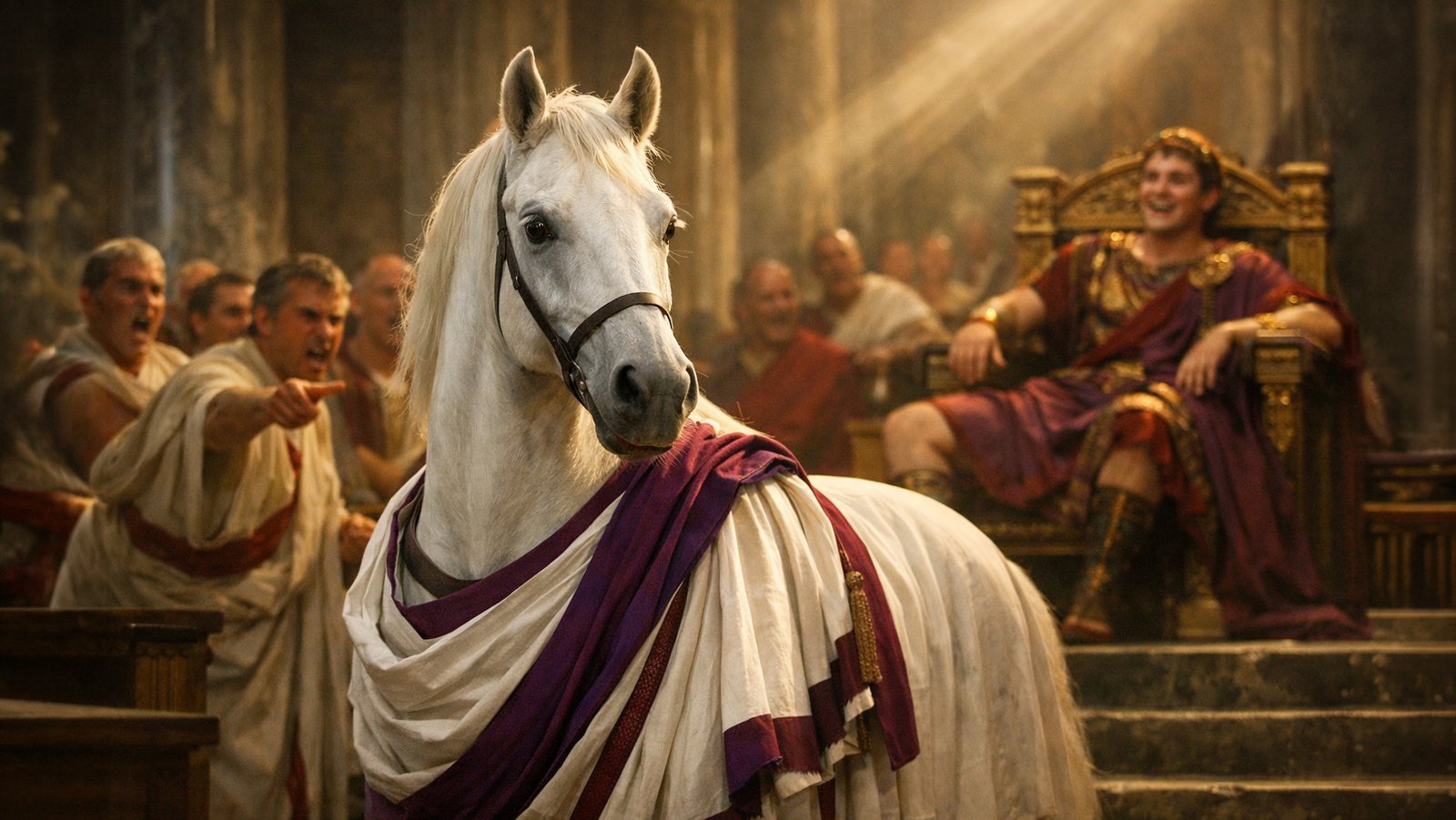
There was a moment in Roman history when the line between satire and governance became so thin that a horse nearly stepped across it. Not metaphorically, not in the way modern headlines exaggerate for effect, but in a way that made even hardened Roman senators pause and wonder whether they were part of a functioning political system or an elaborate performance. The horse was called Incitatus, a respectable name, energetic and almost dignified. It belonged to Emperor Caligula, a ruler who did not so much test boundaries as casually ignore them.
By the time this story takes shape, Rome had already transitioned from Republic to Empire, yet it still clung to the visual language of shared power. The Senate still met, senators still debated, and speeches were still delivered with the weight of tradition. Yet behind all of it stood one man whose authority made those rituals increasingly symbolic.
Incitatus did not live like an ordinary horse. He had a marble stable, which already suggests priorities that would raise eyebrows even in Rome. His manger was made of ivory, an unnecessary flourish unless the point was precisely to be unnecessary. He wore purple blankets, a colour so tightly controlled that it functioned as a kind of social firewall between the elite and everyone else. Servants attended to him, and invitations to dine were reportedly extended, though one imagines the conversation remained limited.
At first glance, it looks like extravagance, the sort that powerful people occasionally indulge in when surrounded by too much comfort and too little resistance. But the story does not stop there. According to later accounts, Caligula intended to make Incitatus a consul, not a mascot or curiosity, but a holder of one of Rome’s highest offices. That is where things shift from indulgence to something more pointed.
The immediate reaction is to assume madness. It is the easiest explanation, and for centuries it has been the most popular. A ruler loses touch with reality, elevates a horse, and confirms everyone’s worst fears about absolute power. The narrative is neat, memorable, and satisfying. It also happens to come largely from sources written after Caligula’s assassination, which introduces a certain incentive to make him appear as unstable as possible.
Yet there is another way to read the situation, one that feels less theatrical and more strategic. By the time Caligula took power, the Senate’s influence had already been eroded. Emperors controlled the army, the treasury, and the direction of policy. Senators retained prestige, but their practical authority had thinned out to something closer to ceremony. It was a system built on appearances, sustained by mutual agreement not to examine it too closely, and Caligula, by most accounts, had little interest in maintaining that agreement.
So imagine suggesting, even half-seriously, that a horse could hold office. The statement lands not as a joke, but as a demonstration. If a horse could be considered for the role, what did that say about the role itself, or about the people currently occupying it? It transforms the idea from absurdity into commentary, sharp enough to cut through the layers of tradition that protected the Senate from direct criticism.
It also places the senators in an impossible position. Laugh, and you risk offending the emperor. Object, and you acknowledge the insult. Ignore it, and you silently accept the premise. The brilliance of the gesture, if it was intentional, lies in how thoroughly it destabilises the room without requiring a single formal decision.
Of course, there is still the possibility that the story was exaggerated. Roman historians were not neutral observers. They wrote with perspective, often shaped by their own class and political loyalties. Portraying Caligula as erratic made his assassination easier to justify in retrospect, turning a political killing into a necessary correction. In that light, the image of a horse approaching high office becomes less a fact to be verified and more a symbol to be deployed.
Even so, the details about Incitatus’ lifestyle feel grounded in something real. Marble, ivory, purple fabric—these are not vague accusations but specific choices, each carrying cultural weight. They suggest a ruler who understood the language of status and used it deliberately, perhaps even playfully, to send signals that could not be easily challenged.
What keeps the story alive is not whether Incitatus ever formally entered the Senate chamber. It is the unsettling plausibility of the idea. Strip away the horse, and the underlying dynamic becomes familiar. Institutions continue to operate, but their influence fades. Positions retain their titles, but not their substance. Power consolidates elsewhere, while the outward structure remains intact for the sake of continuity.
In that context, elevating a horse stops being the central issue. The real question becomes why such a gesture could carry weight in the first place. What conditions allow a political system to be mocked so openly without collapsing immediately, and what does it say about the balance of power when satire begins to resemble policy?
Rome, for all its achievements, was not immune to performance. It thrived on spectacle and on displays that reinforced hierarchy and control. Triumphs, games, public ceremonies—these were not distractions but tools. Against that backdrop, the idea of a horse in high office fits uncomfortably well. It is excessive, yes, but also entirely in character.
Caligula’s reign did not last long, and it ended violently, as such experiments often do. He was assassinated by members of his own guard, a reminder that even absolute power has its limits when it alienates enough people at once. After his death, stories about his behaviour multiplied, each one reinforcing the image of a ruler who had gone too far.
The horse remained, not physically, but as an idea that proved difficult to discard. Incitatus became shorthand for excess, for absurdity, for the moment when authority slips into parody. Yet there is a subtle shift worth noticing. The story does not only mock the emperor; it also reflects, perhaps unintentionally, on the system that allowed such a story to feel believable.
Because if a horse could be imagined as a senator, even in jest, then the Senate itself had already changed, not suddenly or dramatically, but gradually, in ways that made such a comparison possible. And that is what lingers, not the image of the horse standing awkwardly among robed politicians, but the quiet recognition that by the time the joke was made, it may not have been entirely a joke anymore.
Post Comment
You must be logged in to post a comment.