How the Aye-Aye Finger Defies Anatomy
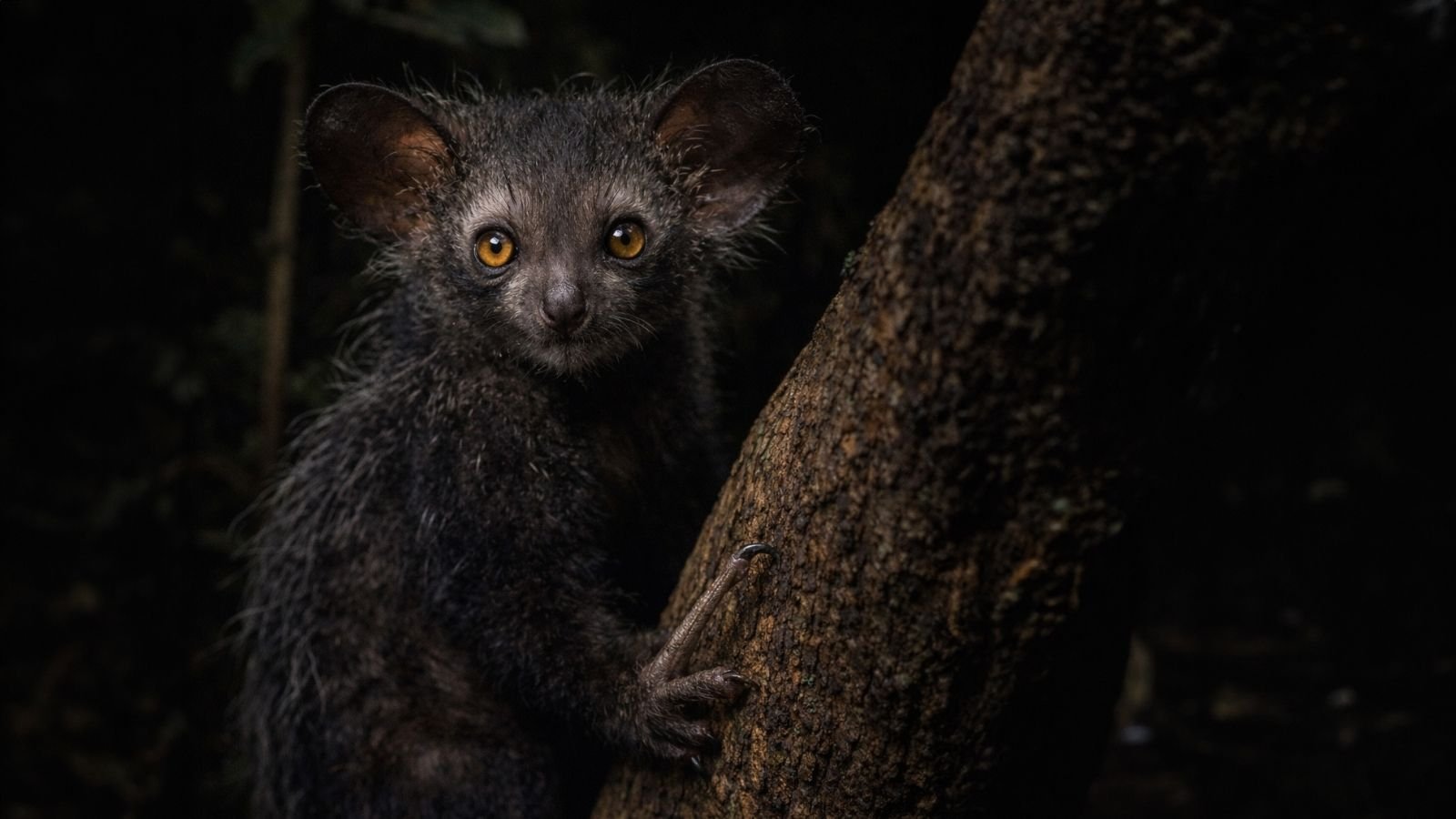
The aye-aye finger looks like a mistake someone forgot to correct. Long, skeletal, twitchy, and oddly expressive, it hangs off the hand like an afterthought. Yet despite appearances, this single finger explains more about evolution than a shelf of tidy diagrams ever could.
When European naturalists first encountered the aye-aye, admiration never entered the room. Instead, they recoiled. The animal arrived in museums stripped of context, preserved and silent, its middle finger frozen in a pose that suggested deformity rather than design. At the time, biology still carried an unspoken aesthetic code. Mammals were supposed to look balanced. Hands were meant to grasp, not probe. Fingers were expected to cooperate rather than act alone.
The aye-aye ignored those expectations entirely. Its finger was thinner than the others, longer by a disturbing margin, and flexible in ways that resisted neat classification. Moreover, instead of ending in a soft pad, it tapered into a hooked claw. The bones looked undernourished. The joints appeared excessive. Consequently, early descriptions treated the finger as a flaw, or worse, as evidence that the specimen itself was abnormal.
Because of this uncertainty, the aye-aye drifted between categories for decades. Some scholars leaned towards rodents because of its teeth. Others grouped it with squirrels. A few quietly suspected fabrication. Eventually, consensus settled on its place among lemurs, although even that classification felt uneasy. Still, the finger remained unresolved.
What complicated matters further was behaviour. No one had observed the aye-aye properly in the wild. Removed from Madagascar’s forests and placed under glass, the animal lost the context that made its anatomy intelligible. As a result, the finger looked pointless. Meanwhile, evolutionary theory, still finding its modern footing, struggled to justify such an extreme departure from the expected primate hand.
That picture shifted once long-term observation became possible. In the forest, the aye-aye reveals itself slowly, usually after dark. It moves with deliberate caution along branches, pausing often, ears swivelling like radar dishes. Then the finger comes alive. It taps along bark in short, rhythmic bursts. Not randomly, but methodically. Tap, pause. Tap again. Listen.
Crucially, the aye-aye hunts using sound. Tiny differences in echo reveal whether wood is solid or hollow. Inside those hollow spaces, insect larvae hide, protected from birds, lizards, and other mammals. The aye-aye hears what others cannot. Once it locates a cavity, its rodent-like incisors gnaw through bark with alarming efficiency. After that, the finger slips inside, fishing out prey that would otherwise remain unreachable.
Seen this way, the finger stops looking strange. Instead, it starts looking precise. Its thinness reduces resistance. Its length extends reach. And its flexibility allows delicate movements inside narrow tunnels. Even the claw makes sense, acting as a hook rather than a grip. In other words, every awkward feature aligns with a single purpose.
This realisation forced scientists to confront an uncomfortable idea. Mammalian anatomy did not converge on one ideal solution. Rather, it sprawled outward into extremes whenever conditions allowed. The aye-aye finger was not a deviation from the rules. Instead, it exposed how narrow those rules had been drawn.
Unlike most primates, whose hands evolved for climbing, grasping, and social interaction, the aye-aye committed to foraging specialisation. One finger became dominant. The others remained competent but secondary. As a result, independence replaced symmetry. In evolutionary terms, that trade-off paid off.
The finger also disrupted assumptions about sensory hierarchy. Primates are typically framed as visual animals. Hands support what eyes discover. The aye-aye reversed that logic. Hearing led. Touch followed. Sight became optional. Unsurprisingly, this inversion unsettled early observers because it contradicted what primates were supposed to represent.
Additional details deepen the story. The finger’s joint structure allows movement in multiple planes, closer to a rotating instrument than a simple hinge. The tendons stretch farther than expected. Even the muscles differ in arrangement, favouring precision over strength. Under close examination, nothing about it looks accidental.
Beyond feeding, the finger appears in daily routines. Aye-ayes groom themselves with it. They dip it into water sources and lick moisture from its surface. In captivity, they tap on metal bars, plastic enclosures, and wooden beams with the same seriousness they apply to tree trunks. Notably, the behaviour persists even when it serves no purpose, suggesting it runs deep in their neural wiring.
This insistence on tapping fascinated researchers. The rhythm varies. The pressure changes. Individuals show preferences. Some tap faster. Others pause longer between strikes. Consequently, each aye-aye develops its own acoustic style. This subtle individuality rarely appears in anatomical descriptions, yet it matters.
Outside laboratories and forests, the finger acquired a darker reputation. In many parts of Madagascar, the aye-aye became associated with death. Folklore warned that if it pointed its finger at a person, misfortune would follow. Some stories went further, claiming the finger could pierce hearts at night. These myths did not emerge from malice alone. The animal’s nocturnal habits, eerie appearance, and silent movements made it an easy vessel for fear.
As a result, aye-ayes were often killed on sight. Villagers destroyed them not for food or sport, but as a precaution. Ironically, the finger that represented evolutionary brilliance also became the source of cultural stigma. Conservation efforts struggled against this legacy for decades.
Even today, conservationists tread carefully. Education campaigns must respect local belief systems while gently reframing the animal’s image. Emphasising the finger as a tool rather than a threat has proven more effective than outright dismissal of folklore. Gradually, attitudes shift, although unevenly.
The aye-aye’s endangered status reflects this fragile balance. Habitat loss remains the primary threat, driven by deforestation and agricultural expansion. Nevertheless, superstition still contributes. Unlike more conventionally appealing animals, the aye-aye does not benefit from instant sympathy. Its finger unsettles rather than charms.
Within scientific circles, however, the finger enjoys a kind of cult status. It appears in lectures, textbooks, and evolutionary debates as a cautionary example. Whenever biology risks sliding back into ideas of normality and ideal form, the aye-aye resurfaces to complicate the picture.
What makes the finger especially valuable as a teaching tool is its honesty. It does not hide the messiness of evolution. Instead, it shows how selection can exaggerate one trait without smoothing the rest. Moreover, it reveals how adaptation often looks ungainly when removed from context.
In that sense, the aye-aye finger is less an anomaly than a reminder. Nature does not design with elegance in mind. It solves problems locally, opportunistically, and without concern for aesthetics. When a long, skeletal finger works better than a neat, symmetrical hand, evolution does not hesitate.
This perspective reshapes how normal anatomy gets defined. Normal becomes statistical, not moral. Common does not mean correct. Rare does not mean wrong. The aye-aye simply occupies a narrow niche with absolute commitment.
There is also something quietly human about the discomfort it provokes. People expect hands to behave socially. Fingers point, grasp, wave, and touch. The aye-aye finger does none of this. Instead, it listens. It probes. It intrudes into hidden spaces. Unsurprisingly, that inversion unsettles.
Over time, discomfort fades into fascination. Once the finger’s function becomes clear, it no longer reads as grotesque. Instead, it feels inevitable. Given the problem of hidden larvae and competition from birds, this solution almost seems obvious in hindsight.
The real surprise, then, is not that the aye-aye evolved such a finger. It is that biology took so long to accept it. Early naturalists saw error where there was ingenuity. They mistook unfamiliarity for malfunction.
Today, the aye-aye finger stands as a quiet corrective. It reminds science to stay humble. It warns against letting expectation harden into doctrine. Above all, it demonstrates that life’s most successful solutions often look strange until someone watches closely enough.
Seen tapping in the dark, finger extended, ears alert, the aye-aye finally makes sense. The rules never broke. They were simply broader than anyone realised.