How Printing Press Turned Ideas into a Force That Could Not Be Contained
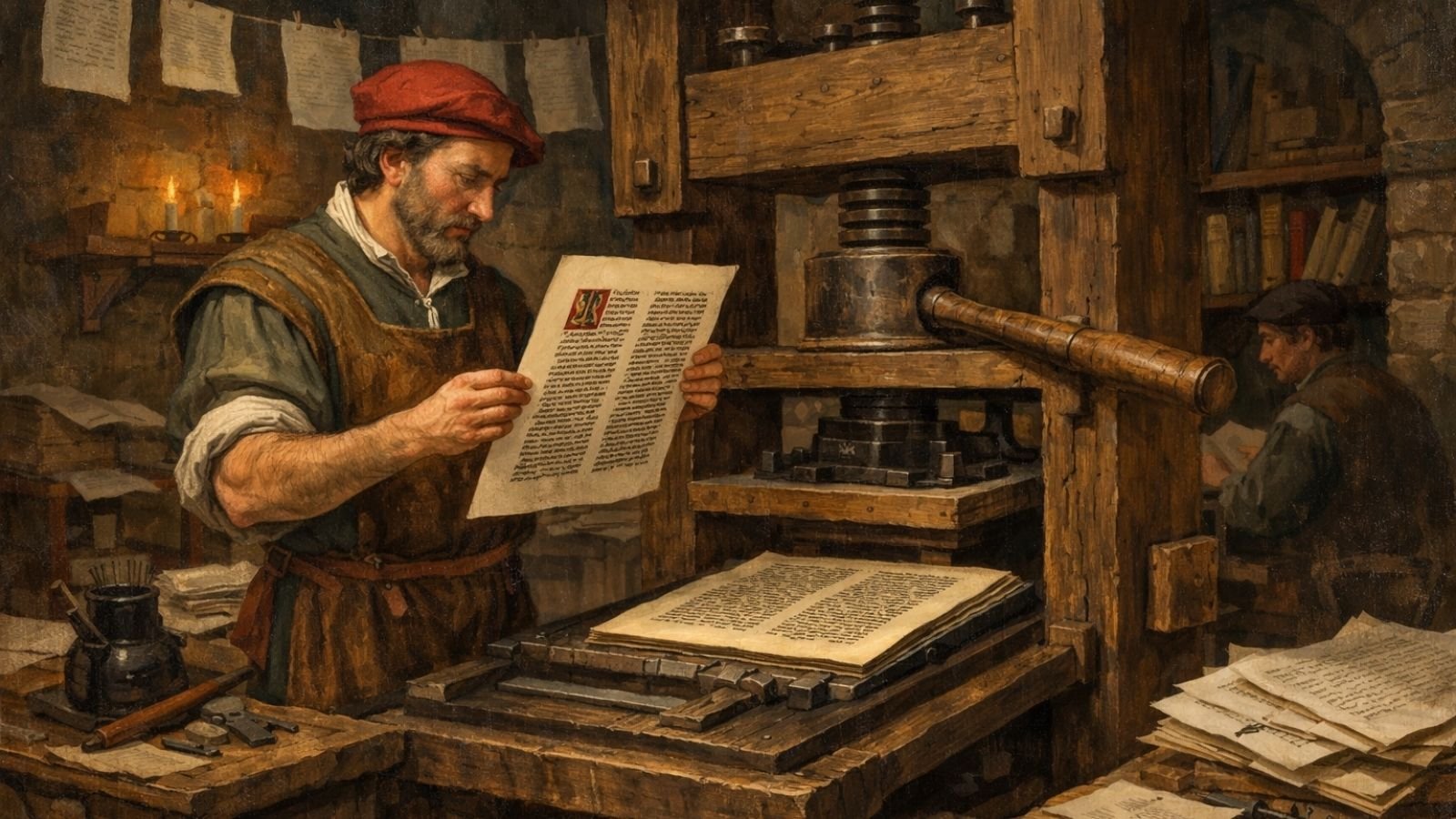
The printing press arrived in Europe in the middle of the fifteenth century and immediately caused a problem. Suddenly there were too many words. Opinions multiplied. People began reading things they were not supposed to see. Until then, knowledge had moved at the speed of a patient hand and a tired wrist. Monks copied books one letter at a time, lawyers guarded documents, and universities rationed texts like rare medicine. Information travelled, but it travelled slowly, expensively, and with supervision.
Then metal letters started clattering into place, ink rolled across them, paper pressed down, and something irreversible happened. Words learned how to multiply.
Johannes Gutenberg tends to get the credit, partly because he deserves it and partly because history likes a single name. Even so, the story is less about a lone genius and more about clever assembly. In reality, he assembled a system rather than inventing a miracle. He borrowed the screw press from wine-making, perfected durable metal type, and mixed an oil-based ink that behaved itself on metal. Each part existed already. Together, they changed Europe’s mental plumbing.
The first major printed books tried very hard not to look new. Early printers understood their audience well. Readers trusted manuscripts, not strange mechanical pages. So the earliest printed Bibles copied the look of handwritten ones, complete with gothic fonts, columns, and blank spaces for decorative initials. This visual disguise worked. People bought them. Clerics blessed them. The revolution slipped in wearing familiar clothes.
Before printing, a book cost a fortune. As a result, ownership meant power. A hand-copied Bible could equal the price of a house. Ownership meant power. Libraries functioned like vaults. With printing, prices fell steadily. A merchant could afford a book. A lawyer could build a reference shelf. A student could own the text instead of borrowing it under supervision. Literacy stopped being a clerical privilege and started turning into a social skill.
As readership expanded, more readers created more writers. Pamphlets flourished because they were cheap, fast, and disposable. Short arguments, jokes, insults, and sermons flooded cities. Printing turned opinion into a physical object that could circulate without permission. That mattered enormously once religious disagreement entered the chat.
When Martin Luther criticised church practices in 1517, printing did the rest. His ideas did not creep across Europe; they sprinted. Printers translated, summarised, and exaggerated his arguments. Woodcuts mocked bishops and popes for people who could not read at all. The Reformation became the first ideological movement powered by mass reproduction. Theology turned into something you could buy on a street corner.
Unsurprisingly, authorities panicked. Once a press existed, control required licensing, censorship, and punishment. States tried all three. They never fully succeeded. Shutting down one press simply pushed the work to another city. Ideas learned to travel faster than law.
Meanwhile, science benefited in a quieter way. Printing stabilised knowledge. Diagrams stopped mutating with every copy. Tables of numbers became reliable enough to argue over. Scholars could reference page numbers instead of vague memories. When errors appeared, later editions corrected them instead of copying them forever. The habit of revision took root.
This mattered for astronomy, anatomy, botany, and engineering. Printed star charts let observers compare notes across borders. Anatomical drawings fixed the human body on the page in a way memory never could. Even mistakes helped, because they became shared mistakes, visible to everyone. Science moved forward by arguing with the same diagrams.
Printing also reshaped language in ways nobody planned. Printers favoured dialects that sold well. Over time, spelling froze. Grammar hardened. Luther’s Bible helped standardise German. English printers nudged London English into dominance. National languages began to look solid long before nations felt politically stable.
Still, not everyone felt grateful. Some scholars complained that easy access to books produced shallow thinkers who read too much and understood too little. Others warned that memory would rot if people relied on paper. Moralists worried about corrupting texts circulating without supervision. These complaints sound familiar for a reason.
Within decades, by 1500, Europe held tens of millions of printed books. By 1600, the number reached into the hundreds of millions. Universities expanded. Bureaucracies grew addicted to paperwork. Contracts, laws, and manuals multiplied. Commerce learned to trust printed numbers. Credit systems became more complex because records could persist.
The printing press did not create capitalism, science, or democracy on its own. Instead, it removed friction. By lowering the cost of copying ideas, it made scale feel normal. Once that happened, feedback loops formed. More readers demanded more texts. More texts produced more disagreement. Disagreement produced change.
Printing also altered how people imagined time. In manuscript culture, tradition dominated. With printed pages, comparison became unavoidable. Old editions sat next to new ones. Progress became visible. The past stopped being a fixed authority and started looking negotiable.
None of this felt tidy. Religious wars followed. Propaganda thrived. Lies spread more efficiently. Printing amplified nonsense as well as insight. Every tool that multiplies truth also multiplies rubbish. The press never promised wisdom; it promised reach.
In many ways, that promise still shapes modern life. Newspapers, novels, political manifestos, instruction manuals, and eventually screens all grew out of the same logic. Reproducibility changed what mattered. Once an idea could reach thousands, then millions, influence stopped depending on proximity or permission.
The printing press did not shout. It hummed, clanked, and smelled of ink. It worked quietly in workshops while the world adjusted around it. By the time anyone fully understood what had happened, reading had become normal, argument had become public, and ignorance had become harder to defend.
Ideas had learned to multiply, and they have never stopped.