How Magna Carta Was Rewritten — And Why That Version Endured
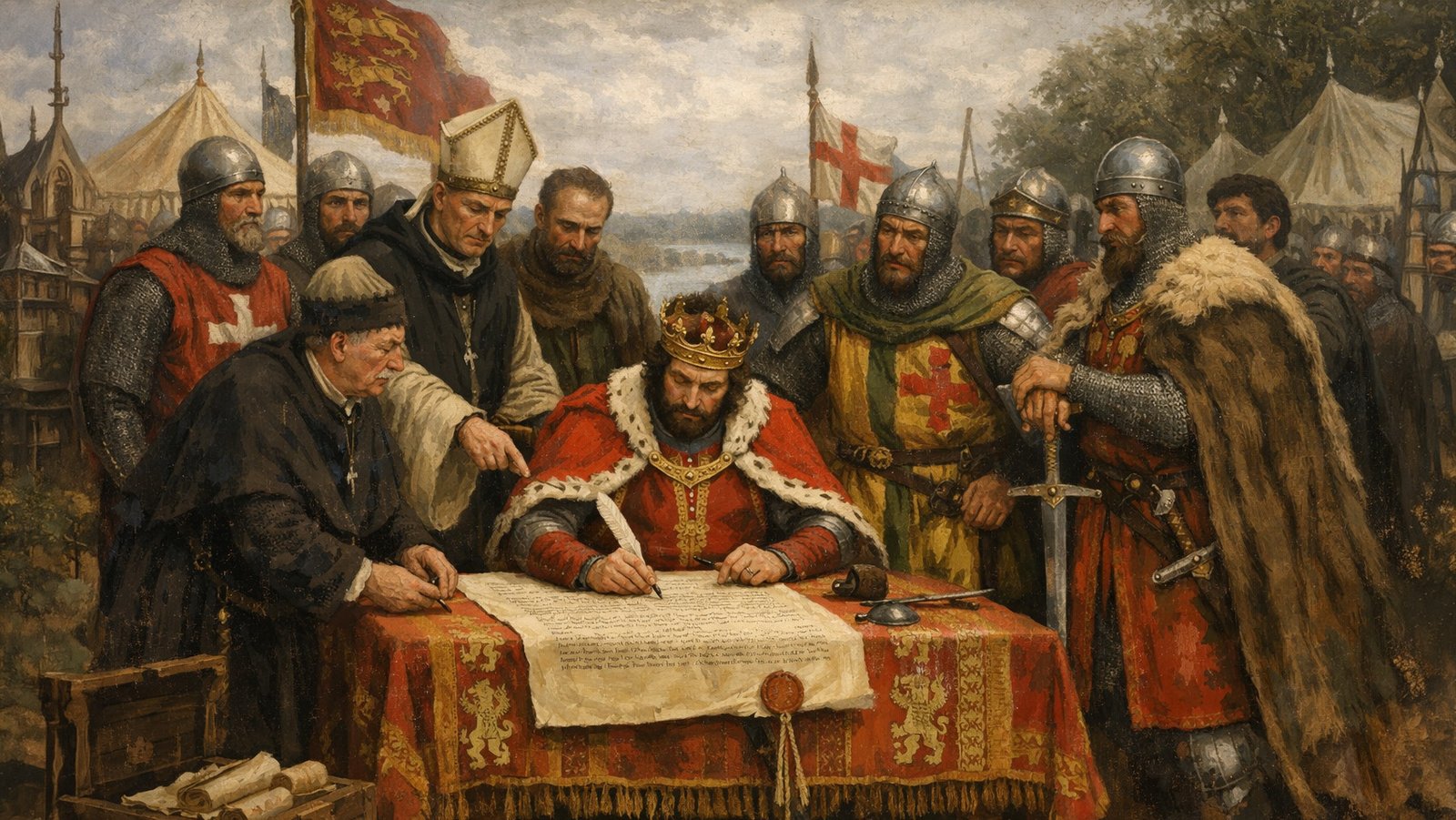
Everyone thinks they know the story. Angry barons, a sulking king, a meadow called Runnymede, and a document that allegedly launched liberty into the world like a medieval startup. Schoolbooks love it. Politicians quote it with solemn faces. Campaigners wave it around whenever they need a thirteenth-century receipt for modern rights. Yet the Magna Carta that actually shaped history was not the one sealed in 1215. In fact, that first version did not even last the year.
King John did not sit down at Runnymede because he fancied constitutional reform. Instead, he turned up because his barons had run out of patience. He had lost Normandy, squeezed his nobles for cash, quarrelled with the Pope, and turned royal justice into something that looked suspiciously like a vending machine. Insert silver, receive verdict. When armed aristocrats occupied London in 1215, the king needed breathing space. Therefore, the charter offered a temporary truce rather than a philosophical manifesto.
Consequently, the document that emerged in June 1215 read less like a timeless declaration of human dignity and more like a very specific list of complaints. Sixty-three clauses tackled feudal relief payments, wardship rules, inheritance technicalities, fish weirs clogging the Thames, and the rights of London merchants. The text did include lines that later generations would frame on their walls. It promised that no free man would face imprisonment except by lawful judgment or the law of the land. It declared that justice would not be sold, denied, or delayed. Stirring stuff, certainly. However, context matters.
Crucially, “free man” did not mean everyone. Medieval England contained a vast population of villeins who worked the land and enjoyed few of the protections that modern readers imagine. Meanwhile, many clauses read like administrative housekeeping. The charter tried to stabilise a feudal system, not overthrow it.
Then came the explosive part. Clause 61 created a committee of twenty-five barons with the right to enforce the charter against the king. Should John break his promises, those barons could lawfully seize castles and lands until he corrected himself. In other words, the document authorised organised resistance. As a result, the peace treaty edged dangerously close to controlled rebellion.
Unsurprisingly, John did not cherish that innovation. Within weeks he appealed to Pope Innocent III, who obligingly annulled the charter. The Pope condemned it as illegal and shameful. Civil war resumed almost immediately. By the autumn of 1215, the grand parchment that supposedly birthed democracy lay politically shredded.
Had the story ended there, Magna Carta would occupy a footnote in medieval crisis management. Instead, fate intervened in the form of King John’s death in 1216. His nine-year-old son inherited the crown, and although the boy could not command armies, his regents could read the political weather. They needed to peel moderate barons away from the rebel cause, so reissuing Magna Carta looked like a clever move. However, they did not simply photocopy 1215.
The 1216 version quietly removed Clause 61. The mechanism that allowed barons to gang up on the king vanished, and other contentious provisions disappeared too. As a result, the tone shifted. Rather than forcing a monarch to submit, the revised charter framed concessions as part of orderly governance under a new, innocent child king. That edit mattered more than the meadow at Runnymede.
Moreover, a further revision followed in 1217. This time the government separated out the Charter of the Forest, which dealt with access to royal forests and hunting rights. Forest law affected livelihoods across the kingdom, so splitting it into a companion document made administrative sense. At the same time, the text of Magna Carta itself grew leaner and more focused, and gradually the revolutionary edge dulled.
Then came 1225, the version that rarely features in dramatic retellings. By now Henry III had reached adulthood, and he issued Magna Carta again, but crucially he did so “of his own free will” in exchange for taxation. That phrase transformed the political optics. Instead of barons extorting a reluctant ruler, the narrative presented a king who voluntarily confirmed liberties in return for financial support. Thus, consent replaced coercion.
The 1225 charter became the authoritative text, and later generations copied it, cited it, and built upon it. When lawyers and parliamentarians invoked Magna Carta in subsequent centuries, they relied on this matured version rather than the turbulent 1215 original. Nevertheless, the myth clung stubbornly to the meadow.
Another layer arrived in 1297 under Edward I. The king faced military pressures in Scotland and France, along with resistance to taxation at home. Confirming Magna Carta again offered a pragmatic way to calm tempers, and consequently the Confirmatio Cartarum placed the charter on the statute roll. From that moment, it formed part of the realm’s statutory framework. Notice the pattern: each reissue served a political purpose, and each monarch used the charter to secure cooperation. Over time, the text gained authority not because it froze in amber but because rulers kept finding it useful.
Meanwhile, the most dramatic element of 1215 remained absent. No later version restored Clause 61, and England did not institutionalise a standing committee of barons empowered to overrule the crown. Instead, the country evolved toward parliamentary negotiation and statutory consent. Ironically, Magna Carta survived by abandoning its boldest enforcement mechanism.
So when people quote the famous due process clause, they cite a line that passed through several editorial filters. The spirit endured, yet the wording and context shifted. The clause originally protected “free men” within a feudal hierarchy, but centuries later jurists expanded its meaning to encompass broader legal principles. During the seventeenth century, parliamentarians battling the Stuart kings treated Magna Carta as ancient proof that the monarch stood under the law. Similarly, American colonists used it to challenge imperial authority. In each case, they read their own struggles back into a medieval compromise, and that reinterpretation fascinates me far more than the romantic tableau at Runnymede.
Constitutional history rarely unfolds in cinematic bursts. Instead, it creeps, adjusts, and negotiates while documents change and meanings stretch. Political actors borrow old language to legitimise new agendas, and Magna Carta offers a textbook example of this process. The 1215 charter failed almost instantly, whereas the 1225 version endured because it fit within a workable system of taxation and consent. Edward I’s confirmation entrenched it further, and later lawyers elevated it into a symbol of immemorial liberty. Myth prefers clean origins, yet reality prefers drafts.
Consider how only a handful of clauses from the later text remain technically in force in modern UK law. They concern the freedom of the Church, the liberties of the City of London, and the guarantee of lawful judgment. Parliament repealed most other medieval provisions over the centuries, so contemporary Britain rests on parliamentary sovereignty, common law development, and modern statutes rather than feudal relief rules. Nevertheless, Magna Carta retains enormous rhetorical power, and that power springs partly from selective memory.
Public discourse often treats 1215 as the moment democracy emerged blinking into daylight. However, medieval England in 1215 did not resemble a democratic society in any modern sense. The charter addressed elite grievances and did not establish representative government for the masses. It did not proclaim universal equality; instead, it stabilised relationships within a stratified world. Yet symbols evolve. Because later generations faced their own constitutional battles, they reached for Magna Carta as a legitimising ancestor. During the English Civil Wars, parliamentarians cited it against royal prerogative, while lawyers in the age of Coke framed it as ancient constitutional bedrock. Across the Atlantic, colonial pamphleteers invoked it to argue that taxation without representation violated long-standing English liberties. As a result, each era polished the legend further, even as the original manuscript sat quietly in archives, its clauses trimmed and reshaped in successive copies.
The irony feels irresistible because the version that history celebrates most loudly collapsed within months, whereas the versions that endured did so because they compromised. Radical enforcement gave way to institutional negotiation, and coercion softened into consent. Therefore, the charter’s survival depended on moderation. Even the famous meadow plays a subtler role than we imagine, for Runnymede provided a stage for crisis while the real transformation occurred in chancery offices where clerks revised wording, struck out clauses, and recalibrated tone. Political theatre grabbed attention, but bureaucratic editing secured longevity.
That pattern feels strangely modern. Grand gestures capture headlines, whereas technical amendments shape outcomes. In that sense, the Magna Carta that shaped constitutional tradition emerged from revision meetings rather than battlefield heroics. Of course, none of this diminishes the significance of 1215, because the crisis established a precedent that a king could negotiate limits, and that idea carried weight. However, the charter’s authority grew through repetition. Each confirmation reinforced the principle that royal power interacted with established liberties, and over decades that habit of confirmation embedded itself in political culture.
Gradually, Magna Carta shifted from a bargaining chip to a constitutional touchstone. By the time lawyers in the seventeenth century cited it, they treated it as ancient and almost sacred. They did not obsess over which clauses appeared in which draft; instead, they cared about the broader claim that the king ruled under law. Consequently, the charter’s layered history faded behind a simplified narrative of origin, and that simplified narrative still dominates.
When commentators declare that Magna Carta “gave us our rights,” they compress a century of revisions into a single dramatic summer. They overlook the fact that the most radical clause never survived, they forget that later monarchs reissued the document strategically, and they ignore that Parliament eventually repealed most of its medieval content. Yet perhaps myth serves a function. Societies need stories about the taming of power, and Magna Carta offers a compelling one. Even if the surviving text differs from the 1215 original, the legend reinforces the idea that authority must answer to law, and that belief shapes institutions more effectively than any single clause.
Still, I prefer the messier version of events because it reveals politics as negotiation rather than destiny. It shows how texts evolve under pressure and demonstrates that constitutional development rarely depends on pristine originals. Instead, it thrives on adaptation. The Magna Carta that survived was not the one first sealed at Runnymede; rather, it was the edited, refined, strategically granted charter of 1225, later confirmed in 1297. Its endurance owed less to rebellion than to recalibration, and its authority grew not from immobility but from revision.
Next time someone invokes 1215 as the birth certificate of liberty, picture a scribe in 1225 adjusting language to secure a tax grant. Imagine Edward I confirming clauses to steady his realm, and think of lawyers centuries later stretching medieval phrases to confront modern kings. The legend may start in a meadow, but the real story unfolds across decades of careful rewriting. Liberty, it turns out, rarely arrives fully formed. Instead, it develops through argument, compromise, and persistent reuse of old words. Magna Carta exemplifies that slow craft: the parchment changed, the meaning expanded, the myth endured, and the version that shaped history was never the original at all.
Post Comment
You must be logged in to post a comment.