How Isaac Newton Became the Most Dangerous Man in London
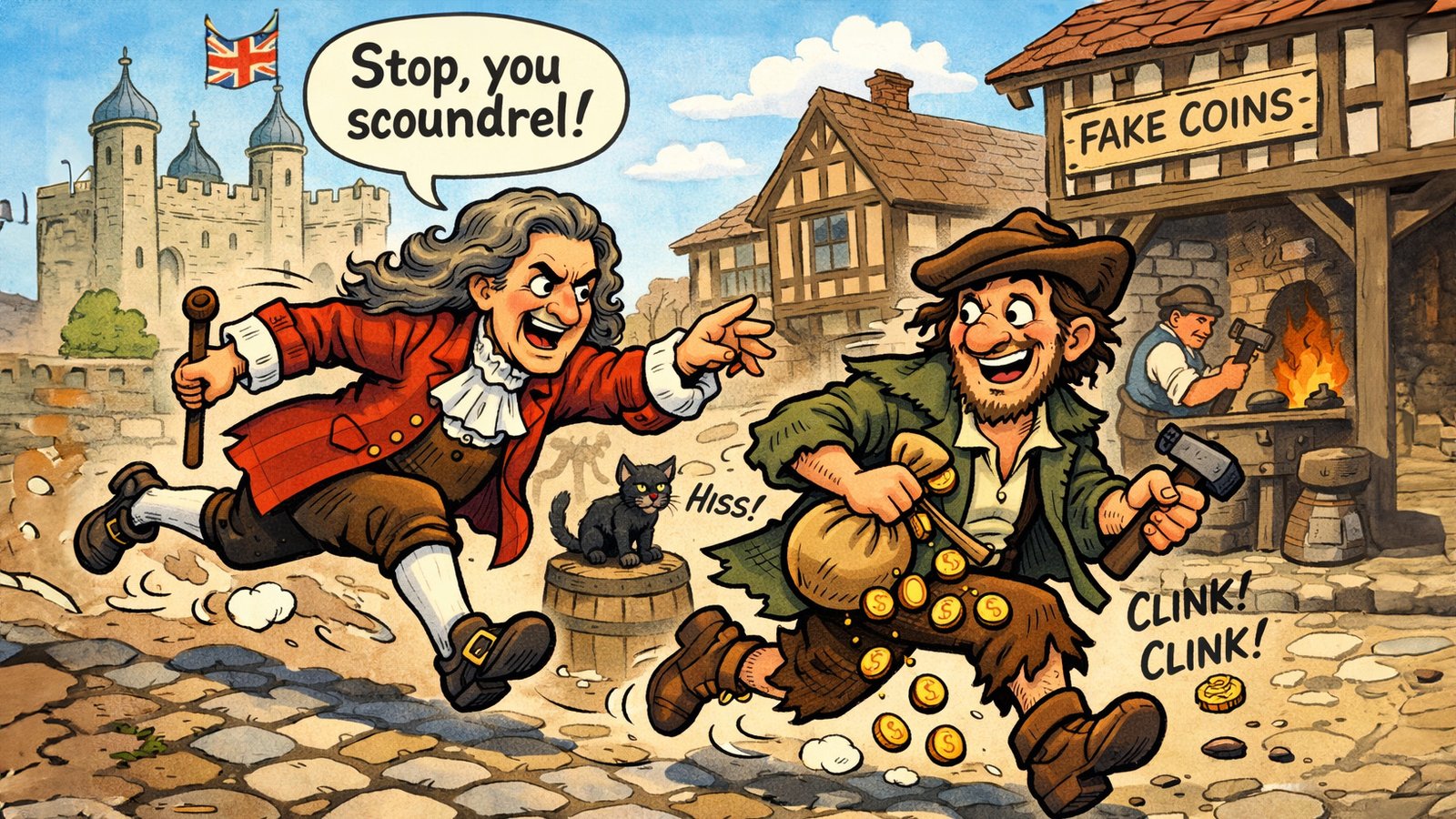
Strip away the familiar image of Isaac Newton beneath an apple tree and a stranger figure emerges. The man who explained gravity and reshaped mathematics also put on disguises, drank in grimy London taverns, and questioned hardened criminals face to face. It sounds implausible, yet this was no brief eccentric episode. For a substantial stretch of his later life, Isaac Newton abandoned the quiet of the study for the noise and danger of the city, transforming himself into a relentless criminal investigator. For nearly three decades, Britain’s greatest scientific mind hunted the kingdom’s most dangerous counterfeiters with the same cold precision he once applied to the laws of nature.
The saga began in 1696. Newton, mentally exhausted after decades of scientific work, needed a change. He bombarded his friend Charles Montagu, Chancellor of the Exchequer, with letters begging for a job in London. Montagu eventually replied with an offer: Warden of the Royal Mint. Newton accepted at once. Most people regarded the post as a cushy sinecure—a ceremonial role that paid well and demanded little. Previous wardens had treated it like an extended holiday. Newton did the opposite.
England’s currency system sat on the brink of collapse. Nearly ten percent of coins circulating were fakes. Criminals known as clippers shaved silver from the edges of hand-struck coins made before 1662. The newer machine-struck coins, with milled edges, stopped clipping overnight. Counterfeiters adapted instead. Because silver bullion fetched higher prices abroad than English coins did at face value, smugglers melted down vast quantities and shipped them to France. The entire monetary system teetered.
Newton rolled up his sleeves and took control. He masterminded the Great Recoinage, a vast operation that involved millions of pounds’ worth of silver. He organised 500 men at the Tower of London and set up branch mints in Bristol, Chester, Exeter, Norwich, and York. Working six days a week from four in the morning until midnight, his teams increased output from 15,000 coins a week to 50,000. Between 1696 and 1699, they struck more than £5.1 million in silver.
Another part of the job troubled Newton far more. As Warden, he had to track down and prosecute counterfeiters. He wrote to the Treasury asking for exemption. They refused and told him to get on with it. Once Newton accepted the task, he attacked it with the same rigour he had once applied to physics. London had no police force at the time, so Newton built his own intelligence network from nothing.
He recruited spies and informants across eleven counties. Records show him tracking criminals to their hideouts himself. He became a regular visitor to rat-infested Newgate Prison, where he conducted more than 58 interviews. Between June 1698 and December 1699, Newton personally carried out over 100 cross-examinations. The most surprising detail comes next: Newton went undercover. The man who had reshaped mathematics disguised himself and drank in notorious taverns, buying rounds, cultivating contacts, and recruiting informants while posing as an ordinary punter.
His methods were meticulous and unforgiving. Newton weighed coin clippings, measured cut depths, and analysed alloy compositions. He treated counterfeiting as a system that required understanding before destruction. His interrogation style unsettled witnesses. He did not shout or rage. Instead, he stayed silent, let suspects talk themselves into contradictions, then calmly produced the evidence. He waged psychological warfare with scientific discipline.
During his tenure, Newton secured convictions against 28 counterfeiters. Most ended their lives at the gallows. The law classed counterfeiting as high treason, a crime punishable by death. Newton’s greatest test arrived in the shape of William Chaloner, a criminal who made the fatal mistake of challenging him openly.
Chaloner possessed real talent. Born around 1650 into poverty, he began as a nail maker before turning to fraud. By his own account, he counterfeited roughly £30,000. He produced fake coins and sold counterfeit French pistoles, guineas, crowns, half-crowns, banknotes, and lottery tickets. He also worked as a quack doctor, played the soothsayer, and masqueraded as an anti-Jacobite agent.
Unlike most criminals, Chaloner courted attention. He boasted that his counterfeits were so perfect that spending them pained him. He lived in Knightsbridge, rode in a carriage, dressed well, and styled himself a gentleman. Then he committed a spectacular error: he tried to insert himself into the running of the Royal Mint.
Before Newton arrived, Chaloner wrote to the government claiming Mint employees sold duplicate coin casts. He failed to mention that he knew this because he had bought such casts himself. Newton learned of the letter and immediately launched an investigation, interviewing more than 30 suspects. Chaloner soon revealed his real ambition—he wanted Parliament to put him in charge of the Mint. He followed this with pamphlets and testimony accusing Newton of incompetence and possibly fraud.
At that point, the matter turned personal. Newton could not tolerate the insult. He pieced together evidence linking Chaloner to much of London’s counterfeiting and pursued him relentlessly for nearly three years. He planted informers inside Chaloner’s circle, cultivated relationships with former mistresses, bribed associates, and turned forgers into witnesses. One spy, John Peers, rejoined Chaloner’s operation in Egham and produced 18 forged shillings to help secure convictions.
Newton assembled a formidable case. He gathered more than 200 depositions tying Chaloner to counterfeit coins and forged lottery tickets. He documented every detail with obsessive care. By early 1699, the evidence formed a net Chaloner could not escape. The trial moved quickly. A court convicted Chaloner of high treason on 3 March 1699.
From his cell in Newgate, Chaloner wrote frantic letters to Newton pleading for mercy. His final appeal ended with the words: “Oh dear Sir nobody can save me but you. O God my God I shall be murdered unless you save me.” Newton never replied. On 22 March 1699, guards dragged Chaloner through filthy streets to Tyburn. He protested to the crowd that the law was murdering him. The rope killed him slowly, while onlookers treated the spectacle as entertainment.
Newton almost certainly stayed away. In his notebook, he recorded only that “Chaloner could have lived a long, honest life had he let the money and Government alone.” No triumph, no flourish—just a cold entry.
Afterwards, Newton ordered the destruction of his interrogation records. Historians still argue over what that implies. Some suspect intimidation or coercion. Torture was illegal, but hints suggest Newton may have tested limits. One associate, Thomas Carter, added a desperate postscript to a letter: “I shall have Irons put on me tomorrow, if yo[ur] Worship not order to the contrary.”
Debate continues. Critics portray Newton as vindictive and bloodthirsty. Others see a hard-headed administrator doing his job with ruthless efficiency. He sacrificed minor offenders to dismantle major operations, and some small players did receive pardons for testimony. What no one disputes is his lack of mercy toward those convicted.
The cat-flap legend still clings to him. According to the story, Newton cut holes in his door so his cat—and its kittens—would stop interrupting experiments. The tale charms because it softens an austere figure. It also collapses under scrutiny. People had installed cat holes in doors long before Newton. The myth survives because it humanises him.
In 1699, Newton became Master of the Mint and remained in the post until his death in 1727. His 1717 report fixed a new gold-to-silver ratio and nudged Britain onto the gold standard. The ridged edges on modern coins trace back to his reforms. His relentless precision restored the Mint’s reputation and made British coinage the most trusted in Europe.
What fascinates most is the continuity. Newton chased gravity, prophecy, and criminals in the same way. He defined systems, measured forces, and eliminated uncertainty. London’s forgers were simply another set of bodies in motion, obeying laws he believed he could expose.
So next time you picture Newton, don’t stop at the apple tree. Picture him instead in a smoky tavern, disguised and watchful, building cases that sent men to the gallows. For him, crime-fighting was not a diversion from science. It was science, applied to the real world, with all its brutal consequences.