How Invention of Mechanical Clock Turned Hours into Power
Before the mechanical clock, time behaved with suspicious flexibility. It stretched in summer, shrank in winter, followed the sun, listened to bells, obeyed hunger, bowed to weather and took most of its instructions from nature rather than machinery. A medieval farmer did not wake up worrying that he had missed his 7:43 productivity window. He cared whether there was enough light to work, whether the animals needed feeding, whether the sky looked threatening, and whether the field in front of him had finally stopped behaving like an enemy.
Then Europe put machines in towers and taught them to shout at everyone.
That, more than the charming tick-tock nostalgia, explains why the mechanical clock mattered so much. It did not simply help people know the time. It helped institutions organise it, own it, announce it and eventually sell it back to human beings in neat little portions. The clock turned the hour from a loose experience into a public command. Once time could be divided, counted and heard across a town square, it could also be priced, disciplined and punished. Not bad for a machine that often started life in church buildings.
For most of human history, people measured time through events rather than abstract numbers. Sunrise opened the day, sunset closed it, market days gave the week structure, saints’ days shaped the calendar, and seasons ruled agricultural life with the casual tyranny of mud, frost and harvest. People had deadlines, of course. Medieval society was not one long rustic picnic interrupted by lute music. Rents had to be paid, courts had to sit, goods had to arrive, prayers had to happen and rulers had a remarkable talent for demanding things at inconvenient moments.
Still, the older relationship with time was different. A task often defined the working period. You worked until the bread was baked, the sheep were moved, the field was cut, the wall was repaired or the light gave up. Even the medieval hour could vary. In older systems, daylight and darkness were divided into twelve parts each, which meant a daytime hour in June could last longer than a daytime hour in December. Time followed the sky, which at least had the decency to look beautiful while ruining your plans.
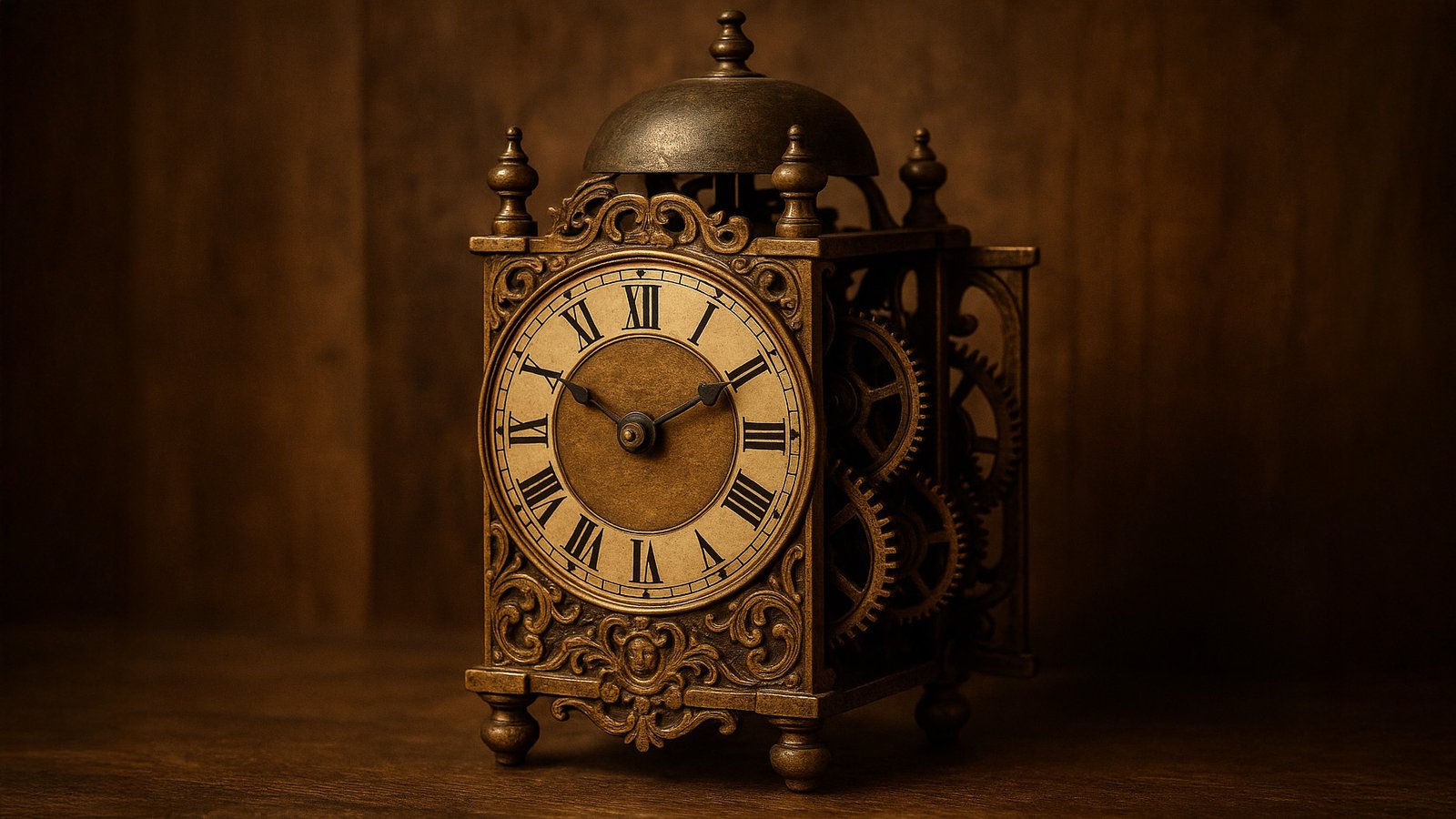
The mechanical clock changed this relationship because it helped detach time from nature. Its crucial trick was the escapement, the mechanism that controlled the release of energy from a falling weight. Without it, a weight would simply drop and the whole thing would become a very expensive demonstration of gravity. With it, energy moved in regulated bursts. The clock could keep beating, measuring and eventually striking. Early clocks were not exactly models of Swiss perfection. Many drifted, needed adjustment and lacked minute hands. Some had no public face at all. But they had bells, and bells mattered.
A clock face informs anyone who looks at it. A bell informs everyone whether they like it or not. When a clock sat in a tower, time travelled through the air as sound. It crossed streets, workshops, markets and courtyards. It told people when to pray, when to gather, when to trade, when to begin, when to stop and when authority wished to be noticed. In that sense, the public clock was not just a device. It was an early management system with better acoustics than most modern offices.
The monastery gave clock-time one of its first homes. Monastic life depended on rhythm, repetition and obedience. Prayer followed the canonical hours: Matins, Lauds, Prime, Terce, Sext, None, Vespers and Compline. Someone had to wake the community, including at night, because holiness apparently did not respect sleep patterns. Before mechanical clocks, monasteries used sundials, water clocks, candle clocks and human watchfulness. The point was not modern precision but disciplined regularity. Life had to bend around sacred order.
That is why Lewis Mumford’s famous claim still bites: the clock, not the steam engine, was the key machine of the modern industrial age. He did not mean that monks secretly invented shift work while pretending to chant psalms. He meant that the habit of dividing life into regulated units came before the factory. The monastery helped train Western Europe to imagine time as something that could be structured, obeyed and repeated. The sacred timetable came first; the office calendar arrived later wearing worse clothes.
By the fourteenth century, public clocks had become civic trophies. Milan had one of the first known public clocks to strike the hours in 1335, and other European towns followed. These machines were expensive, complex and highly visible. A city clock told residents and visitors that this was a place of order, technical skill and civic confidence. It also told everyone that the town, not the sun, now had something to say about the day.
This mattered especially in commercial towns. Markets needed opening and closing times. Courts needed schedules. Guilds needed rules. Merchants needed predictable durations for journeys, debts, bills, fairs and deliveries. The more complicated urban life became, the less useful vague time felt. Trade likes precision because profit hates ambiguity. A delayed ship, a late payment, a missed market or an idle worker could all translate into lost money.
A sharp example comes from Aire-sur-la-Lys in northern France. In the mid-fourteenth century, the town gained permission to build a belfry whose bells would regulate commercial dealings and the working hours of textile workers. That little historical detail says a great deal. The bell no longer called only souls to prayer. It called bodies to labour. The same sound that once organised spiritual duty now organised economic output, and nobody even needed to invent a motivational poster.
The medieval historian Jacques Le Goff described this wider shift as a tension between church time and merchant time. Church time looked towards salvation, ritual and sacred rhythm. Merchant time looked towards calculation, transport, risk, credit and profit. The merchant needed to know when a bill came due, how long a journey took, when prices might change, when fairs opened and when workers should appear. Time became measurable because money demanded it.
That is the real turning point. Time stopped being only a condition of life and became a resource. People began to speak of wasting time, saving time, losing time, spending time and stealing time. These phrases now sound ordinary, almost harmless. Yet they reveal a major cultural shift. If time can be wasted, someone will try to prevent waste. If time can be saved, someone will try to optimise it. If time can be stolen, someone will appoint himself the victim and produce a policy document.
E. P. Thompson captured this transformation beautifully when he wrote that time had become currency: it was no longer passed, but spent. Once that idea takes hold, the clock becomes more than a convenience. It becomes a judge. A worker who arrives late has not merely followed a different rhythm. He has taken something. A pause becomes suspicious. A slow morning becomes indiscipline. The employer watches the clock because the clock defines what has been bought. The worker watches the clock because the clock defines what has been surrendered.
Before industrial capitalism reached its full force, much work followed what Thompson called task-time. The job governed the rhythm. A worker might be paid for a task, a craft, a delivery or a season. The work could be exhausting and insecure, so there is no need to turn the past into a cosy village fantasy. Still, the logic differed from the later wage system. Clock-time increasingly meant that employers bought slices of the worker’s day, not just a finished piece of work. The hour itself became the product.
Factories later intensified this logic, but they did not invent it from nothing. The tower clock, workshop bell, market schedule and town belfry had already prepared people to accept public, standardised time. Industrialisation simply made the arrangement louder, stricter and more profitable. The machine in the tower became the machine at the gate, and eventually the machine on the wall next to the punch card.
Astronomical clocks add another layer to the story. Figures such as Richard of Wallingford, the fourteenth-century Abbot of St Albans, and Giovanni Dondi, who completed his astonishing Astrarium in the 1360s, built clocks that did more than mark hours. They modelled the heavens. These devices displayed planets, celestial cycles and cosmic order. They suggested that the universe itself could be understood as a kind of mechanism, full of wheels, ratios and predictable motion.
That symbolism made clocks powerful in another way. A cathedral, abbey, palace or city that owned a great clock did not merely own a practical device. It owned a public claim to knowledge. The clock said: we understand order, we command technique, we can place the movements of heaven into metal. Medieval power loved that sort of message, especially when it could be mounted high enough for everyone else to feel appropriately small.
The modern world still lives inside the clock’s victory. Trains, schools, courts, hospitals, banks, airports, armies, newsrooms and offices all depend on standardised time. Without it, large-scale coordination would collapse into a very British queue of people politely asking whether anyone knows what is happening. Mechanical time made complex society possible. It helped strangers cooperate across distance, trade and institution.
Yet the price of that coordination sits in our pockets. The medieval bell tower has become the phone alarm, the calendar notification, the meeting reminder, the delivery slot, the timesheet, the screen-time report and the cheerful productivity app that gently implies you are failing as a person. We no longer wait for the town bell to strike. Our devices strike all day, usually with less architectural dignity.
The invention of the mechanical clock did not transform Europe overnight. Older rhythms survived. Farmers still watched weather, sailors still watched tides, and communities still followed festivals and seasons. But over time, the clock made hours more uniform, public and enforceable. It turned time into something that could be announced by a bell, written into a contract, priced by a merchant, demanded by an employer and regretted by anyone arriving five minutes late.
That is why the mechanical clock deserves its reputation as one of history’s quiet revolutions. It did not conquer by army, manifesto or royal decree. It conquered by repetition. Tick by tick, bell by bell, it taught societies to think of life as divisible, measurable and accountable. The clock made time visible. The bell made it public. Commerce made it valuable. Labour discipline made it punishable. After that, an hour was never just an hour again.s intricate as the clocks that shaped them.