How Britain Lost 11 Days Overnight
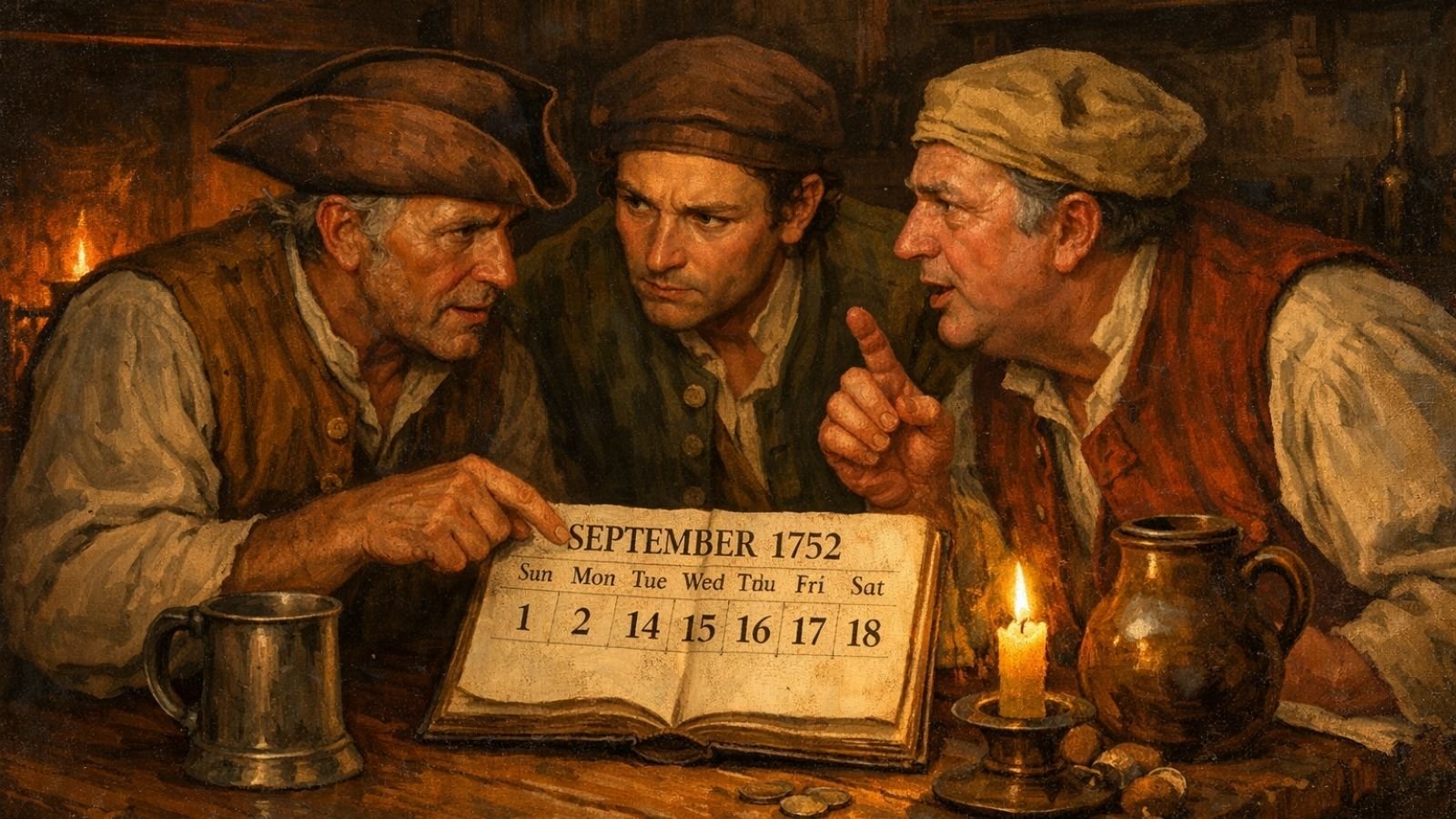
Britain did not wake up one morning feeling slightly less alive, yet in September 1752 something quietly unsettling happened. The country went to bed on Wednesday the 2nd and opened its eyes on Thursday the 14th. As a result, eleven days vanished without ceremony. No plague followed, no comet appeared, and no invasion arrived. Instead, there was only a line in an Act of Parliament and a calendar that suddenly refused to behave as it always had.
For modern readers, this sounds like a curiosity. However, for people living through it, the experience felt sharper. Time was not an abstract grid pinned to walls. Instead, it governed rents, wages, saints’ days, markets, fairs, debts, birthdays, and funerals. When the dates jumped, all those things wobbled at once. Unsurprisingly, many Britons felt something had been taken from them.
The roots of the problem stretched far back into Roman history. At the time, the calendar Britain used in the eighteenth century was already old when the Anglo-Saxons arrived. It assumed the year lasted exactly 365 and a quarter days. In reality, the solar year is slightly shorter. Because of that, the mismatch accumulated quietly, century after century. Meanwhile, seasons drifted away from dates. Gradually, spring crept earlier and religious festivals slid out of alignment with the sky.
By the early modern period, the error could no longer be ignored. Across the Channel, continental Europe had already corrected it in the sixteenth century. Britain, however, hesitated. The correction came from Rome, which made it politically awkward. Accepting it felt suspiciously Catholic. In a country that still remembered the Reformation with feeling, astronomical accuracy ranked below theological independence.
As a result, Britain delayed for nearly 170 years. During that pause, the problem worsened. What had once required the removal of ten days now demanded eleven. By the middle of the eighteenth century, Britain found itself visibly out of step with most of Europe. Consequently, merchants, diplomats, and scientists increasingly complained. Time itself had become inconvenient.
The solution arrived not as a philosophical debate but as legislation. In response, Parliament passed the Calendar (New Style) Act in 1751. Its language sounded reassuringly administrative. It spoke of alignment, uniformity, and order. At the same time, it promised that no one would lose money or legal standing. The text insisted that the reform would merely correct an error rather than change reality.
Reality, unfortunately, did not receive the memo. Under the Act, two reforms happened at once. First, Britain abandoned the old habit of starting the legal year on the 25th of March. From 1752 onwards, the year would begin on the 1st of January, as it already did in much of Europe. Second, the calendar would jump forward by eleven days to bring it back into line with the sun.
This second change caused the shock. Wednesday the 2nd of September 1752 was followed by Thursday the 14th. In effect, the dates in between ceased to exist. They were not postponed, nor were they renamed. Instead, they were erased.
For officials and astronomers, this looked like a tidy correction. For ordinary people, however, it felt as though time had developed holes.
Daily life depended on dates more than theory. Rent was often due on quarter days. Likewise, wages followed weekly or monthly rhythms. Fairs opened on fixed saints’ days, and debts matured on agreed dates. Therefore, when eleven days vanished, people immediately wondered who would benefit.
Parliament insisted that obligations would simply shift forward. A rent due on the old date would now be due eleven days later. Similarly, a contract measured by months would remain the same length. In theory, no one lost anything.
In practice, trust mattered more than theory. Landlords collected rents. Employers paid wages. Courts enforced debts. All of these institutions already sat above the labouring population. Moreover, the calendar reform arrived from the same direction. Even if the law promised fairness, many assumed fairness would evaporate at ground level. To them, a missing date looked suspiciously like a missing pay packet.
Confusion deepened because timekeeping was uneven. Many households did not own printed calendars. Instead, people tracked time through church bells, market days, and seasonal cues. Suddenly, the familiar rhythm stuttered. Bells rang on unexpected days. Market schedules shifted. Festivals arrived out of season.
Religious unease further sharpened the mood. The reform traced its origins to a Catholic pope. As a result, pamphlets warned of papal influence creeping back into English life. Sermons framed the change as spiritual interference disguised as science. For those already wary of authority, the calendar became another battlefield.
Later generations loved to imagine riots erupting in the streets. Prints showed crowds demanding their eleven days back. Over time, the slogan “Give us our eleven days” became part of popular memory. In reality, evidence for widespread violent unrest is thin. Nevertheless, something subtler and arguably more interesting did exist.
People argued. They complained, they petitioned, they grumbled in taverns and marketplaces. At the same time, they suspected manipulation. They felt mocked by officials who insisted that nothing had changed while everything felt different.
The image of riots survives because it expresses a truth, even if the events themselves were exaggerated. Specifically, the reform symbolised a moment when everyday experience collided with administrative logic. Time stopped belonging to communities and started belonging to paperwork.
This tension appeared elsewhere too. For example, Sweden attempted to ease the transition by gradually removing leap days. The plan collapsed. Instead, the country accidentally invented the 30th of February before giving up and jumping forward anyway. Russia waited until the twentieth century, when thirteen days vanished overnight after the revolution. In each case, the same pattern repeated. Officials corrected calendars, while people questioned motives.
Britain’s experience stands out because it arrived alongside broader social change. By then, the eighteenth century already felt unstable. Enclosures reshaped land ownership. Industrial rhythms crept into work. Urban life accelerated. Against this backdrop, losing eleven days felt less like a correction and more like another reminder that the old certainties were slipping.
Birthdays disappeared. Anniversaries evaporated. Meanwhile, legal ages shifted. Someone born in early September could suddenly find their birthday had never technically occurred. These details sound trivial until you imagine explaining them to a court, a landlord, or a parish clerk.
Over time, the panic faded. New calendars replaced old ones. Eventually, children grew up never knowing the missing days. The reform succeeded because it had to. After all, a society cannot function with multiple competing timelines forever.
Yet the memory lingered. The story of the lost eleven days became shorthand for something larger. In effect, it captured a moment when authority rewrote a shared framework without fully carrying the population along. It revealed how deeply time anchors trust.
Britain did not truly lose eleven days. The sun still rose and set as usual, and seasons kept their pace. What vanished instead was confidence. People realised that even something as basic as the calendar could be changed by decree. That realisation stayed unsettling long after the dates themselves were forgotten.
In that sense, the reform worked perfectly and failed socially at the same time. It fixed the sky and disturbed the ground. Britain gained a more accurate calendar but briefly lost faith in how time was meant to behave. Eleven days became the price of learning that time, once administered, never quite feels neutral again.