How Bombay Became Mumbai: Cotton Booms, Empire Dreams and a City Reborn
Mumbai never settles for a straightforward story. The place began as seven wind-battered islands inhabited by Koli fishermen, only to end up as the throbbing financial capital of India. Somewhere in between it became a Portuguese dowry, a British corporate experiment, a global cotton nerve centre and a city whose fortunes could be rewritten overnight by a war happening across the Atlantic. It’s hard to name another metropolis where geography, empire and sheer opportunism collided so energetically.
The Portuguese originally treated the islands as a useful foothold on the Arabian Sea, but the British East India Company saw something more ambitious. Once Charles II received the islands as part of his marriage to Catherine of Braganza and promptly leased them to the Company, the transformation began. The British found a natural harbour that practically begged for ships, warehouses and hopeful merchants. They also found a problem: the islands weren’t connected to each other. Much of the early colonial energy went into plugging tidal gaps, building causeways and reclaiming land so the place stopped behaving like a cluster of soggy stepping stones.
The name of the city tells its own complicated story before we even get to the engineers. The word Bombay likely emerged from the Portuguese “Bombaim,” itself probably derived from an older local phrase meaning “good bay,” though folklore insists it honoured the goddess Mumbadevi. The British clung to Bombay for centuries, stamping it on maps, legal documents and railway boards with the confidence of people certain their labels would last forever.
After independence the name persisted through habit and global usage, but by the 1990s the political mood shifted. Regional leaders wanted a name that reflected the city’s Marathi roots rather than its colonial pronunciation. In 1995 the state government officially restored the name Mumbai, weaving together linguistic history, cultural pride and a clear desire to reclaim the narrative. The change didn’t silence Bombay entirely—many still use it out of nostalgia or stylistic preference—but Mumbai became the city’s formal identity, signalling a step away from empire and towards self-definition.
Commerce arrived with the engineers. Merchants poured in from all over India and beyond. Parsis built trading houses; Gujaratis knitted together networks stretching from Muscat to Manchester; Baghdadi Jews set up shop with an instinctive understanding of credit. Bombay, as the British insisted on calling it, turned into a layered bazaar of ambition long before skyscrapers came into fashion. The city hummed with possibility, tobacco smoke and the irresistible sense that fortunes could be made quickly if one simply placed the right bet.
Cotton became the city’s favourite gamble. By the early 1800s the Deccan Plateau was producing mountains of raw cotton, and Bombay’s harbour offered the perfect exit route for British ships craving the fibre to feed the hungry mills of Lancashire. Cotton didn’t just provide export revenue. It altered neighbourhoods, reconfigured migration patterns and filled the city’s evenings with a new chorus: the clattering of press houses and the muttered calculations of brokers who swore they’d cracked the global market.
Then the American Civil War swaggered into the plot like a disruptive guest. When the war began in 1861, the Confederate South stopped exporting cotton. Britain panicked. Lancashire mills faced closures; workers queued for relief; newspapers muttered about catastrophe. Bombay, meanwhile, discovered that the universe occasionally hands out winning lottery tickets. Cotton prices soared. Merchants who had been merely comfortable became spectacularly wealthy. Middle-class speculators mortgaged ancestral homes because everyone assumed prices would escalate forever. Cotton mania had arrived.
During those feverish years Bombay felt like a frontier town masquerading as a port city. Brokers raced across Hornby Row with the latest price rumours. Ships loaded with cotton left the harbour at a pace the clerks in the counting houses could barely keep up with. People who had never before touched speculative trades suddenly behaved like seasoned financiers. Cotton became not just a commodity but a collective obsession. The city tasted what fast money felt like, and it liked it a bit too much.
Then peace returned to America. Cotton from the South poured back into global markets. Prices collapsed. Bombay’s cotton bubble ended with a sort of theatrical cruelty. Merchants went bankrupt. Brokerage houses folded like weak umbrellas. Families that had boasted of their savvy one year were quietly selling jewellery the next. The crash of 1865 became a defining cautionary tale: Mumbai, long before it learned to build skyscrapers on reclaimed land, first learned how to build a financial system on exuberance and rueful hindsight.
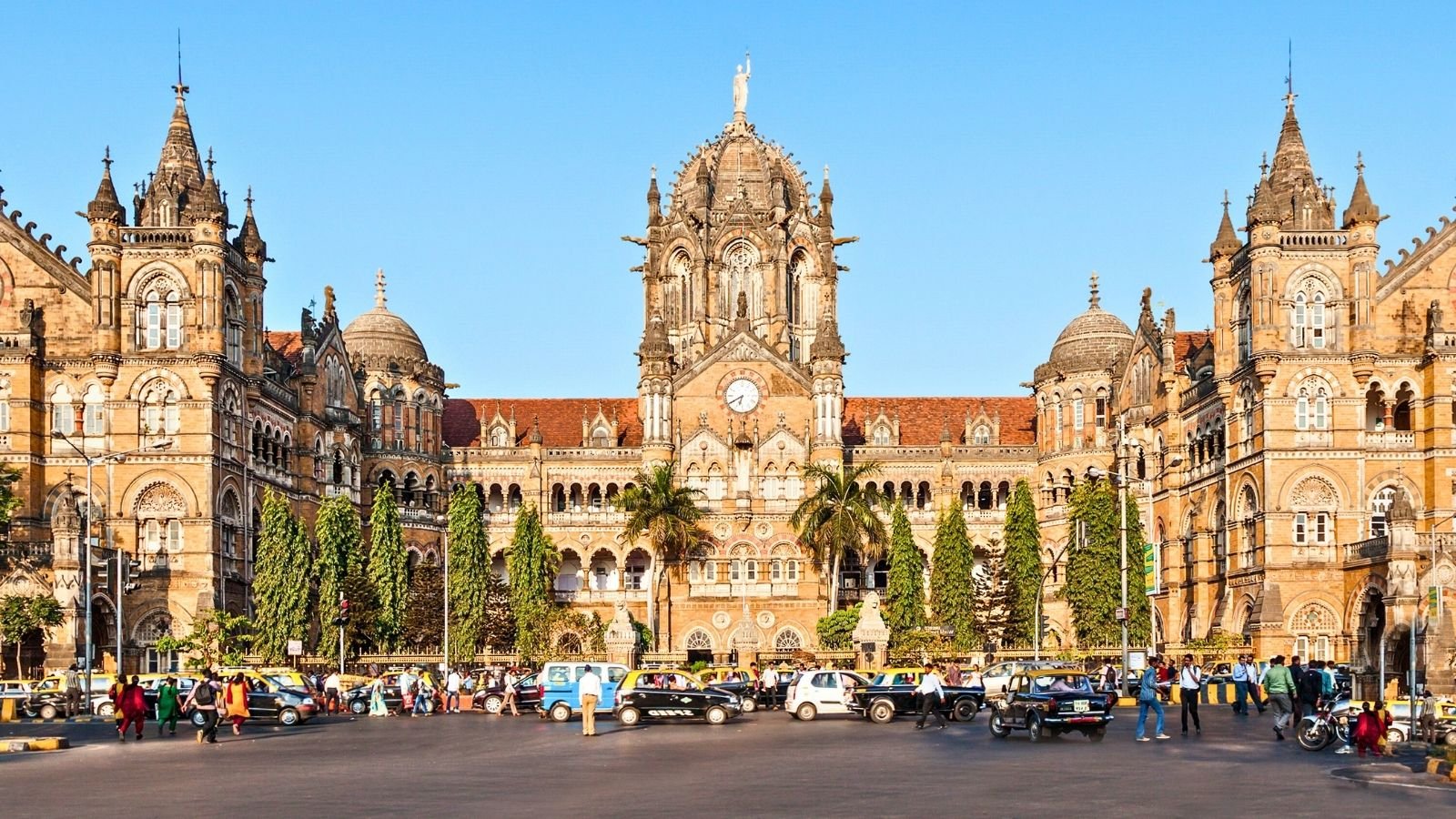
Yet the city absorbed the shock and kept going. The accumulated wealth from the boom left visible marks all over South Bombay in the form of public buildings, liberal institutions and architectural statements that still make visitors tilt their heads upwards in admiration. This was the age when British confidence wrapped itself in stone. Indo-Saracenic domes rose beside Gothic spires; decorative tiles and carved brackets announced a curious combination of imperial authority and local craft. The merchants who had profited from cotton endowed colleges, libraries and museums in a gesture that mixed philanthropy with quiet reputation-polishing.
Nothing captures this era better than the building once known as Victoria Terminus, now Chhatrapati Shivaji Maharaj Terminus. Standing in the middle of that monument today feels like attending a Victorian costume party that forgot to end. The station began as the headquarters of the Great Indian Peninsula Railway, the organisation responsible for hauling cotton from the interior to the port. Designed by Frederick William Stevens, the building luxuriates in every Gothic flourish imaginable: turrets, stained glass, pointed arches and enough stone ornamentation to keep an army of sculptors employed.
Victorian Britain adored symbolism, and Victoria Terminus became an architectural victory lap celebrating imperial engineering and economic muscle. It signalled to everyone, from newly arrived traders to Indian princes, that Bombay wasn’t just another colonial outpost. It was a global player. Trains rumbled in with cotton bales, clerks scribbled ledgers, and outside the station hawkers sold snacks to men whose entire livelihoods depended on the exact price of the fibre being discussed in distant chambers.
The station’s story didn’t freeze in time, though. Twentieth-century Bombay introduced new players, new tensions and new transformations. Textile mills multiplied across the city, drawing migrant labourers who filled chawls built with the fuzzy optimism of mill owners convinced the good times would roll on forever. Labour unions emerged, and with them the kind of political ferment that made colonial administrators shift uncomfortably in their chairs. As the independence movement gathered momentum, Bombay’s mills and working-class neighbourhoods became hubs of mobilisation.
The architecture paid for by cotton profits witnessed not just imperial pride but its erosion. Meetings, protests and student gatherings unfolded in the shadow of those Gothic facades. Streets that once echoed with the clatter of horse hooves began to fill with voices demanding self-rule. Victoria Terminus, the jewel of Bombay’s colonial infrastructure, became a sort of theatre for the changing mood of a nation that no longer wished to supply an empire’s demands without having a say in its future.
Over time the city diversified far beyond cotton. Film studios replaced mills; financial institutions replaced warehouses; and neighbourhoods that once smelt of fibre dust gradually shifted to other economies. The renaming of Victoria Terminus to Chhatrapati Shivaji Terminus in the 1990s, later updated to Chhatrapati Shivaji Maharaj Terminus, signalled more than administrative tidying. It signalled the city’s desire to describe itself in its own vocabulary rather than the language of its former rulers.
The station remains an architectural marvel cherished by commuters, tourists and architectural obsessives alike. Its presence reminds the city of the unlikely chain of events that made it possible: the tides that shaped the islands, the ambitions of a foreign trading company, the cotton grown under a hot Deccan sun and a faraway war that briefly turned Bombay into the global capital of commodity speculation.
Mumbai’s colonial story isn’t a neat narrative. It’s a mosaic built from gamble and grit, from people who arrived with nothing and others who arrived with imperial mandates. It’s a reminder that a city can be both a product of empire and a stubborn force that reshapes the very powers trying to control it. Above all, it’s a tale of how global events, from American battlegrounds to Lancashire mills, can sculpt the streets where millions now weave through trains, markets and the ever-present possibility of reinvention.