Herodotus and the Ancient Art of Asking Why
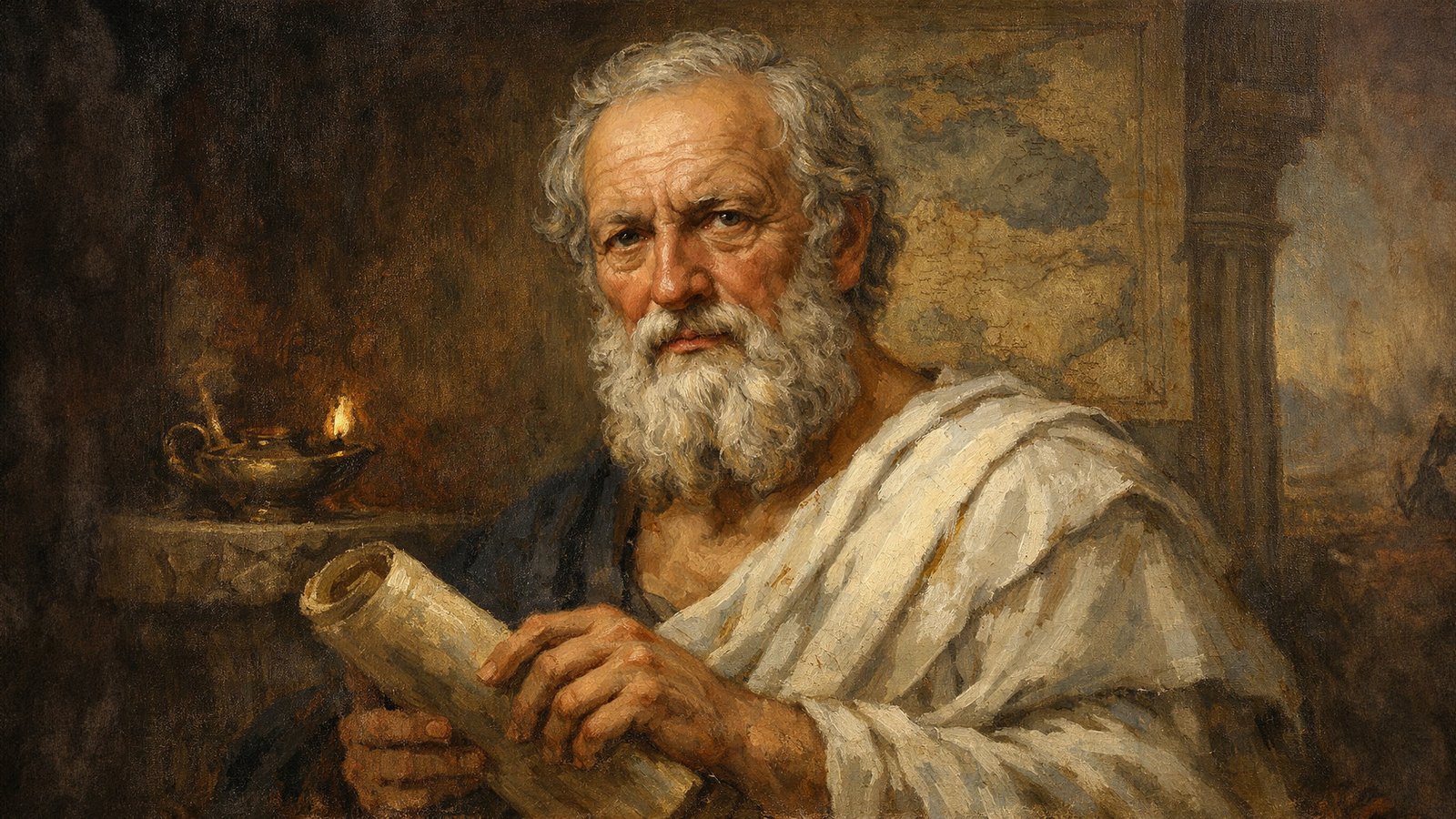
Herodotus arrived in the world around 484 BCE, in the city of Halicarnassus, on the south-western edge of what is now Turkey. At the time, this Greek city lived under Persian rule, and that single fact shaped everything that followed. He never grew up inside a clean opposition between “us” and “them”. Instead, he learned early that power looks different depending on where you stand, and that loyalty often bends under pressure rather than snapping cleanly.
Halicarnassus spoke Greek, paid Persian taxes, obeyed Persian governors, and traded constantly across the Aegean. As a result, Herodotus grew up surrounded by overlapping loyalties rather than clear borders. Greeks were not abstract heroes waiting for epic poetry. Persians were not distant villains lurking beyond the horizon. They were administrators, neighbours, soldiers, merchants, and employers. History, for him, never started as a moral fable with assigned roles.
The world he inherited was unstable, and it rarely paused long enough to feel secure. The Persian Empire expanded at astonishing speed under Cyrus the Great and his successors. Lydia fell, Babylon followed, and Egypt soon joined them. Consequently, Greek cities along the coast of Asia Minor lived with the daily reality of imperial power. Meanwhile, mainland Greece simmered with rivalries, alliances, vendettas, and grudges that shifted with exhausting speed and little warning.
Herodotus wrote one surviving work, later titled the Histories. The name matters, because in his Greek, historia meant inquiry rather than record-keeping. He did not promise a tidy account of events neatly filed by year. Instead, he promised to investigate why humans repeatedly ended up killing one another on such a grand and often unnecessary scale.
The Persian Wars provide the backbone of the narrative. Marathon, Thermopylae, Salamis, and Plataea all appear in due course. Yet the road to those battles takes long detours, and those detours are deliberate. Before an army marches, Herodotus explains how a river behaves, how a people bury their dead, how a king was raised, and what rumours and omens circulated at court. Causes matter more than dates, and atmosphere matters more than chronology.
He travelled extensively to collect these explanations, because second-hand certainty rarely satisfied him. Egypt left the deepest mark. He walked along the Nile, spoke with priests, observed embalming practices, and tried to understand a civilisation far older than Greece. He described crocodiles, hippos, cats, sacred rituals, and the annual flooding that made Egyptian agriculture possible. Some details were wrong. Nevertheless, many were startlingly accurate, especially given the limits of language and translation.
Egypt also unsettled Greek assumptions. Its gods behaved differently. Its customs reversed familiar norms. Women owned property. Cats received reverence. The dead required careful preparation for eternity. Herodotus does not mock these differences. Instead, he records them with the fascination of someone discovering that the world does not owe him familiarity.
He also visited Babylon, Tyre, mainland Greece, the Black Sea region, and parts of southern Italy. Wherever he went, he returned to the same questions. How do you live? Who rules you? What do you fear? Which stories explain your past? He understood that answers to these questions shaped political behaviour long before armies assembled.
Herodotus rarely pretended to certainty, even when readers wanted it from him. He distinguished carefully between what he saw himself, what others told him, and what he personally found implausible. He often wrote several versions of the same story side by side. Rather than resolving contradictions, he exposed them and let them stand, trusting readers to notice the tension.
This habit unsettled later audiences, particularly those trained to expect verdicts. Critics accused him of gullibility, exaggeration, and even dishonesty. Plutarch famously attacked him for bias and malice centuries later, accusing him of enjoying Greek failures. Yet Herodotus never claimed neutrality. He claimed curiosity, which was a different and riskier position.
Strange stories fill his pages, especially at the edges of the known world. In distant lands, he reports gold-digging ants, winged snakes, and unfamiliar peoples living far from Greek experience. These passages provoked laughter for centuries. However, archaeology and anthropology later suggested that many of these tales preserve distorted observations of real animals, customs, or geological phenomena. Exaggeration often travelled faster than fact, especially along trade routes.
Numbers caused equal controversy. Herodotus describes Persian armies numbering in the hundreds of thousands, and modern historians object on logistical grounds. Yet these figures likely reflect how power communicated itself at the time. Size functioned as intimidation. Recording those numbers preserves the psychology of empire, even if the arithmetic fails.
Crucially, Herodotus refused to treat Greeks as morally superior by default. Persian kings receive nuanced portraits throughout his work. Cyrus appears disciplined and pragmatic, a ruler who understands limits until success tempts him to ignore them. Darius emerges as an organiser obsessed with order, measurement, and administration. Xerxes oscillates between ambition and anxiety, haunted by dreams, advisers, and the sheer scale of his own power.
Greek leaders fare no better. Pride, rivalry, and poor judgement plague them repeatedly. Alliances fracture under stress. Victories breed arrogance. Success encourages infighting. Herodotus presents courage and stupidity as frequent companions rather than opposites.
Dreams, prophecies, and oracles occupy serious space in his narrative. Herodotus understood that belief shapes action long before evidence intervenes. A king who trusts a dream changes policy. A general who misreads an oracle risks catastrophe. Whether the omen proves true matters less than the fact that people acted on it, sometimes with irreversible consequences.
This attention to belief makes him an accidental psychologist. He watches how fear spreads, how confidence hardens into recklessness, and how advisers soften warnings to survive court politics. Consequently, his history feels populated by recognisable personalities rather than marble statues.
His moral universe borrows heavily from Greek tragedy. Hubris invites collapse. Excess provokes correction. Success dulls judgement. These patterns repeat across cultures and centuries. History, for Herodotus, behaves like a long cautionary tale without a final moral or redemption arc.
He likely performed sections of his work aloud, rather than imagining silent readers. The rhythm of his prose suits listening. Digressions feel deliberate. Suspense builds gradually, while irony appears quietly. This was history as a shared social experience, not private study conducted in isolation.
Later historians, especially Thucydides, rejected this approach in favour of stricter causality. They preferred speeches, strategy, compression, and cold logic. Compared to them, Herodotus looked messy. Yet that mess preserved texture. Where others flattened events into analysis, he captured atmosphere, confusion, and hesitation.
Herodotus eventually settled in Thurii, a Greek colony in southern Italy founded as a pan-Hellenic experiment. There, removed from Athenian politics and factional pressure, he seems to have continued refining his work. He never finished smoothing it into a final form, and perhaps he never intended to. Inquiry, after all, resists closure.
His influence endured precisely because of his imperfections. Medieval scholars mined him for ancient knowledge. Early modern explorers recognised themselves in his curiosity and caution. Anthropologists now see him as an early ethnographer rather than a failed scientist.
Above all, Herodotus wrote against forgetting. Empires collapse. Archives burn. Victors rewrite memory. Stories survive longer, especially when recorded with care and doubt. He believed forgetting was more dangerous than error, because error could be corrected, while silence could not.
He did not invent history as a discipline. Instead, he invented attention. Attention to causes, to belief, and to how humans explain themselves when power, fear, and ambition collide.
That invention still holds. Long after his facts are debated, revised, or rejected, his questions remain unsettlingly familiar. Why do people ignore warnings? Why does success breed overconfidence? And why does power so often mistake itself for destiny?
Herodotus never answers these questions definitively. He simply refuses to stop asking them. In doing so, he leaves behind not a monument, but a method, one built on curiosity, patience, and an uncomfortable respect for complexity.