Groundhog Day: The Fear That Winter Might Never End
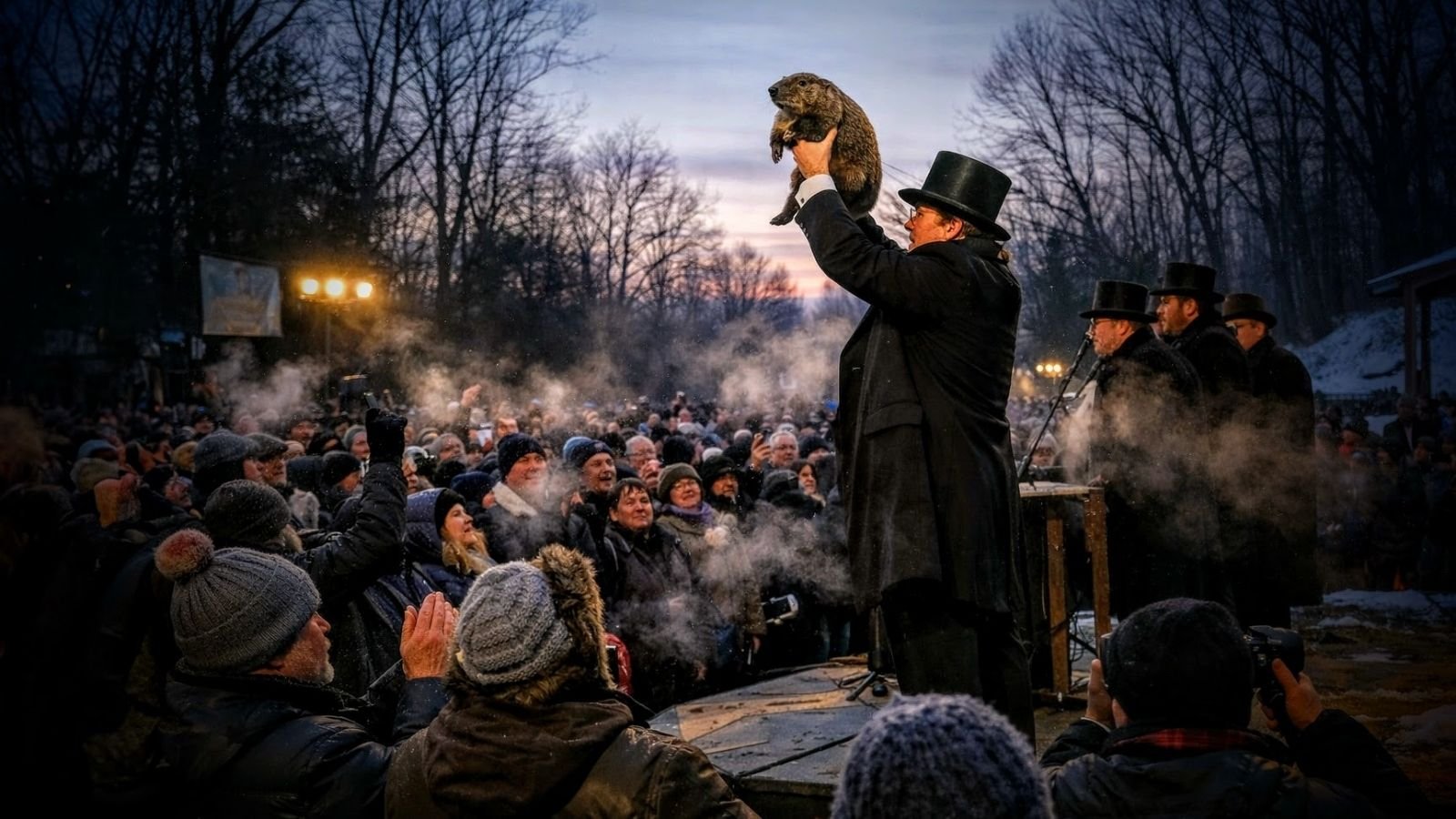
Groundhog Day arrives every year on 2 February, quietly wedged between winter’s worst moods and spring’s distant promises. It does not announce itself with fireworks or solemn rituals. Instead, it sends a half‑asleep animal into the cold morning air and asks it a question no creature could possibly answer. Then it waits.
That waiting matters more than the verdict. By early February, the novelty of winter has vanished, the holidays feel like folklore, and daylight still behaves as if it is doing us a favour. Yet something has shifted. The sun lingers slightly longer. Darkness retreats by minutes rather than hours, but enough to be noticed. Many cultures sensed this hinge in the year long before calendars became precise.
For centuries, early February functioned as a seasonal checkpoint. It sat roughly halfway between the winter solstice and the spring equinox, a liminal stretch when people asked whether winter would loosen its grip or tighten it again. Agricultural societies could not afford optimism without evidence, so they watched animals, clouds, frost, and light with obsessive care. As a result, patterns, even unreliable ones, felt safer than silence.
Across ancient Europe, this moment aligned with Imbolc, a festival tied to lambing season and the first signs of renewal. The land still looked frozen, yet underground life had begun to stir. Milk returned to ewes. Stored food demanded rationing. Consequently, hope had to be practical rather than poetic.
Christian Europe later absorbed this seasonal anxiety into Candlemas, held on the same date. Candles were blessed not because light had won, but because it was desperately needed. Over time, weather sayings attached themselves to the day with stubborn persistence. Clear skies suggested more cold ahead, while clouds hinted at mercy.
In German‑speaking regions, these sayings proved especially durable. If the sun appeared, winter would persist. If clouds ruled the sky, spring would hurry. These ideas did not emerge from scientific testing. Instead, they reflected lived experience. Clear winter days often arrived with biting cold, while overcast skies tended to trap warmth.
When German settlers crossed the Atlantic and settled in Pennsylvania, they carried this logic with them. However, they lacked the animals associated with it. Hedgehogs and badgers did not inhabit North American forests. The groundhog, by contrast, filled the gap with remarkable convenience.
The groundhog already occupied a place in local ecological knowledge. Farmers understood its habits. Hunters tracked its movements. Children watched its burrows. Folding it into seasonal folklore therefore felt less like invention and more like adaptation. Over time, old European sayings reshaped themselves around a new creature.
By the nineteenth century, rural newspapers in Pennsylvania reported groundhog predictions as local curiosities. These reports carried humour rather than authority. Nobody expected accuracy. Instead, people wanted rhythm. The year needed markers that felt human‑sized rather than astronomical.
Punxsutawney later transformed this modest custom into a public ritual. Gradually, the ceremony acquired layers of theatre, mock solemnity, and deliberate absurdity. Men in formal coats spoke on behalf of an animal that had not agreed to representation. A private language even emerged to translate its supposed thoughts.
Canada developed parallel traditions, each shaped by local temperament. In some towns, the tone leaned toward family festival. Elsewhere, satire dominated. Regional groundhogs offered competing predictions, occasionally contradicting each other within minutes. Rather than weakening the tradition, this inconsistency strengthened it.
From a scientific perspective, the predictions perform poorly. Long‑term studies place their accuracy well below modern forecasting methods. Yet this failure never damages the ceremony’s credibility, because credibility is not its currency. Groundhog Day does not promise truth. Instead, it promises participation.
The shadow itself carries symbolic weight. It depends entirely on sunlight rather than temperature. Bright days create shadows. Cloudy ones dissolve them. Consequently, the ritual links itself to light rather than warmth. Light signals change earlier than heat ever does.
Late winter operates psychologically more than physically. People crave confirmation that time is moving forward, even if the environment refuses to cooperate. A cloudy day often feels kinder than a brilliant, freezing one. The tradition encodes this preference without stating it openly.
Over time, the ceremony absorbed irony without losing sincerity. Participants understand the animal does not decide the season. Even so, they gather anyway. This coexistence of belief and disbelief gives the day its resilience.
The tradition also grants permission to laugh at winter without dismissing its power. Winter still controls travel, budgets, moods, and health. By making it negotiable, even symbolically, the ritual restores a sense of agency.
Popular culture eventually carried Groundhog Day far beyond North America. The idea of repetition, stasis, and slow awakening resonated globally. The date became shorthand for emotional loops and deferred change. Interestingly, this metaphor mirrors the original seasonal experience.
What often goes unnoticed is how precisely the date holds. It arrives early enough to matter, yet late enough to feel earned. A January ritual would seem premature. A March one would feel redundant. Early February balances anticipation with restraint.
Groundhog Day also avoids grand promises. It predicts six weeks rather than miracles. Six weeks feels survivable. It demands patience instead of faith. Even continued winter carries an endpoint.
In this sense, the ritual functions as emotional infrastructure. It does not change the weather. Rather, it changes how people talk about it. That conversation reduces isolation. Millions experience late winter privately, yet this day makes it briefly communal.
Calendars alone rarely satisfy human instincts. We also require narrative markers that respond to mood as much as to mathematics. Astronomical events explain when seasons change. Traditions explain how they feel.
Modern life has reduced our dependence on seasonal forecasting, yet it has not erased seasonal anxiety. Heating, logistics, and global supply chains insulate bodies, but not minds. Winter still compresses routines and delays plans.
Groundhog Day survives because it addresses this feeling directly. It acknowledges uncertainty without pretending to resolve it. It offers humour without cynicism. Most importantly, it frames endurance as shared experience.
Each year, the groundhog emerges into cameras and applause, returns to its burrow, and leaves humans to interpret the moment. The animal resumes its instincts. People resume their waiting. Nothing changes immediately. Still, something subtly resets.
Late winter no longer stretches endlessly forward. Instead, it gains a name, a prediction, and a story. Spring remains distant, yet it now occupies the calendar rather than imagination alone.
That is the quiet genius of Groundhog Day. It does not promise warmth or transformation. Rather, it reassures people that they are exactly where they should be in the year. Halfway through the dark, and moving, however slowly, toward light.