Glowing Trouble: The Strange Life of Ball Lightning
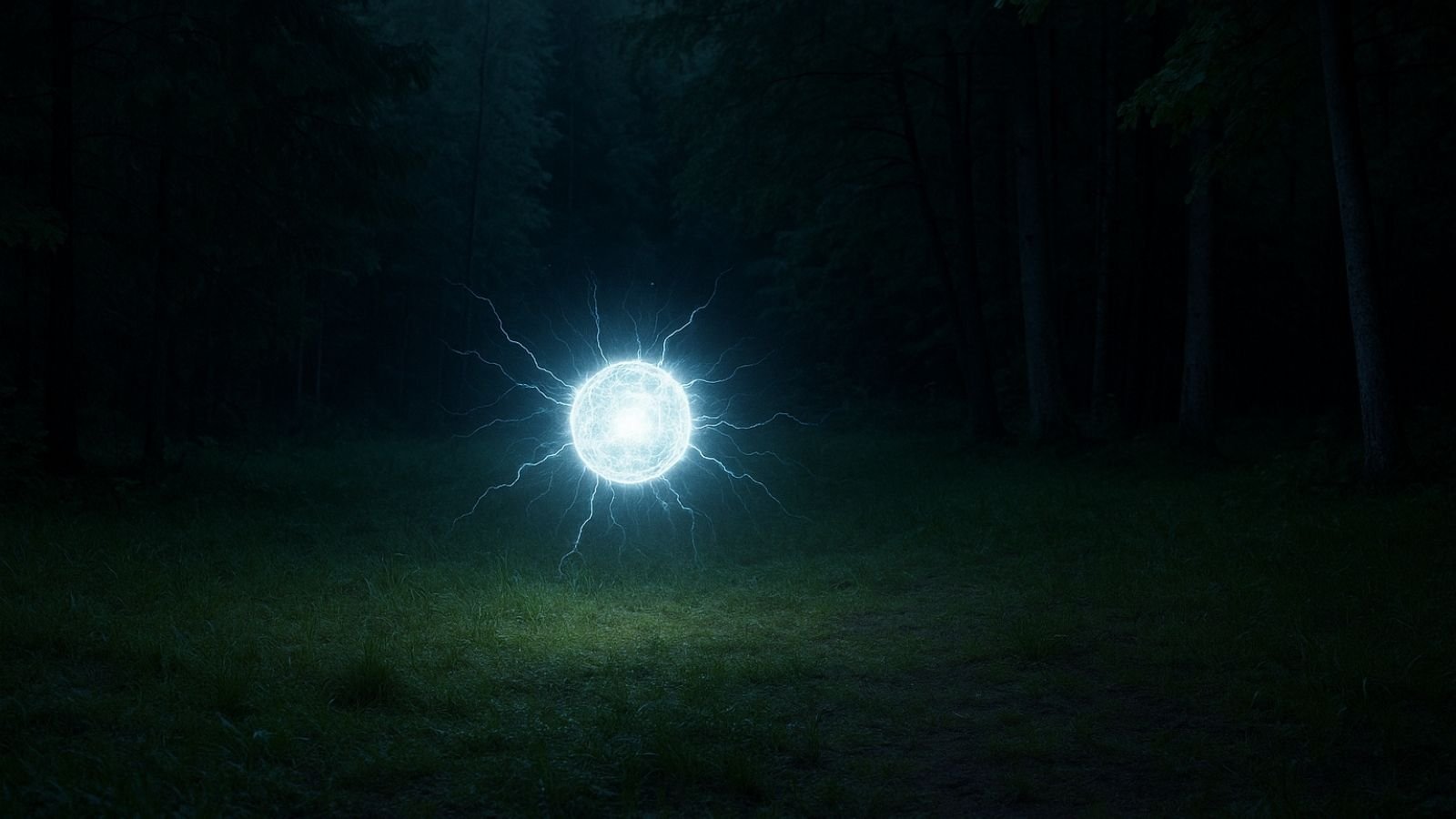
Ball lightning has the manners of a party guest who turns up uninvited, glows in the middle of the room, hisses politely, terrifies everyone present and then evaporates before anyone has a chance to offer refreshments. Storm‑chasers swear by it. Physicists argue about it. Pilots blame it for frightening moments mid‑flight. And ordinary people report it drifting through living rooms as if it owns the place. You’d think that after centuries of sightings someone would have pinned it down by now. Instead it hovers in that maddening space between folklore and physics, appearing just long enough to make everyone question their eyesight.
A glowing sphere hanging in the air during a thunderstorm doesn’t sound like something nature should allow. Yet that’s precisely what witnesses describe. Most stories place it at about the size of a grapefruit, although some insist it can grow to the width of a large pumpkin. Some claim it dances. Others say it floats with the bored serenity of a balloon that has given up trying to be festive. A few describe colours straight out of a firework stand, leaning towards orange, red or a ghostly yellow that suggests it might fancy itself as a distant cousin of the sun. The lifespan rarely stretches beyond ten seconds, which admittedly doesn’t give a researcher much time to set up instruments.
A Tibetan Plateau storm once offered scientists a gift: an optical spectrum of a drifting orb that appeared right after a ground strike. That fleeting rainbow of data showed silicon, calcium and iron among the glowing emissions. The team celebrated like Victorian inventors discovering electricity for the first time. It wasn’t a complete explanation, but it was something tangible amid a mountain of eyewitness anecdotes that usually leave everyone shrugging. That tiny fragment of evidence added fuel to one hypothesis that refuses to go away: the idea that a lightning bolt hitting soil vaporises silicon, turning it into a burning aerosol cloud that floats briefly before disappearing in a puff of chemistry.
Of course, that theory stumbles as soon as someone mentions ball lightning entering a house without bothering to knock. You can’t blame soil chemistry for an orb that drifts down a corridor or hovers by a bookshelf, which makes the silicon camp groan whenever such stories surface. Plasma enthusiasts take these accounts as proof their own idea must be closer to the mark. They argue that electromagnetic fields left swirling after a lightning strike can trap microwaves in a little bubble of ionised air. The bubble shines as energy bounces around inside it. The whole thing sounds suspiciously like a miniature microwave oven having a crisis of identity. And yet, it does explain the occasional report of orbs seeming to pass through thin barriers without causing immediate destruction.
Laboratories across the world have tried their best to recreate this spectacle under controlled conditions. Some have managed to coax glowing spheres from high‑powered microwaves. Others zap water surfaces and watch little luminous blobs dance briefly above the ripples. These laboratory plasmoids look the part, at least for a moment, though purists argue that nature is unlikely to mimic exactly what scientists conjure in a box lined with cables. Still, it demonstrates that glowing balls of plasma aren’t impossible to produce. The sticking point is whether the world’s thunderstorms reliably engineer the same trick, and if so, under what conditions.
Plenty of witnesses describe a faint hiss accompanying the glow, often accompanied by the familiar scent of ozone that follows electrical discharges. Some mention popping sounds when the orb disappears. A few claim furniture damage. One nineteenth‑century account reports a ball of fire rolling into a French farmhouse and promptly exploding in the kitchen, which must have put a swift end to whatever was cooking. On the other hand, there are stories in which the orb simply fades away politely, without so much as heating the wallpaper. Lightning rarely offers such courtesy, so this gentle exit only adds to the maddening inconsistency of the entire phenomenon.
Because nature refuses to give a clear answer, humans have filled the gap with all sorts of suggestions. Some propose electromagnetic illusions tricking the brain into seeing luminous shapes. The theory isn’t wild; strong electromagnetic fields can indeed stimulate the retina into perceiving phantom flashes. Yet it’s rather hard to convince someone who insists they saw their curtains smoulder. There are reports involving several witnesses at once, all describing the same glowing sphere. Unless everyone simultaneously hallucinated the same shape, these events seem to require something with at least some physical presence.
Many scientists suspect that what people call ball lightning might not be a single phenomenon at all. Some sightings may genuinely involve burning silicon aerosols. Others might be plasmoids formed by electromagnetic disturbances. A few could be hallucinations triggered by extreme atmospheric conditions or neurological responses to nearby lightning strikes. In other words, the name may be a convenient umbrella covering a handful of unrelated events that simply look similar. It’s rather like calling every loud noise upstairs a ghost when half of them are just the boiler misbehaving.
Part of the enduring fascination comes from its behaviour. Bolts of lightning follow strict physics, albeit violently. Ball lightning strolls about as though it didn’t receive the memo. Some eyewitnesses say it moves against the wind. Others swear it follows power lines or hovers near metal objects. There are even reports of orbs boarding aircraft cabins, giving passengers an unexpected alternative to in‑flight entertainment. One Soviet airliner allegedly hosted a glowing sphere that drifted through the cabin before vanishing with an explosion. You can imagine the pilot’s reaction: relief that the flight hadn’t been hijacked by a luminous grapefruit.
For centuries, sailors told tales of glowing balls rolling along ship masts during storms. Medieval chronicles mention church naves filling with fire during tempests. Rural myths across Europe treat ball lightning with the wary respect usually reserved for mischievous spirits. In some villages people insisted it rolled along the roads like a wandering soul. In China and Australia the phenomenon appears in folklore as a fiery visitor with unpredictable moods. Whether myth or memory, these stories all describe the same impossible thing: a glowing ball that exists just long enough to convince people they saw something extraordinary.
Attempts to classify sightings read like a menu of improbable behaviours. Some balls drift horizontally with monk‑like calm. Others zigzag as though shocked by their own existence. A few bounce, which is especially unfair to physicists who then have to explain why a luminous plasma seems to imitate a rubber toy. There are stories of orbs disappearing into the ground, melting metal, splitting into smaller spheres or reappearing moments after fading. The natural world rarely offers such narrative flair unless it’s plotting to confuse everyone.
A curious feature is the brightness. Witnesses often insist the sphere isn’t dazzling like a lightning flash. Instead, it glows with the soft persistence of an electric bulb that hasn’t quite woken up. This makes it surprisingly easy to stare at. People often report feeling mesmerised rather than blinded. It’s not every day that nature presents a hovering orb that looks like it might start speaking in riddles. A few describe colours shifting subtly as though the sphere can’t decide what mood it’s in. A blue tint appears occasionally, though orange remains the classic shade.
Chemical models attempt to explain that colour palette. Burning silicon oxidises in a way that produces orange to yellow light. Plasma models emphasise the influence of ionised gases and varying levels of excitation. A few fringe researchers speculate about exotic states of matter. One enthusiastic theorist once proposed that ball lightning might involve miniature black holes. Even he admitted it was unlikely, but history will always remember the audacity of the idea. That’s the beauty of a problem that refuses to behave: it invites everyone to take a turn in the academic circus.
The longevity of the glow fascinates specialists the most. Ordinary lightning lasts less than a second. Whatever sustains ball lightning must be replenishing energy in a way that ordinary sparks cannot. In some models the orb forms a kind of chemical battery, with nanoparticles storing electrical charge and releasing it gradually. This resembles a billion microscopic power cells fizzing away in unison. Whether this actually happens in the sky or only in the imaginations of theorists remains to be seen.
A major hurdle for research is the sheer unpredictability of thunderstorms. You can’t schedule one, and even when a storm cooperates, the odds of seeing a glowing sphere remain tiny. Most field instruments capture nothing more than standard lightning strikes, gusts of wind and the occasional drenched researcher. The Tibetan Plateau case stands out because the scientists happened to be filming at just the right time. Years of observation often yield nothing but wet notebooks and disappointment. Trying to study ball lightning is a bit like waiting for a celebrity to wander into a corner shop: technically possible, but the universe rarely obliges.
Intriguingly, some sightings occur without storms. People report seeing glowing spheres emerging from electrical outlets, drifting in barns or appearing during calm weather. These cases send theorists back to the drawing board with a familiar sense of despair. One idea links these events to electrical surges associated with power grids. Another blames underground discharges. None of these explanations fully satisfy anyone, but each adds another piece to the chaotic jigsaw puzzle.
Even today, ball lightning sits awkwardly between physics and folklore. It stubbornly refuses to be recorded in high detail. Most videos are too brief or too blurry to prove anything. Photographs often show nothing but a streak of light that critics dismiss as camera artefacts. Meanwhile, people who have seen the real thing remain adamant that no photo does justice to the eerie beauty of a glowing sphere hovering in the rain.
Despite the mystery, the search continues. Atmospheric scientists dream of collecting more spectra. Plasma physicists try to recreate longer‑lasting orbs in the lab. Geophysicists examine soil after lightning strikes for silicon residues. Psychologists study how electromagnetic fields might affect human perception. Each discipline sees a different angle to the same elusive glow. Progress happens, just slowly, as though the phenomenon likes to set the pace.
Some researchers have proposed setting up wide networks of high‑speed cameras in storm‑prone areas, hoping that automated systems might catch an orb in action. Others want satellite‑based sensors scanning thunderstorms across continents. Funding never quite matches the ambition, because the odds of capturing useful data remain painfully low. It’s hard to convince grant committees when the central pitch amounts to hoping nature throws a glowing ball your way.
Even without definitive answers, ball lightning holds a certain charm. There’s something irresistible about a natural phenomenon that behaves like a special effect. It blurs the line between science and myth, leaving room for wonder in a world that increasingly believes everything has already been explained. People who witness it carry the memory for life, often describing it with the reverence usually reserved for rare astronomical events.
Perhaps one day a camera will catch an orb in crystal clarity. Perhaps researchers will gather enough measurements to pinpoint its exact chemistry, physics and temperament. Or perhaps ball lightning will continue to appear only when nobody is prepared, acting like the universe’s mischievous reminder that certainty is a luxury. Until then we’re left with eyewitness tales, half‑tested theories and the thrill of knowing nature still has its secrets.