Gladiatrices: The Fighters Rome Tried to Forget
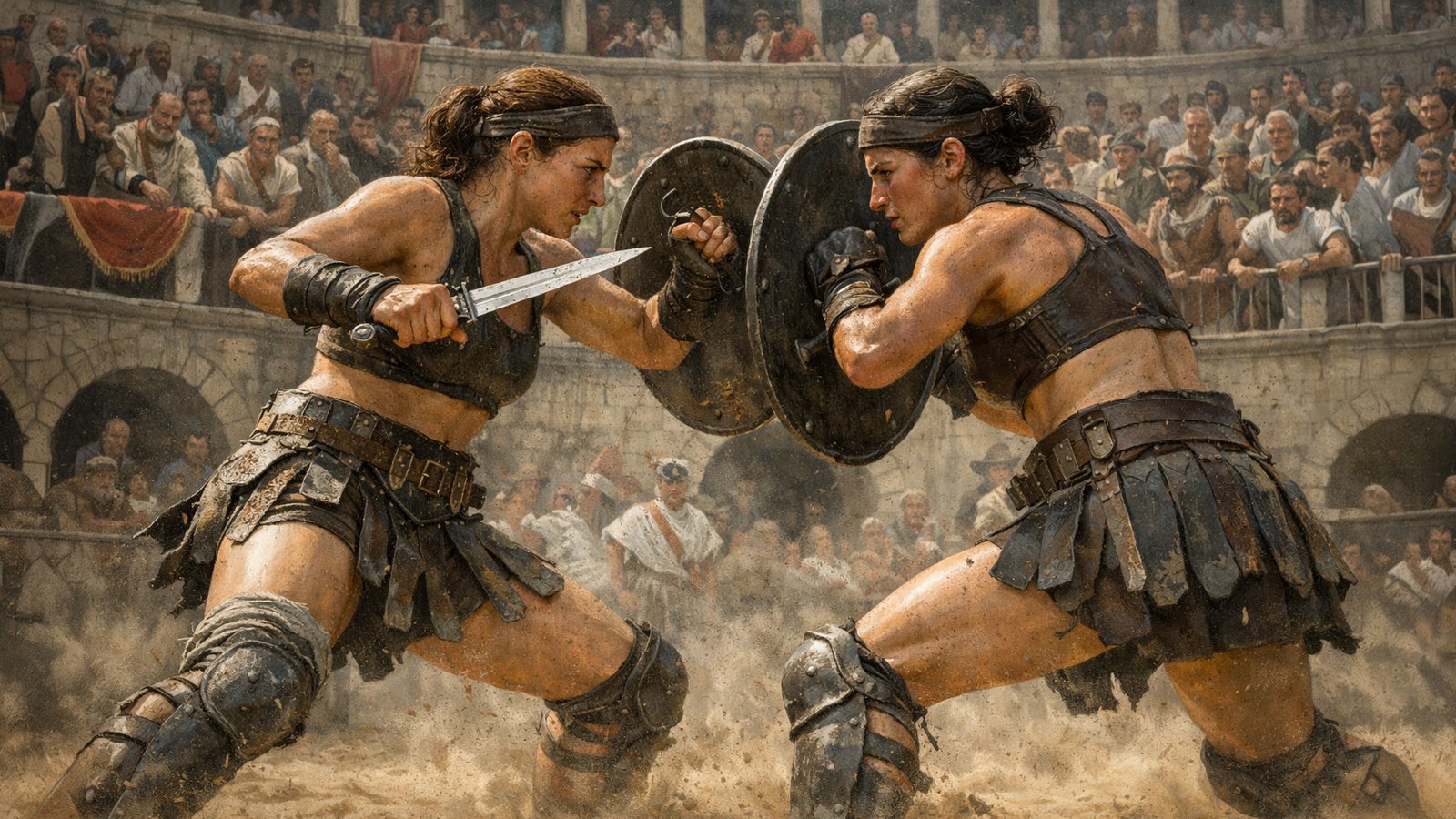
Gladiatrices, or Female gladiators occupy a strange, uncomfortable corner of Roman history. They are not a myth, yet they are never allowed to feel entirely real. Instead, they appear briefly, sharply, and then seem to vanish again, as if the Roman world itself blinked and looked away. Their story survives in fragments: a relief here, a scandalised comment there, and finally a legal ban delivered with quiet embarrassment. Taken together, those fragments reveal less about numbers and far more about anxiety.
The Romans adored spectacle; however, they adored control even more. Gladiators already lived on the edge of respectability. They were admired, desired, and cheered, yet legally and socially degraded. Their bodies belonged to the crowd and to the editor of the games. Violence made them famous, but at the same time it marked them as people who had surrendered dignity. When women stepped into that space, the arrangement became deeply awkward.
Suddenly, the arena did not just display blood and bravery. Instead, it displayed a woman doing things Roman society insisted women should not do. That visual contradiction mattered. Rome tolerated contradictions only when it could contain them. Female gladiators refused to stay contained.
The clearest visual proof comes from a marble relief found in Halicarnassus. Two fighters face one another, shields raised, swords ready. Their names are carved clearly: Amazon and Achillia. Although the names sound theatrical, the scene itself feels sober and technical. These are not dancers or comic performers. They wear standard gladiatorial equipment and stand in correct fighting stances.
The inscription beneath the figures records that they fought to a draw and were released honourably. This detail matters enormously. A draw was not a polite gesture or a publicity trick. Rather, it indicated skill, endurance, and discipline. In other words, they fought well, and everyone present understood that fact.
That relief refuses to let female gladiators be dismissed as fantasy. Someone commissioned it. Someone expected others to understand it. And someone thought this fight deserved memory. Even so, the relief stands almost alone, which already hints at discomfort. Rome recorded victories, lineages, and monuments obsessively. When evidence grows thin, it is often because enthusiasm faded.
Written sources fill in some gaps, though usually in irritated tones. Satirists complain about women who train with swords, lift weights, and obsess over armour instead of spinning wool. The humour relies on recognition. Audiences knew such women existed, or at least believed they plausibly could. Meanwhile, historians mention female fighters during extravagant games, often while lamenting moral decline.
Notably, nobody sounds shocked. Instead, they sound offended. This reaction reveals something important. The problem was not danger or logistics. Rome had no difficulty with violence inflicted on women. Public executions regularly included female victims. Enslaved women endured brutal punishment without much comment. What unsettled elites was agency.
A woman who chose to fight, trained her body for combat, and stood before the crowd as a professional warrior disrupted hierarchy. Roman gender ideals rested on control. Masculinity meant mastery over others and over oneself. Femininity, at least in theory, meant modesty, restraint, and domestic presence. Although reality often disagreed, expectations remained powerful.
When a woman entered the arena, she inverted those expectations publicly. She displayed strength, endurance, aggression, and confidence. Worse still, she invited applause for it. As a result, the supposed natural limits placed on women began to look suspiciously cultural.
The arena amplified this tension. Gladiatorial combat was not only about killing. It was ritualised violence framed as entertainment, discipline, and moral theatre. Every fight reinforced ideas about courage, submission, and authority. When men fought, the symbolism stayed stable. When women fought, the symbolism leaked.
Class made the situation even more volatile. Some female gladiators were enslaved or marginal, which already placed them outside respectability. Others, however, came from freeborn families, including the equestrian order and even senatorial circles. This detail horrified moralists. A freeborn Roman woman was meant to embody family honour. Her public exposure reflected directly on male relatives.
Seeing such a woman fight felt less like entertainment and more like social failure. Therefore, outrage often focused on shame rather than skill. The issue was never whether women could fight. The issue was whether they should be seen doing so.
Emperors who encouraged female gladiatorial bouts understood the provocation perfectly. Spectacle was a political tool. By presenting transgression as entertainment, emperors reminded audiences that normal rules bent at their command. Women fighting at night, nobles performing humiliating roles, and exoticised combatants all served the same purpose.
This pattern explains why references cluster around reigns associated with excess. Nero and Domitian appear frequently, not because they invented the practice, but because they pushed boundaries. They staged games that mixed shock with novelty. Female fighters fitted neatly into that logic.
Yet popularity never meant acceptance. The elite tolerated female gladiators briefly and reluctantly. Over time, irritation hardened into regulation. In 200 CE, a ban prohibited women from appearing in the arena.
The language of that ban reveals its aim. It did not claim women lacked ability. It did not argue the practice endangered order. Instead, it appealed to dignity and propriety. The problem was symbolic, not practical.
After the ban, silence deepens. References become scarce, then nearly vanish. This disappearance feels deliberate. Rome increasingly valued moral restoration and tradition. Remembering women who had challenged gender norms did not serve that project.
Later generations found forgetting convenient. Medieval scholars inherited texts that framed female gladiators as decadence. Renaissance writers romanticised the arena as masculine theatre. Modern popular culture followed, turning the gladiator into a purely male icon.
What makes female gladiators compelling today is not their number, but their effect. They expose how flexible Roman society could be in practice while insisting on rigid ideals in theory. Rome loved rules, yet repeatedly bent them for spectacle.
Their existence also reflects a familiar historical pattern. When marginal figures challenge dominant narratives, they survive in complaints, jokes, and bans. Praise fades first. Records thin next. Silence finishes the job.
Female gladiators were not modern revolutionaries. They operated within a brutal system designed for control and entertainment. Yet their presence mattered. Every time a woman stepped into the arena, Rome had to reconcile reality with ideology.
In the end, the attempt to erase them speaks loudly. Rome banned them, then stopped talking about them, hoping discomfort would dissolve into memory. It did not quite succeed. A relief survived. A few names endured. Enough irritation lingered to tell the story.
Female gladiators stood under the arena lights with swords raised, forcing Rome to confront its contradictions. Then the lights dimmed, and Rome tried to pretend they had never been there.