From Dutch Experiments to Global Powerhouses: The Story of Mutual Funds
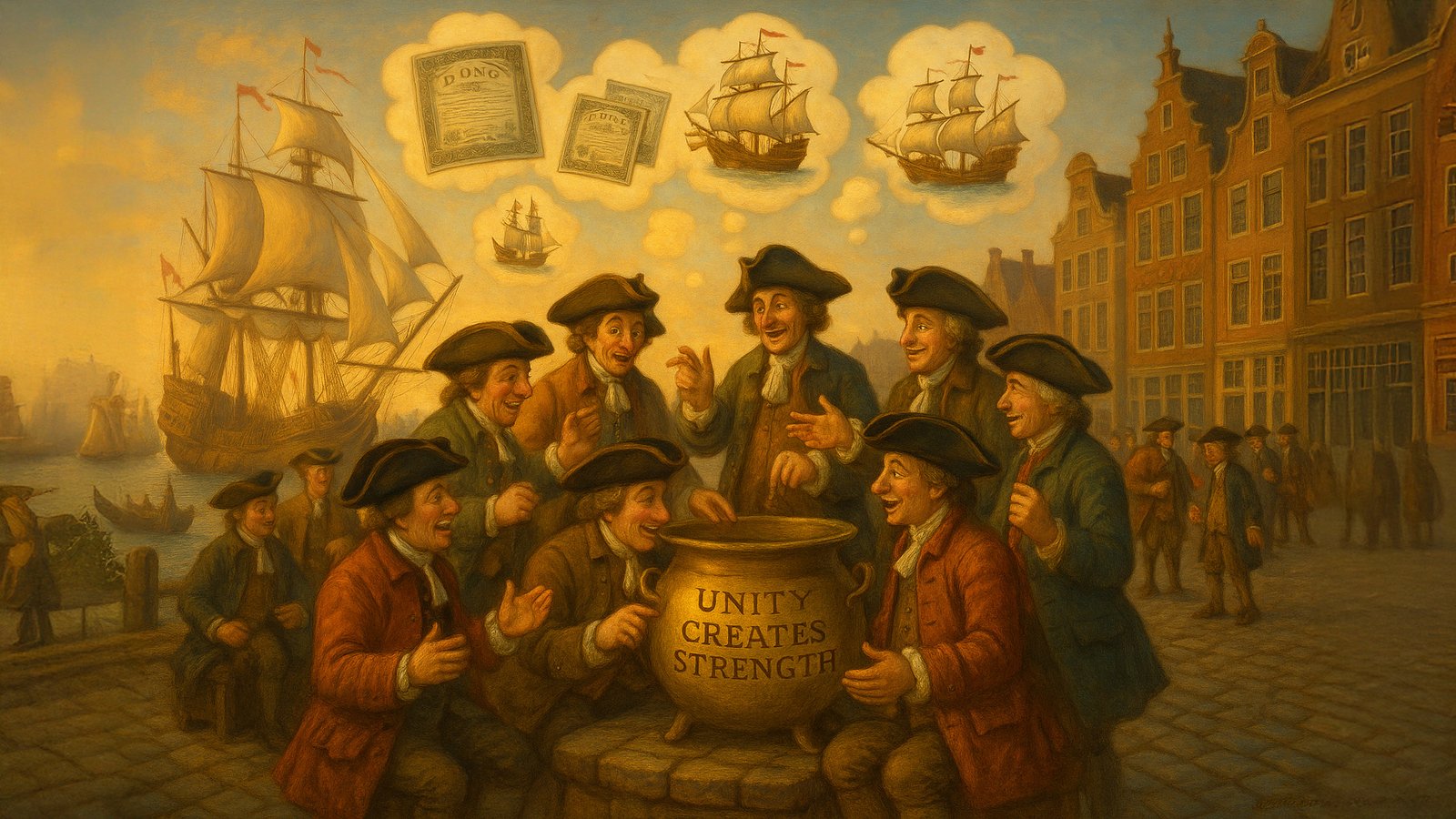
Mutual funds didn’t set out to be the quiet giants of global finance. They simply wanted to give ordinary people a dignified way to invest without needing a monocle, a mansion and a personal banker named Charles. Today they steer trillions, decide the fate of corporate boards and help pay for retirements across continents, yet their story started with something far humbler: a Dutchman trying to stop small investors from losing their shirts.
In 1774, Amsterdam merchant Adriaan van Ketwich gathered a group of people who were tired of watching governments default and markets wobble. He invited them to pool their money into one diversified pot he called Eendragt Maakt Magt, or ‘Unity Creates Strength’. Dutch financiers loved an earnest slogan. The idea wasn’t just poetic—it was practical. By spreading everyone’s savings across many bonds, the fund gave people who weren’t fabulously rich a fighting chance in the world of investing. The concept looked suspiciously modern: diversification, rules to protect small investors, fixed-interest payments. Had van Ketwich offered an app and a podcast, he could have passed for a 21st-century fintech founder.
The idea went a bit quiet for a while, drowned out by wars and financial collapses, but resurfaced in Victorian Britain. The 1860s arrived with railways, global trade and an extraordinary appetite for investing in faraway places most Britons had never seen. Edinburgh lawyers and London bankers began launching something called investment trusts, promising modest investors the same global reach enjoyed by wealthy families. The Foreign & Colonial Government Trust popped up in 1868 with a mission still quoted in investment textbooks: to give the investor of moderate means the same advantages as the large capitalists. It’s the closest finance ever came to a public service announcement.
These early British funds tucked savers’ money into the bonds of Argentina, Egypt, Brazil and other countries full of promise and occasional political drama. Some of those borrowers later collapsed spectacularly, but that’s half the charm of Victorian finance: ambition, optimism and a very strong tolerance for risk. The point was clear—ordinary households could finally invest internationally without needing to book passage on a steamship.
Across the Atlantic, the Americans eventually took the idea and rebuilt it with gusto. In 1924, the Massachusetts Investors’ Trust began offering a new type of pooled investment that allowed people to buy and sell continuously while enjoying diversification and professional management. It looked suspiciously like the mutual funds we know today. The timing was impeccable in a slightly tragic way. The 1920s involved joy, jazz and questionable leverage, followed by a brutal market crash that reminded everyone what happens when financial products get a bit too exciting.
The crash pulled mutual funds into a regulatory makeover. The 1933 Securities Act demanded transparency, while the 1940 Investment Company Act laid down the rules still governing the industry. It tackled leverage, pricing, disclosures and conflicts of interest. Wall Street received a firm parental talk, and investors got guardrails that finally meant something.
The foundations were strong, but the next big plot twist didn’t arrive until the 1970s when a mild-mannered man named John C. Bogle annoyed most of the financial industry. Bogle believed that actively managed funds were charging too much, trading too often and underperforming too reliably. In 1975 he created Vanguard, a company owned not by outside shareholders but by the investors themselves. A year later he launched the first widely accessible index fund, designed to track the S&P 500 with minimal fuss and minimal cost.
Many on Wall Street laughed at his creation and called it ‘Bogle’s Folly’. Investors did not laugh for long. The low-fee revolution caught on, and index funds grew from oddball curiosity to global standard. Bogle’s conviction that simplicity beats cleverness earned him a near-saintly status among personal finance enthusiasts. His influence is so large that some economists say he saved investors billions of dollars just by lowering fees industry-wide. It might be the most profitable rebellion in modern financial history.
Another giant of the story, Peter Lynch, moved in the opposite direction. While Bogle preached the gospel of passive investing, Lynch’s legendary stewardship of the Fidelity Magellan Fund proved that skill, intuition and the occasional field trip to shopping centres could still beat the market. Under his watch, Magellan grew from millions to billions and inspired millions of Americans to invest in companies they recognised from everyday life. His mantra, ‘invest in what you know’, joined the unofficial scriptures of personal finance.
With characters like Bogle and Lynch at its helm, the mutual fund world expanded dramatically. Retirement systems in the US, UK and beyond began channelling savings into funds because they were liquid, diversified and far more palatable than storing cash under sofas. They allowed millions of people to invest small amounts regularly, turning wage income into long-term wealth. These funds didn’t just democratise investing—they democratised financial hope.
Of course, no industry becomes this large without the occasional awkward chapter. The early 2000s delivered one of the most embarrassing: the market timing scandal. Several big-name fund firms allowed favoured clients to trade after daily cut-off times or flip in and out rapidly while ordinary investors remained unaware. The resulting regulatory reckoning involved fines, resignations and a general reminder that fairness isn’t optional.
Another long-running controversy centres on fees. For decades, many active funds charged investors handsomely while underperforming their benchmarks. Academics pointed out, repeatedly and with increasing bluntness, that fees quietly erode long-term returns. The rise of cheap index funds exposed how expensive traditional mutual funds had become. Then came a new embarrassment: closet indexing. Some active funds charged premium prices while secretly hugging the benchmark, determined not to stand out too much. Regulators eventually noticed.
More recently, the spotlight has swung to sustainability claims. ESG-labelled mutual funds multiplied quickly as investors sought to feel virtuous while earning returns. But the criteria for ESG status vary wildly, sometimes allowing companies with dubious records to slip through. Critics call this greenwashing; regulators call it an investigation waiting to happen. The marketing departments of fund firms call it ‘innovative labelling’, but no one’s fooled.
Despite the odd scandal, mutual funds remain crucial pillars of modern finance. They offer simplicity in a world that adores complexity. A mutual fund takes a messy market of thousands of securities and turns it into something a schoolteacher, nurse or bus driver can buy without budgeting for an in-house economist. Funds also play quiet but influential roles inside markets: they vote at shareholder meetings, they steady liquidity, they shape corporate governance. Without them, the financial system would wobble every time an individual retired or panicked.
Their importance stretches beyond markets too. Many pension systems rely on mutual funds to grow long-term savings. Workplace retirement accounts channel contributions into diversified portfolios. Families use funds to save for education, housing and rainy days. Mutual funds became cultural artefacts—symbols of sensible adulthood, right up there with learning to iron shirts and opening a savings account.
Somewhat ironically, the institutionalisation of mutual funds has concentrated financial power in a few massive firms. Companies like Vanguard, BlackRock and State Street now rank among the largest shareholders of many significant corporations. This concentration prompts endless debate. Do index fund giants distort markets? Do they give too much voting power to too few hands? Would breaking them up create more volatility? Opinions vary, egos flare and academic conferences find themselves wonderfully fuelled.
The landscape keeps shifting. Fees continue to fall. Exchange-traded funds attract new fans every year. Robo-advisers automate portfolios with algorithms and cheerful colour schemes. Younger investors expect convenience, low cost and transparency, and the industry scrambles to comply. But the bones of the idea—shared risk, shared opportunity, affordable access—remain exactly as van Ketwich intended back in Amsterdam.
What began as a modest Dutch solution for small savers morphed into one of the world’s largest and most influential industries. The story carries every flavour: innovation, good intentions, ambition, the odd scandal and a cast of characters colourful enough to merit a miniseries. Mutual funds changed who gets to build wealth and how markets behave. Investors don’t typically toast them with champagne, but perhaps they should. After all, these quiet financial workhorses helped millions of people move from ‘I hope’ to ‘I’m invested’.