Food-Forward Travel and the Quiet Shift Away from Landmarks
Food-forward travel no longer sits at the margins of how people do travel. Instead, it has become the organising logic itself. Rather than orbiting landmarks, travellers now orbit kitchens, markets, bakeries, fisheries, and the quiet rituals that hold a town together. As a result, food-forward travel shifts attention away from what a place displays and towards what it sustains. It rewards patience, repetition, and appetite rather than speed, proof, or spectacle.
This change did not arrive suddenly. Instead, it emerged from a slow accumulation of fatigue. Capitals began to feel rehearsed long before arrival. Menus blurred into translation-driven sameness. Itineraries filled with queues, tickets, and camera angles already familiar from screens. Gradually, travellers started moving sideways rather than forward. They turned towards secondary cities and inland towns. They chose places where lunch anchored the day, and where dinner ended when ingredients ran out, not when a booking system said it should.
Food-forward travel works because food still resists abstraction. You cannot experience it properly in advance. Instead, you have to be present, hungry, and attentive. A dish arrives carrying climate, labour, habit, and history in a way no monument ever can. While a cathedral asks to be admired, a meal asks to be joined.
Small towns amplify this effect. Their food cultures tend to exist without explanation. Markets open because they always have. Bakeries produce the same loaves because the ovens demand it. Restaurants serve a narrow range of dishes because that is what the town eats. For visitors, this removes the pressure to optimise. Instead of searching for the best version of something, travellers encounter the normal version. Over time, that normality reveals its value.
San Miniato in Tuscany offers a clear example. The town does not market itself loudly, yet its relationship with white truffles shapes everything from autumn menus to everyday conversations. Food-forward travel here means accepting seasonality as a rule rather than a suggestion. Truffles appear briefly, disappear entirely, and nobody apologises. Consequently, meals revolve around restraint. Pasta carries butter and aroma rather than embellishment. Eating becomes an act of timing rather than choice.
A similar logic governs Cadaqués on the Catalan coast. Despite its artistic mythology, daily life still revolves around the sea. Fish arrives according to weather, not desire. Rice dishes stretch catches across families. Anchovies, simple and salted, anchor the local table. In this context, food-forward travel does not reward planning. Instead, it rewards showing up early, asking what exists, and adjusting expectations accordingly.
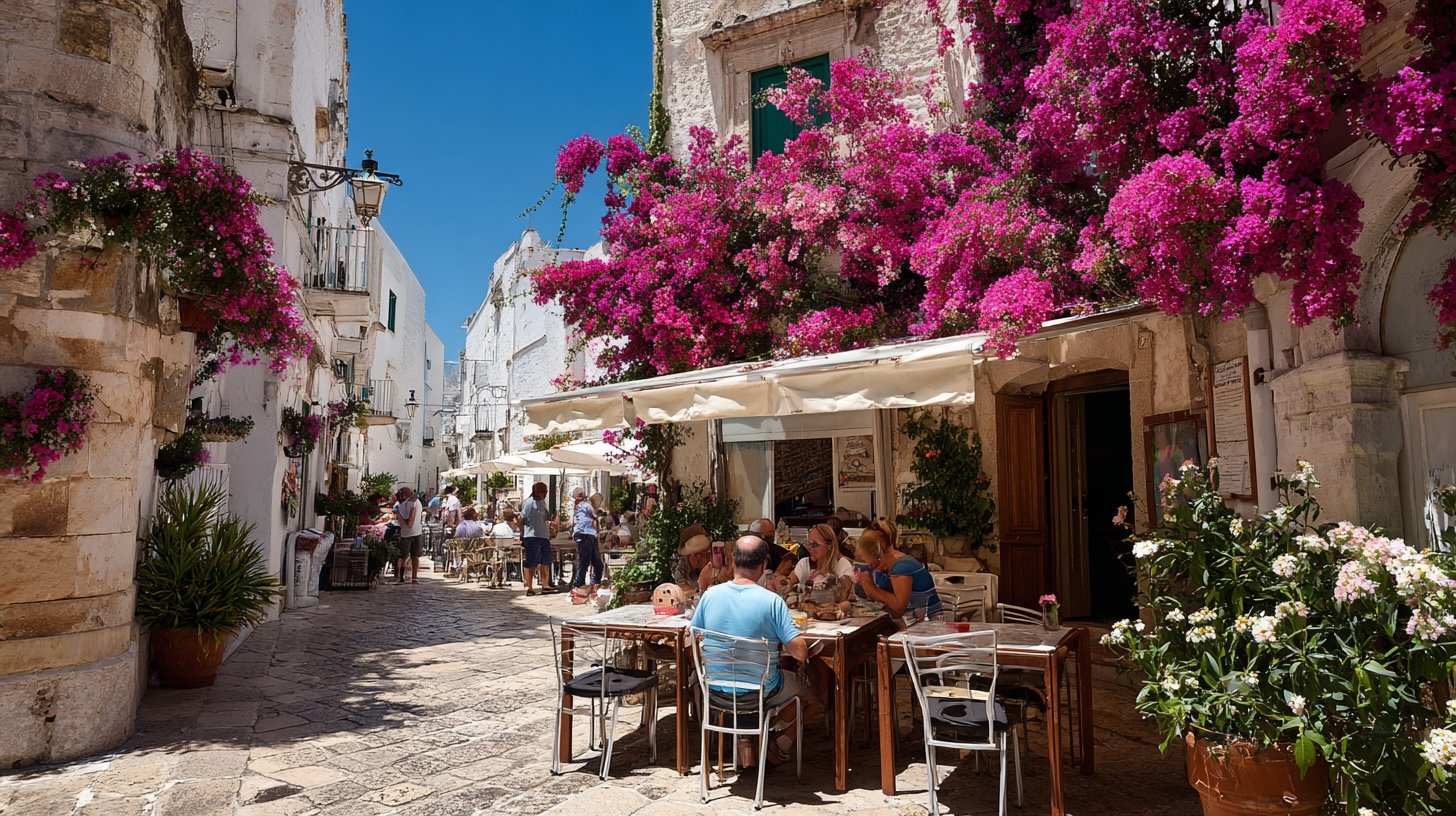
In Ostuni, the white hill town of Puglia, food appears less as performance and more as infrastructure. Bakeries dominate mornings. Olive oil defines flavour. Raw ingredients carry authority. Meals feel assembled rather than composed. As a result, travellers drawn to food-forward travel here often eat repeatedly in unremarkable places, slowly realising that repetition itself functions as the cultural signal. What returns daily must matter.
Japan’s Takayama shows how food-forward travel operates outside Mediterranean patterns. Morning markets shape daily rhythm. Miso varies by neighbourhood. Mountain vegetables appear briefly and then vanish. Regional beef exists within strict limits. Restaurants open when supplies arrive and close when they don’t. Because of this, travellers develop a sense of trust. The town knows what it is doing. You simply participate.
Tlacolula de Matamoros, near Oaxaca, reveals another dimension. Its market culture functions as both pantry and social centre. Regional dishes appear in their weekday forms rather than their celebratory versions. Corn, beans, chillies, and slow-cooked meats dominate. In practice, food-forward travel here unfolds on benches and plastic stools, guided by smell rather than signage. The absence of ceremony sharpens attention.
In France, Vézelay demonstrates how pilgrimage towns can quietly pivot towards food without abandoning their past. Burgundy produce, local wines, and small kitchens serve both residents and visitors without adjusting language or format. Meals remain grounded in agricultural reality. Therefore, the town’s food culture does not compete with its history. It complements it.
Matera in southern Italy shows how scarcity shapes flavour. Bread culture dominates. Legumes carry meals. Dishes feel heavy with memory. Consequently, food-forward travel in Matera often means learning to read restraint as intelligence rather than limitation. The cooking explains why things evolved the way they did. You taste geography directly.
Portugal’s Douro Valley villages illustrate how food-forward travel unfolds beyond restaurant culture entirely. Meals centre on labour rhythms. Preserved meats, soups, and simple stews appear after long days in vineyards. Lunch stretches because work allows it. Dinner arrives early because daylight fades. Visitors who adjust to this rhythm often find themselves absorbed rather than entertained.
In Norway’s Lofoten fishing villages, food-forward travel becomes seasonal discipline. Cod defines winter. Drying racks dominate landscapes. Soups, stews, and preserved fish replace variety. Weather dictates meals. As a result, eating becomes a survival narrative rather than a lifestyle choice. Travellers who arrive expecting options often leave respecting limits.
Guérande, with its salt marshes in western France, shows how a single ingredient can organise a food system. Salt shapes preservation, butter-heavy cooking, and regional confidence. Markets reflect this coherence. Meals feel quietly anchored. Food-forward travel here means noticing how one practice echoes through everything else.
Across these places, a clear pattern emerges. Food-forward travel favours what some travellers call shelf discovery. Instead of ordering the famous dish, they browse edges. They choose soups, sides, breads, and preserved foods. They watch what locals eat midweek. And they ask what exists rather than what is recommended. In this way, behaviour mirrors how people explore bookshops or record stores, trusting proximity over ranking.
Markets play a central role in this shift. They operate as calendars rather than attractions. They reveal what the land currently offers and what it withholds. Increasingly, travellers plan days around market mornings rather than museum openings. Bakeries matter more than dining rooms. Process replaces presentation.
Slowness becomes a feature rather than an inconvenience. Small towns impose limits on transport, language, and choice. These limits create continuity. You return to the same café. You recognise faces. And you eat variations of the same meal. Over time, memory deepens through repetition.
Digital culture has accelerated this desire indirectly. Algorithms reward sameness. They flatten food into visuals. In response, travellers seek places with weak online footprints. Restaurants without websites feel trustworthy. Menus without photographs feel intact. Absence restores curiosity.
Food-forward travel ultimately reframes what success looks like. Success means feeling momentarily integrated. It means understanding a place through daily rituals. It means remembering how something tasted rather than how it looked. Small towns provide containers for this experience because they do not rush to explain themselves.
Rather than replacing landmark tourism, food-forward travel quietly sidelines it. Monuments remain, yet they no longer organise attention. Lunch does. Markets do. Repetition does. Travel becomes less about accumulation and more about alignment.
In that sense, food-forward travel does not promise novelty. Instead, it promises coherence. It asks travellers to slow down enough to notice how places already function. Those willing to do so often leave with fewer photographs and stronger memories, having eaten their way not through a checklist, but into a rhythm.