Eternal question of Baboon
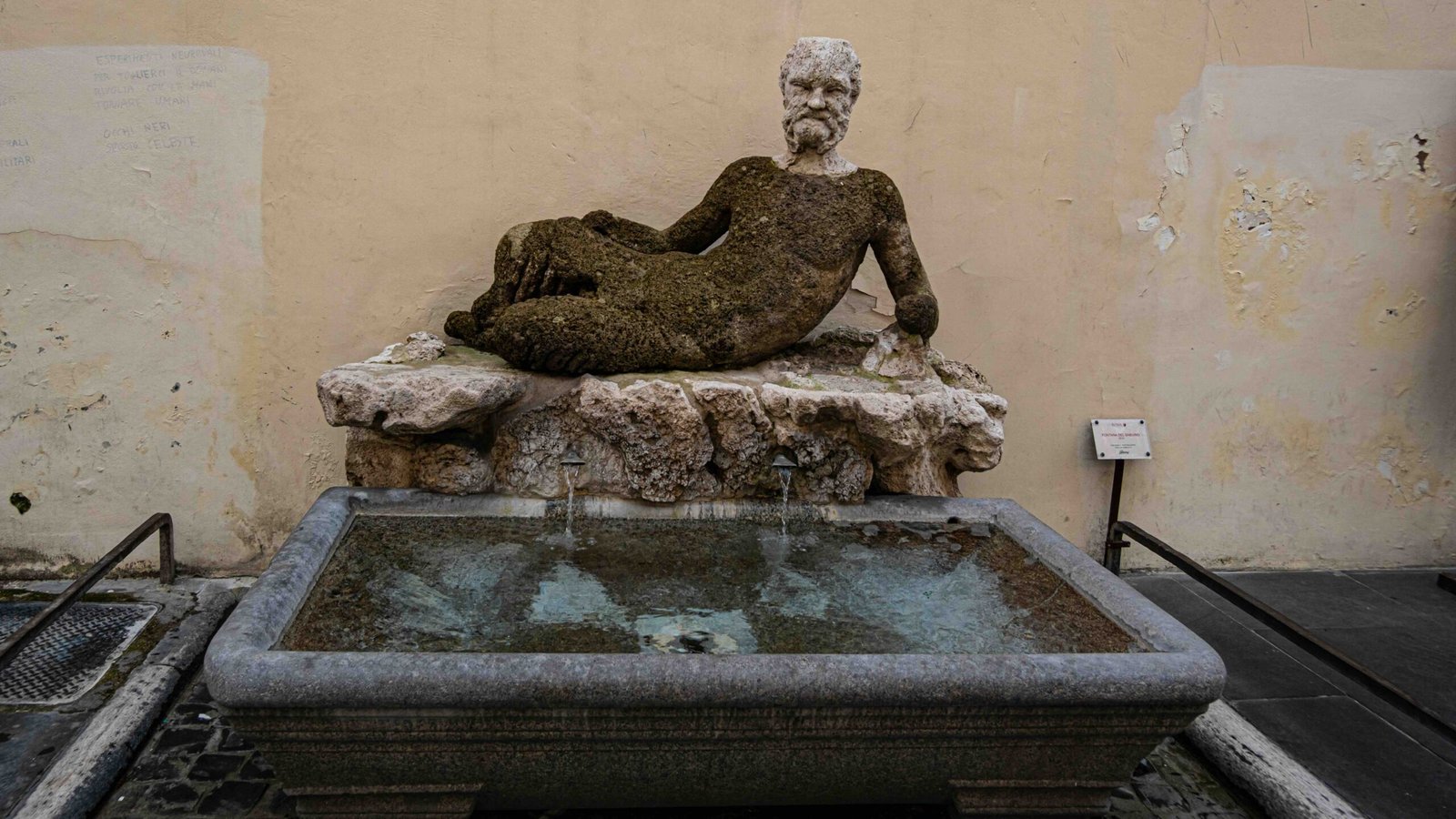
Rome rarely names a street after something flattering. It prefers saints, emperors, martyrs, or at least a respectable family with a coat of arms. Yet one of its most elegant addresses answers to a monkey. Via del Babuino runs in a straight, almost defiant line from Piazza del Popolo to Piazza di Spagna. Stand at the northern end early in the morning and you see geometry at work. Light slides down the façades. The paving stones hold the night’s coolness. Meanwhile, designers polish their windows as delivery vans edge past Renaissance portals. Beneath the gloss sits a battered stone figure that Romans once compared to a scruffy baboon.
The statue, known as Il Babuino, depicts a reclining Silenus, companion of Bacchus. Time damaged his face, and water eroded his limbs. The composition never quite convinced anyone of its classical dignity. Locals looked at him in the sixteenth century and chose mockery over reverence. Consequently, they ignored the official name, Via Paolina, and renamed the street after the creature. Popular humour defeated papal branding without ceremony.
That irreverence fits Rome. The city developed a tradition of talking statues, stone figures that served as unofficial bulletin boards for satire. Citizens pinned anonymous verses onto them, usually targeting whichever pope caused irritation that week. Pasquino near Piazza Navona gained the most fame. However, Il Babuino joined the chorus. Therefore, the street never functioned as a neutral corridor. It carried whispers, jokes, and small acts of defiance along its straight spine.
Straight lines in Rome never happen by accident. Pope Sixtus V launched an ambitious urban plan in the late sixteenth century. He wanted pilgrims to move efficiently between major basilicas. He also wanted to project authority through perspective. Long axes create psychological certainty. They guide the eye and, by extension, the body. Thus, Via del Babuino formed one arm of the Tridente radiating from Piazza del Popolo. Geometry became governance, and stone performed theology.
Before that intervention, the area felt far less orderly. Vineyards and scattered houses covered parts of the zone. Dusty paths linked workshops and modest dwellings. Once the papal plan cut through, property values shifted. Merchants sensed opportunity. Clergy appreciated proximity to influence. As a result, façades grew taller and more coordinated, though never entirely uniform. Rome tolerates order, yet it insists on personality.
Legends cling to Il Babuino himself. Some residents claimed the statue absorbed bad luck, acting as a lightning rod for misfortune. Others insisted he brought trouble to anyone who mocked him too loudly. A nineteenth-century rumour even suggested that couples who quarrelled within sight of the fountain would part within the year. No archive confirms that superstition. Nevertheless, the story survived because Romans enjoy attaching morals to masonry.
By the eighteenth century, the street attracted a different tribe. Young aristocrats from Britain, Germany, and Scandinavia arrived on the Grand Tour eager to collect culture. Artists followed close behind. Painters rented studios nearby. Sculptors chipped away at marble in courtyards hidden behind heavy doors. Landlords discovered that creative ambition pays rent reliably. Consequently, Via del Babuino evolved into a corridor of aspiration.
Foreign communities left subtle traces. Danish sculptor Bertel Thorvaldsen worked close to this district. German painters gathered in cafés that have since vanished. Meanwhile, English visitors wrote letters home describing the Roman light, which felt softer here than along Via del Corso. The street balanced access and calm. It sat near aristocratic salons, yet it escaped the worst carriage traffic. That balance made it fashionable without turning it frantic.
With artists came dealers. During the nineteenth century, antique shops multiplied along the route. Italy experienced political upheaval. Convents closed. Noble families sold heirlooms. Church treasuries quietly dispersed objects. Dealers sourced altarpieces, fragments of sculpture, carved furniture, and devotional silver. Some transactions followed legal channels. Others relied on ambiguity and speed. Consequently, Via del Babuino built a reputation for beauty tinged with moral flexibility.
Collectors from Paris and London walked these pavements hunting Renaissance panels. Soon afterward, American buyers joined them, armed with fresh industrial wealth. They shipped crates across oceans. They furnished townhouses with Roman fragments. In doing so, they transformed the street into a global exchange point for heritage. Today’s debates about restitution echo faintly in that history. However, few boutiques mention it while arranging velvet displays.
The twentieth century reshuffled the cards again. Rome expanded. Cars replaced carriages. The Fascist regime championed classical order and monumental vistas. Although bulldozers reshaped other districts more aggressively, Via del Babuino suited the regime’s taste for symmetry. Its straight perspective looked disciplined. Its proximity to grand squares suited propaganda photographs. Still, daily life continued with stubborn normality. Shopkeepers argued about rent rather than ideology.
After the Second World War, cinema glamour drifted from Cinecittà into central Rome. Designers and jewellers began to notice the street’s potential. Its link between Piazza del Popolo and Piazza di Spagna placed it within easy reach of the Spanish Steps and Via Condotti. Gradually, antique dealers gave way to luxury brands. Tailors installed discreet plaques. Windows gleamed with curated restraint rather than baroque excess.
Yet Via del Babuino never adopted theatrical sparkle. Instead, it cultivated understatement. You sense money here, but it does not shout. The façades maintain a steady rhythm of shutters and cornices. Doorways conceal courtyards where ivy climbs quietly. At dusk, the light turns honey-coloured and forgiving. Even the most extravagant boutique appears almost scholarly against that backdrop.
Controversy surfaced whenever the city proposed moving or restoring Il Babuino. Traffic regulations forced relocations more than once. Each shift provoked letters to local newspapers and heated conversations in nearby cafés. Residents treat the statue as a civic personality rather than decoration. They debate his placement with the seriousness usually reserved for football line-ups.
Stories also circulate about secret tunnels beneath the street linking palazzi to churches. Guides sometimes hint at hidden passages used during unrest. Historians find little evidence beyond standard service corridors. Even so, the rumours persist. Rome breeds subterranean myths because its visible layers already look improbable.
Diplomatic presence added another dimension. Several cultural institutes and embassies settled along or near the street. Foreign flags hang discreetly above Renaissance stone. Consequently, conversations often shift between Italian, French, English, and German within a single block. Fashion buyers, art historians, and diplomats may share the same espresso bar. At the same time, none of them claims the space entirely.
Economics shaped the street as much as aesthetics. Property prices rose steadily during the late twentieth century. Small workshops struggled to survive. Family-run businesses sold leases to international conglomerates. Some locals lament the loss of artisan character. Others point out that Rome has reinvented this corridor for five centuries. Therefore, change feels less like betrayal and more like habit.
Even the name reflects that adaptability. Official documents once insisted on Via Paolina, honouring Pope Paul III. Ordinary Romans ignored the paperwork and kept the monkey. Over time, the nickname achieved formal recognition. Bureaucracy surrendered to humour. That reversal reveals something essential about Roman civic identity.
Architects still debate whether the Tridente layout feels too imposed for a city famed for organic sprawl. Critics argue that straight lines contradict Rome’s medieval intimacy. Supporters counter that the axis provides clarity within chaos. Walk the length slowly and you may feel both reactions at once. The perspective calms the mind. Meanwhile, side streets tempt you away with crooked promises.
During religious festivals, processions occasionally pass along sections of the route. Lit candles flicker against boutique glass. Sacred music mingles with the hum of commerce. Thus, the street stages a quiet negotiation between devotion and display. It refuses to choose a single identity.
Morning reveals a practical side. Delivery workers navigate narrow pavements with enviable skill. Residents carry shopping bags from small grocers tucked into side lanes. Tourists photograph plaques without reading them. Throughout it all, Il Babuino watches with eroded indifference. His stone grin neither condemns nor applauds.
Some Romans joke that the statue symbolises the city itself. Ancient, slightly battered, impossible to categorise, and entirely comfortable with contradiction. Others treat him as a warning against taking grandeur too seriously. After all, a papal urban masterpiece ended up named after a monkey.
Begin at Piazza del Popolo at sunrise and you sense the ambition behind the alignment. Continue towards Piazza di Spagna and you encounter commerce at full volume. Pause midway and listen carefully. Footsteps echo differently against each façade. Conversations bounce between languages. Church bells interrupt retail playlists. That layered soundscape tells the deeper story.
Via del Babuino thrives on reinvention. Pilgrims once hurried along it seeking salvation. Artists later searched for patrons. Dealers negotiated over gilded frames. Fashion houses now curate seasonal fantasies. Throughout those transformations, the street maintained composure. It accepted satire, ambition, controversy, and cash with equal poise.
Rome could have erased the awkward statue and restored a dignified name. Instead, it embraced the joke. That choice feels quietly radical. In a city obsessed with eternity, humour acts as a survival strategy. Ultimately, Via del Babuino proves that even the straightest line can carry irony, and even the grandest plan can bow to a scruffy piece of stone.
Post Comment
You must be logged in to post a comment.