Egyptian Ushabti: How the Dead Outsourced Labour for Eternity
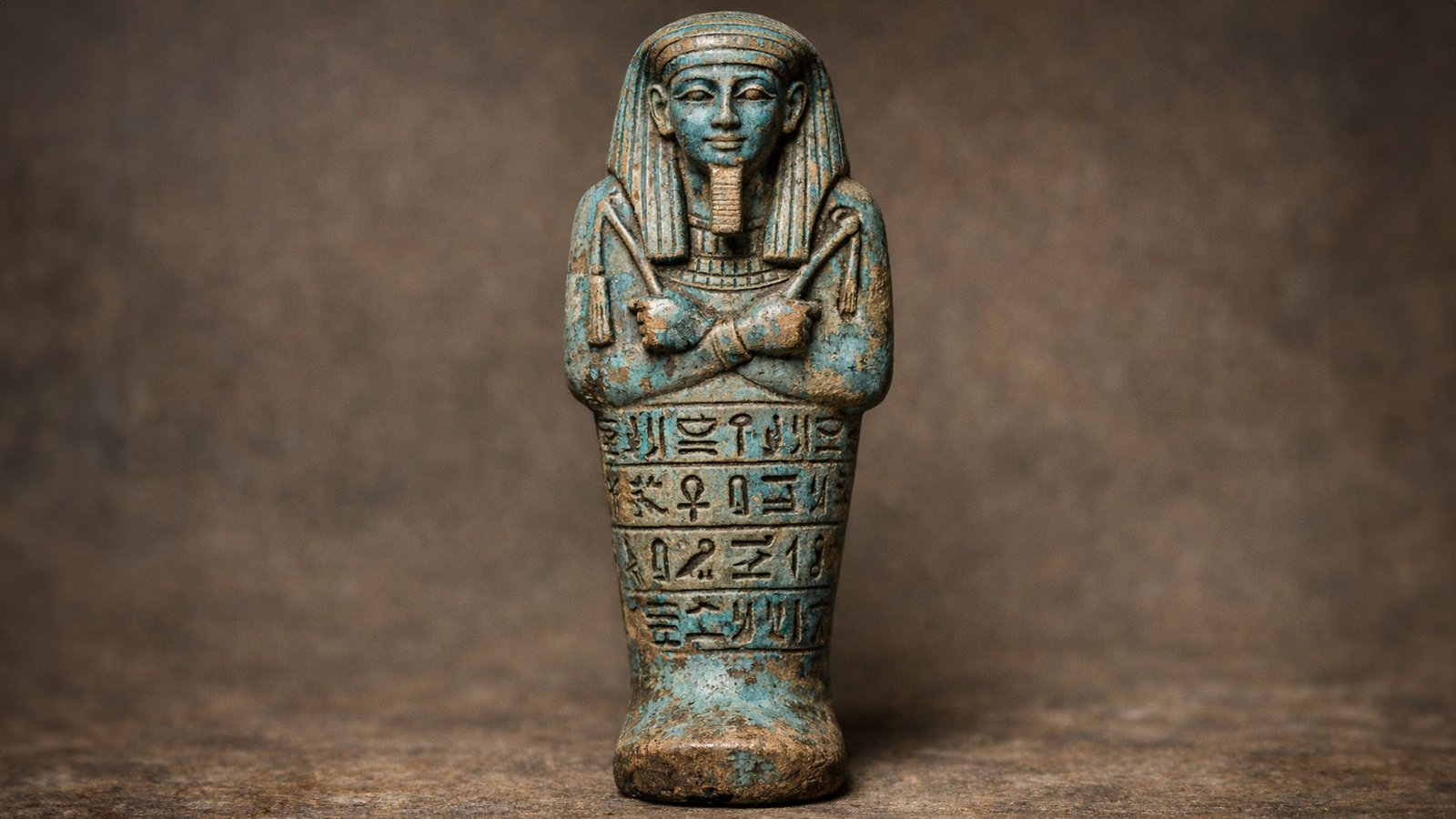
Egyptian ushabti are small, quiet, and astonishingly blunt about what ancient Egyptians thought death involved. They do not promise bliss. They do not hint at transcendence. Instead, they prepare you for work.
In the Egyptian imagination, the afterlife closely resembled life along the Nile, only longer and less forgiving. Fields still needed ploughing. Canals still needed digging. Gods still issued instructions. As a result, the dead had to cooperate. Ushabti made it possible to delegate that cooperation.
The name itself gives the game away. Ushabti comes from a verb meaning “to answer”. When the gods summoned the dead, the figurine replied on behalf of its owner. Not symbolically, but literally. When the call came, the ushabti stepped forward so the deceased did not have to.
They are usually small, between ten and thirty centimetres tall, shaped like mummified humans with arms crossed over their chests. Many hold tiny hoes or carry baskets on their backs. As a result, the message is not subtle. These figures present themselves as labourers, ready for the fields.
Ushabti appear during the Middle Kingdom, at a moment when ideas about the afterlife began to extend beyond kings. At the same time, ordinary elites, and later much wider sections of society, expected divine obligations after death. As those expectations spread, the figurines spread with them.
At first, a single ushabti might suffice. Over time, burials grew more ambitious. By the New Kingdom, some tombs included entire workforces. A full set could contain 365 worker ushabti, one for each day of the year, plus 36 overseers to manage them. Even in death, Egyptian administration refused to relax.
The overseers look different. They often wear kilts instead of mummy wrappings. In addition, they sometimes hold whips. Their presence points to something uncomfortable but familiar. Labour, even in the afterlife, demanded supervision.
Material mattered. Royal or high-status ushabti came carved from stone or made from bright blue or green faience, a glazed material associated with regeneration and the Nile. Meanwhile, others appeared in wood, clay, or rough moulds. The afterlife may have promised universality, but budgets still set limits.
Inscription turned these objects from ornaments into agents. Many ushabti carry Spell 6 from the Book of the Dead. This text instructs the figurine to respond when labour is demanded. Without the spell, the figure remains inert. With it, the ushabti accepts obligation.
Some inscriptions are personal. They include the owner’s name, titles, and lineage. For that reason, this detail mattered deeply. A named ushabti belonged to one individual. It worked for that person alone. In a culture obsessed with identity surviving death, anonymity offered no protection.
The tone of the spell is revealing. It does not plead. Instead, it commands. The ushabti is told to say “Here I am” when summoned. No negotiation appears. The figurine exists to obey.
This reflects a broader Egyptian assumption that the cosmos ran on rules, schedules, and paperwork. The gods wielded power, yet they also kept records. Osiris presided over judgment. Thoth tracked outcomes. Consequently, even the afterlife relied on systems.
Ushabti quietly undermine the modern fantasy that ancient Egyptians imagined paradise as leisure. Eternal life involved obligation. The reward lay in continuity, not escape. You kept your land, you kept your status, you also kept your workload.
Irony runs through this logic. The wealthy, who enjoyed comfort in life, equipped themselves with hundreds of ushabti to avoid labour after death. Meanwhile, the poor, who worked relentlessly while alive, could afford fewer substitutes. Eternity reproduced inequality with remarkable efficiency.
Over time, the design of ushabti changed. Early examples appear plain and stiff. Later figures show more detail, with carefully modelled faces and hieroglyphs arranged in neat columns. Because of this, archaeologists use stylistic shifts to date tombs with surprising precision.
Workshops clearly mass-produced many ushabti. Mould lines remain visible. Craftspeople sometimes added names later. As a result, funerary production became a specialised trade, driven by fear, tradition, and social pressure.
A brief comparison helps clarify their role. Egyptian ushabti and Chinese tomb guardians both assume that the afterlife demands preparation rather than hope alone. However, they solve different problems. Ushabti absorb labour obligations when work is demanded. Chinese tomb guardians project authority and protection, guarding boundaries and enforcing order. Egypt outsourced work. China outsourced defence.
The figurines also travelled. Grave robbers, collectors, and later archaeologists carried ushabti far from their original tombs. Today, museums hold thousands, many detached from context but still bearing the names of people who expected them to work forever.
Modern viewers often find them charming. Their small size and serene expressions make them seem harmless. Yet their purpose remains stark. They exist because even eternity inspired caution.
Ushabti also reveal how Egyptians understood magic. Power did not require spectacle. Instead, it relied on correct wording, correct form, and correct placement. A small figure, properly inscribed, could redirect divine demands.
Egyptians did not worry about rebellion. They did not fear ushabti. They treated them as tools, not companions. Their makers built obedience into their design.
In that sense, ushabti resemble bureaucratic paperwork more than religious icons. They function like magical forms filled out in advance, ready for use if the gods came knocking.
Their popularity lasted for centuries. Dynasties rose and fell, yet the logic endured. Death required preparation. Work continued. Someone else could do it.
Seen this way, Egyptian ushabti are not quaint curiosities. Instead, they stand as brutally practical objects. They reveal a civilisation that imagined eternity as manageable, provided you planned properly.
They also leave an unsettling question. If you believed work never ended, how many substitutes would you want waiting on the other side?