Edubba: Where the First Bureaucrats Learned to Write
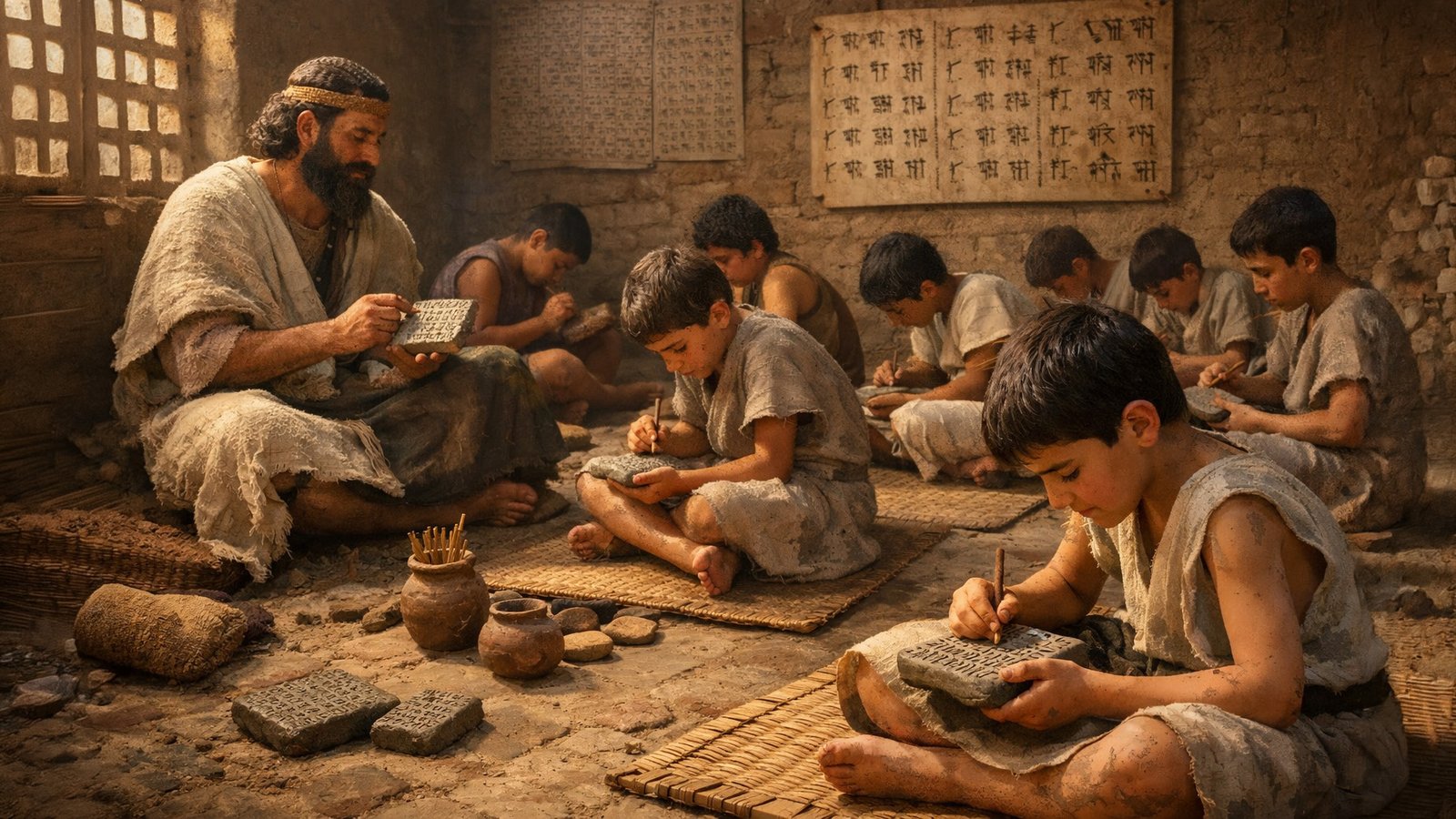
Clay dust hung in the morning air of a Mesopotamian classroom nearly four thousand years ago. A boy sat cross-legged on the floor with a damp tablet in his hands, staring at a wedge-shaped sign that refused to behave. Nearby, his teacher held a reed stylus and displayed very little patience. Around them lay dozens of discarded tablets, scattered across the room like debris from a bureaucratic battlefield. This place had a name: the edubba, the “House of Tablets,” where the ancient world quietly manufactured literacy.
In a civilisation built on clay records, scribes mattered enormously. Temples, palaces, merchants, farmers, and tax collectors all relied on written accounts. Grain deliveries, livestock counts, land measurements, legal disputes, hymns to the gods, royal propaganda, and astronomical observations all required writing. However, writing in Mesopotamia was far from simple. Cuneiform contained hundreds of signs, each formed from precise wedge impressions. Consequently, mastering it demanded years of repetition and stubborn patience.
Because of that complexity, the edubba emerged as one of the earliest educational institutions in human history. The word came from Sumerian: “e” meaning house and “dub” meaning tablet. Quite literally, it described a building dedicated to producing tablets and the people capable of writing them.
Most students entered school at a young age. Boys often began training before the age of ten, although a small number of girls also attended. Typically, education lasted around twelve years. Such a long apprenticeship made scribal training one of the most demanding professional paths of the ancient world. Families who invested in this education expected clear rewards, and social advancement usually followed.
Becoming a scribe meant joining the educated elite.
The physical setting of an edubba rarely looked impressive. Archaeological evidence suggests many schools operated inside ordinary houses rather than monumental buildings. In the city of Nippur, for example, excavators discovered a structure containing more than a thousand fragments of student exercise tablets. The rooms resembled workshops full of clay debris rather than temples of learning.
Nevertheless, intellectual ambition filled those modest rooms.
Each day usually began early. Students arrived carrying lumps of fresh clay and shaped them into tablets before lessons began. First of all, they needed to learn technique rather than language. Pupils had to judge how soft the clay should be, how to grip the stylus, and how to press wedges at the correct angle.
At the beginning, practice focused on basic strokes of cuneiform. Students repeated the vertical wedge, the horizontal wedge, and the angled wedge again and again. Those impressions formed the building blocks of every sign in the system. Eventually the tablet surface resembled a field of tiny arrowheads.
Only after mastering those strokes could a student attempt full characters.
The curriculum then unfolded slowly and methodically. Initially, students copied lists. Long catalogues appeared everywhere: animals, professions, cities, plants, and stones. Meanwhile, teachers expected pupils to memorise them with relentless precision.
Although the approach sounds monotonous, it served a clear purpose. Cuneiform functioned partly as a logographic script and partly as a phonetic system. Therefore students needed to memorise a vast number of signs rather than simply learning an alphabet.
Gradually the exercises became more complex. After the vocabulary lists came short texts. Proverbs worked particularly well at this stage because they were memorable and culturally meaningful. One surviving proverb remarks, “A scribe who does not know Sumerian, what kind of scribe is he?” The message required no explanation.
Later the curriculum became genuinely demanding. Advanced pupils copied royal hymns, myths, debates, and literary compositions that had circulated for centuries. Modern scholars reconstructed part of this advanced syllabus from collections known as the Tetrad and the Decad, groups of classical Sumerian works every serious student needed to master.
As a result, scribal schools unintentionally preserved the literature of Mesopotamia.
Life inside the edubba could be difficult. One famous Sumerian composition, often called “Schooldays,” describes the experience of a struggling pupil with striking honesty. In the story a boy arrives late and receives punishment. Later he speaks during class and receives another beating. When his handwriting appears sloppy, the teacher punishes him again.
By evening the unfortunate student has been beaten several times by different officials in the school.
Although the poem exaggerates events for humour, it reveals an important reality. Discipline within scribal education could be strict. Teachers demanded accuracy, obedience, and relentless repetition. Poor writing was not merely untidy; instead it threatened the administrative machinery of the state.
Interestingly the story ends with a clever twist. The student persuades his father to invite the teacher home for dinner and present gifts. Consequently the teacher suddenly praises the boy’s potential. Ancient education, it seems, already understood the usefulness of networking.
Despite harsh discipline, scribal training offered enormous rewards. Literacy remained rare in Mesopotamia. Most farmers, labourers, soldiers, and craftsmen never learned to read or write. Instead they relied on scribes to record contracts, transactions, and legal disputes. Consequently the profession carried prestige as well as authority.
Scribes worked almost everywhere.
Temples employed them to record offerings, agricultural yields, and ritual activities. Palaces needed them to manage taxation, military supplies, and diplomatic correspondence. Merchants hired scribes to document shipments and trade agreements. Even private citizens occasionally consulted scribes to compose letters or legal contracts.
In many respects scribes functioned as the administrative nervous system of Mesopotamian civilisation.
The training reflected those broad responsibilities. Beyond writing itself, advanced students studied mathematics, measurement systems, legal formulas, and technical vocabulary used by different professions. Mathematical tablets reveal exercises involving multiplication tables, land surveying, and geometric calculations.
Meanwhile literary education exposed students to myths, hymns, debates, and moral reflections. These texts strengthened cultural memory while also teaching language structure and rhetorical style.
Therefore scribal schools operated not merely as technical training centres. Instead they acted as guardians of intellectual culture.
Another intriguing aspect of edubba education involved language itself. By the second millennium BCE everyday speech in many regions had shifted from Sumerian to Akkadian. Nevertheless scribal schools continued teaching Sumerian long after it vanished from daily conversation.
In practice Sumerian functioned much like Latin in medieval Europe.
Students therefore learned to navigate two languages at once. Administrative records usually appeared in Akkadian, whereas classical literature remained in Sumerian. Consequently bilingual training required even more discipline and memorisation.
Archaeology reveals how intensely pupils practised. Excavations across Mesopotamia uncovered thousands of school tablets. Many display awkward signs clearly produced by beginners. Others show a teacher’s elegant model text on one side and a student’s clumsy attempt on the other.
Some tablets even preserve visible corrections where a student smoothed the clay and tried again.
Through these small imperfections we glimpse real children learning to write nearly four thousand years ago.
Not every pupil completed the long programme. The complexity of cuneiform discouraged many students along the way. However those who persevered joined a professional class capable of shaping politics, economics, and culture.
A few scribes reached remarkable influence. Royal courts employed chief scribes who supervised archives and advised kings. In Assyria, King Ashurbanipal proudly described himself as a literate ruler capable of reading ancient tablets. His famous library at Nineveh eventually contained tens of thousands of texts.
Without generations of students copying material in edubba classrooms, such libraries would never have existed.
Yet the system also reinforced social inequality. Education required years of study and family resources. As a result most of the population remained illiterate. Literacy therefore acted not only as a skill but also as a gatekeeper to administrative power.
In effect scribal schools helped create one of the earliest intellectual elites in human history.
Nevertheless the system proved remarkably durable. Scribal education appeared alongside the earliest writing around 3200 BCE and continued in various forms for more than two thousand years. Empires rose and collapsed—Sumerian, Babylonian, and Assyrian—yet the tablet houses kept training new generations of writers.
Today the evidence of those classrooms still survives in museums around the world. Small clay tablets bearing student exercises often preserve the fingerprints of ancient pupils. Each wedge impression records not only a sign but also a moment of learning.
When people imagine the origins of education, philosophers debating ideas in marble halls often come to mind. Mesopotamia offers a different picture. Instead one finds a cramped room filled with children, wet clay tablets stacked against the walls, and a teacher insisting that every wedge be perfectly formed.
Civilisation, it seems, may have begun with homework.