Do Ravens Recognise Humans, or Are They Quietly Studying Us
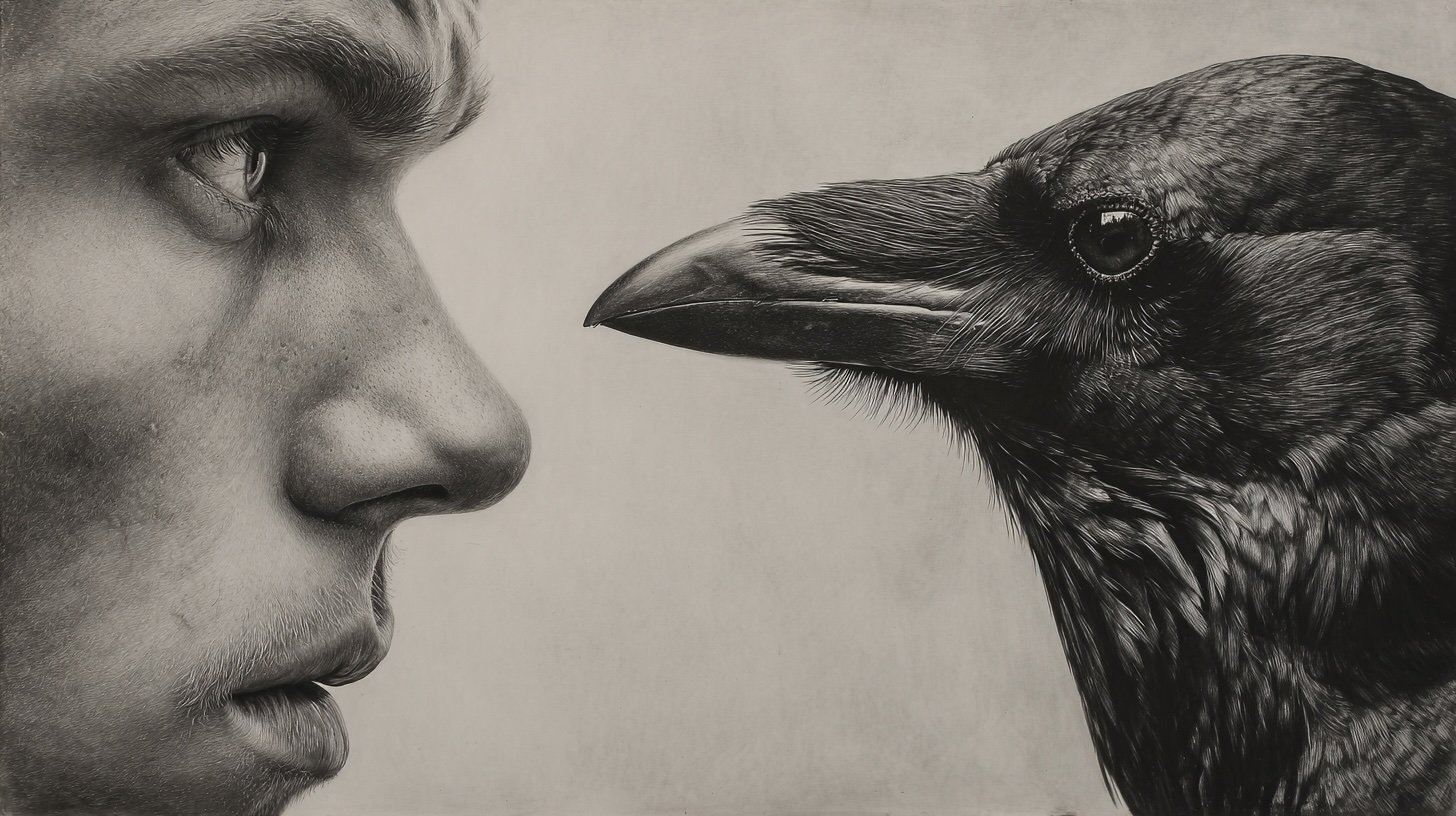
Do ravens recognise humans? The question sounds simple, almost childlike. Yet it keeps resurfacing in scientific journals, field notebooks, and that uneasy moment when a large black bird pauses mid-hop and looks straight at you. Not in a vague animal way, but with focus. With memory. Possibly with judgement.
Ravens have lived alongside humans for thousands of years. They followed hunter-gatherers, hovered near early settlements, and learned the rhythms of farms, battlefields, roads, rubbish tips, and cities. Over time, they became skilled observers. Consequently, it makes sense to ask whether they see humans as a single blur or as a collection of individuals with different risks and rewards attached.
Modern research leans firmly toward the second option. Ravens do not treat humans as interchangeable scenery. Instead, they distinguish between people, remember past encounters, and adjust their behaviour accordingly. This ability sits at the intersection of facial recognition, long-term memory, and social learning, all of which ravens possess in abundance.
Some of the clearest evidence comes from studies designed to remove guesswork altogether. Researchers working with wild ravens captured birds briefly for tagging, health checks, or monitoring. During these procedures, they wore distinctive masks. The masks mattered more than the people beneath them. Later, when those same masked faces reappeared in the environment, doing nothing more threatening than walking past, ravens reacted instantly.
They scolded loudly, they followed from above, they recruited other ravens into noisy aerial protests. However, the initial reaction was not the most interesting part.
Years later, ravens still reacted to those specific masks. Even more tellingly, ravens that had never been captured themselves joined in, having learned from others. Meanwhile, neutral masks triggered little or no reaction. The birds were not afraid of humans in general. Instead, they responded to particular human identities associated with past stress.
This pattern suggests that ravens recognise humans visually, store that information long-term, and retrieve it when relevant. In simpler terms, they remember faces.
Facial recognition alone does not explain the full picture, though. Ravens also remember behaviour. A person who regularly disturbs nests, approaches too closely, or interferes with food sources quickly earns a different status from someone who passes through quietly or behaves predictably. Over time, ravens alter flight paths, perch choices, and vocal patterns depending on who appears.
Long-term field observations support this interpretation. In rural areas, ravens often ignore farmers who follow consistent routines. These humans become background elements, part of the landscape rather than a focal point. By contrast, gamekeepers, climbers, forestry workers, or photographers who behave unpredictably may trigger heightened vigilance long after the original encounter. The response is rarely panic. Instead, it reflects calculated caution.
Crucially, ravens do not keep these assessments to themselves. They share information. Alarm calls vary depending on context, and other ravens respond differently to different calls. Juveniles learn quickly which humans deserve attention and which can be ignored. As a result, entire local raven populations can develop shared responses to specific people, even if only a few individuals had direct experience.
This social transmission turns individual recognition into collective memory. It also explains why ravens sometimes seem to “know” you before you have done anything noteworthy. In practice, you may simply be inheriting someone else’s reputation.
Recognition is not limited to threats. Ravens also remember positive interactions. In studies where specific researchers fed ravens repeatedly, birds later approached those individuals preferentially, even after long gaps without contact. Importantly, this trust did not generalise to all humans. Ravens did not become universally friendly. They became selectively so.
That selectivity weakens the idea that ravens respond only to location, routine, or clothing colour. Instead, it points to individual recognition shaped by facial features, body shape, gait, and behaviour patterns combined. Ravens integrate multiple cues rather than relying on a single signal.
This flexibility helps explain their success across very different environments. Urban ravens learn which humans drop food and which chase them away. Rural ravens learn which vehicles signal danger and which mean roadkill. In both cases, humans are not abstract forces. They are specific actors.
Beyond recognition lies something even more intriguing. Ravens appear aware of human attention. Experiments show that they modify their behaviour when they believe they are being watched. They re-hide food more often in the presence of observers. They delay actions if eye contact persists. Notably, this effect becomes stronger if the observer has previously interfered.
Such behaviour suggests ravens do not merely recognise humans as objects. They treat us as agents with intentions. They track who interferes, who observes, and who exploits opportunities. That does not mean ravens attribute complex human emotions. It does mean they understand that different individuals behave differently and that those differences matter.
Some researchers describe this as interspecies social cognition. Ravens occupy a mental category where humans function as powerful, unpredictable social variables rather than passive environmental features. This capacity may help explain why ravens thrive despite centuries of persecution.
Inevitably, myths follow. Ravens do not hold grudges in a moral sense. They are not nursing emotional vendettas. Instead, they act pragmatically. If a particular human proved dangerous before, avoiding them again makes sense. If another proved useful, cautious engagement may pay off. Memory guides behaviour, not resentment.
Another misconception suggests that only clever, urban ravens display this ability. In reality, some of the strongest evidence comes from wild populations with minimal exposure to people. In those contexts, recognising individuals rather than fearing all humans indiscriminately may reduce unnecessary energy expenditure and risk.
Evolution rewards efficiency. For ravens, that efficiency includes remembering who matters.
There is also an uncomfortable implication. Ravens may be better at recognising us than we are at recognising them. Humans often lump ravens together. Ravens do not return the favour. They differentiate, categorise, and update their assessments continuously.
From a broader perspective, this capacity challenges older assumptions about animal minds. Facial recognition, once treated as a primate speciality, appears in birds with very different brain structures. Ravens achieve similar outcomes using alternative neural architectures, suggesting multiple evolutionary paths to complex intelligence.
Moreover, raven recognition operates within a social framework. It is not an isolated trick. It connects to communication, learning, cooperation, and long-term planning. When ravens recognise humans, they fold that knowledge into an existing web of social information.
This may explain why encounters with ravens feel different from encounters with most wildlife. There is often a sense of being assessed. That sensation is not entirely imagined. Ravens look, remember, and decide.
In practical terms, behaviour around ravens matters. Consistency builds predictability. Erratic actions invite scrutiny. Repeated encounters create reputations. Over time, a person becomes part of the local social landscape.
Ultimately, the answer remains clear. Do ravens recognise humans? Yes. They recognise individual humans, remember how those humans behave, communicate that knowledge socially, and act on it long after the encounter ends.
The more interesting question follows naturally. Are we prepared to accept what that implies? Ravens are not merely watching us. They are learning us.