Do Animals Have Culture? The Evidence Is Hard to Ignore.
What if culture is not a rare human invention but something far more ordinary, quietly unfolding in forests, oceans, and skies without ever needing a museum or a manifesto? That idea sounds slightly unsettling at first. After all, culture feels like one of those things we use to separate ourselves from everything else. Yet the closer you look at animal behaviour, the more that neat boundary begins to blur.
For years, culture was treated as shorthand for language, art, and written history. However, that definition always leaned toward what humans happen to be good at. Meanwhile, scientists began to ask a simpler question: what if culture is just shared behaviour that is learned from others and passed on over time? Once framed that way, the concept becomes less exclusive and far more interesting.
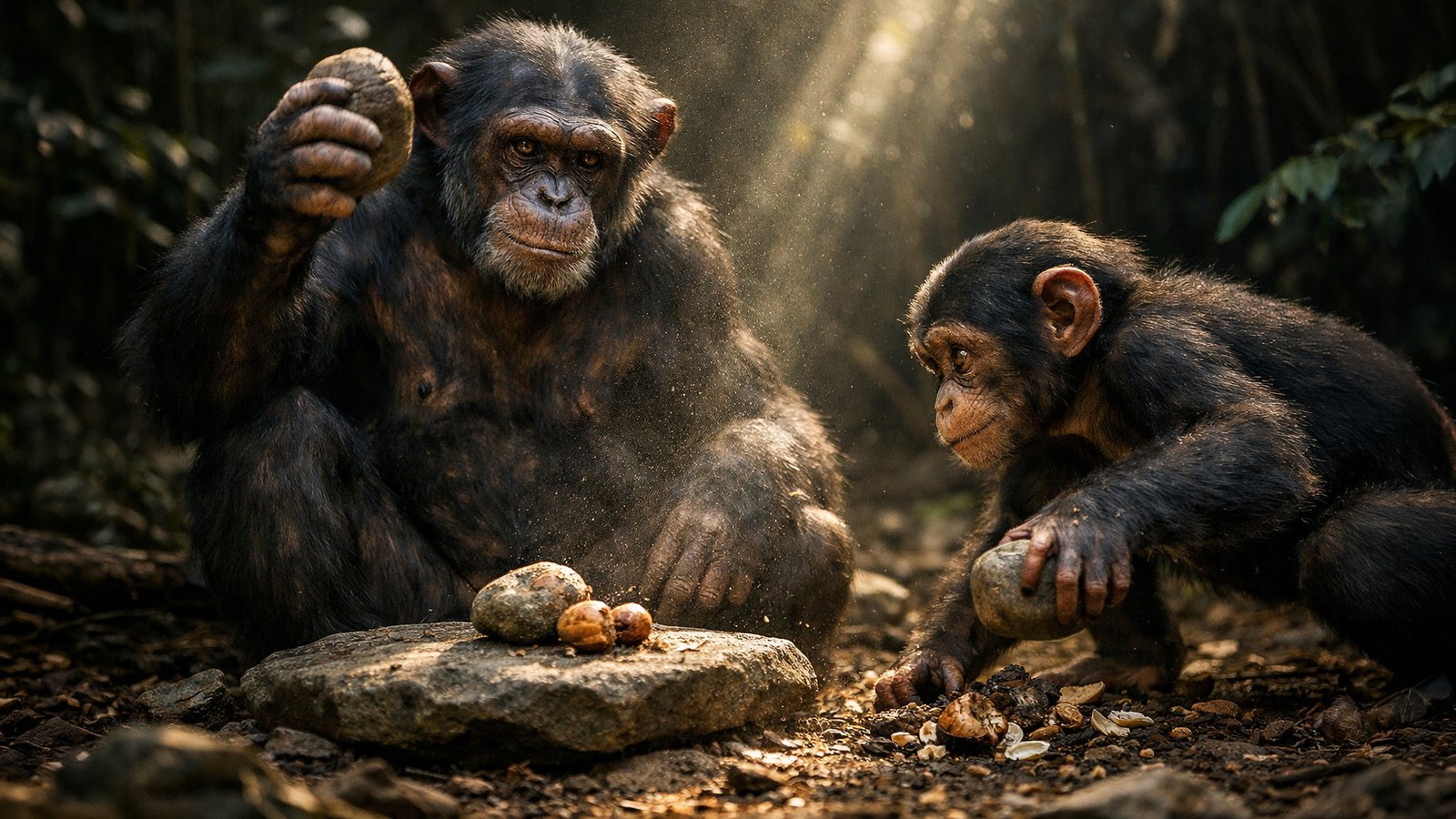
Take chimpanzees as an example. Different groups behave in noticeably different ways, even when they live in similar environments. Some use sticks to fish termites from mounds, while others crack nuts with stones. In addition, a few have peculiar grooming habits that look almost ritualistic. These are not random quirks. Young chimpanzees spend years watching older individuals, copying their techniques with a patience that feels almost deliberate. As a result, each group develops its own behavioural signature.
Even more striking, neighbouring groups can have completely different approaches to the same problem. One community might rely heavily on tools, whereas another ignores them altogether. The environment does not fully explain this divergence. Instead, it points to something social. Behaviour spreads not because it is encoded in genes, but because it is observed, remembered, and repeated.
Out at sea, the case becomes even harder to dismiss. Orcas live in tightly knit family units, and each group seems to follow its own unwritten playbook. Some specialise in hunting fish, while others pursue marine mammals using coordinated tactics that look almost choreographed. These strategies are not improvised on the spot. Rather, mothers teach them to calves over years, refining timing and coordination through practice.
At the same time, orca groups communicate using distinct vocal patterns. These differences function a bit like dialects, with each pod maintaining its own acoustic identity. Crucially, these sounds are learned rather than inherited. Calves pick them up from their family, and the patterns persist across generations. In other words, the ocean carries something resembling tradition.
Birds offer a quieter version of the same story. Many species do not simply produce songs automatically. Instead, they learn them. Young birds listen to adults, practise, adjust, and eventually settle into a version that matches their local group. Over time, these songs diverge between regions. Consequently, a bird in one area may sound noticeably different from a bird of the same species elsewhere.
Moreover, these variations can shift across decades. Songs drift, simplify, or become more elaborate depending on what spreads successfully within a population. This is not quite language, but it behaves in a way that feels uncomfortably close to it. Patterns emerge, change, and stabilise, all without a written record.
Then there are elephants, which bring a different dimension altogether. Elephant herds rely heavily on memory, especially the knowledge carried by older matriarchs. They remember migration routes, water sources, and seasonal changes that younger individuals have not yet experienced. This knowledge is not instinctive. Instead, it is accumulated over time and shared through leadership and observation.
In addition, elephants display consistent social behaviours that look structured rather than accidental. They greet each other in recognisable ways. They cooperate when caring for calves, and they respond to death with actions that appear patterned and deliberate. Recent research adds another layer to this picture. Scientists analysing elephant vocalisations have found evidence that individuals may use specific calls for particular members of the herd, functioning in a way that resembles names. These calls are not simple imitations but distinct signals that seem to refer to specific individuals and are recognised over distance. While it is tempting to interpret these behaviours emotionally, even a cautious reading suggests something organised and shared.
Of course, not everyone agrees that this counts as culture. Some researchers argue that these behaviours could still be explained by environmental pressures or subtle genetic differences. After all, animals in different locations face different challenges, and natural selection shapes behaviour over long periods.
However, this explanation struggles when neighbouring groups behave differently despite living under similar conditions. It also falters when behaviours clearly spread through imitation rather than individual discovery. When a young animal learns by watching others, and that behaviour persists across generations, the case for culture becomes difficult to ignore.
At this point, the debate shifts from existence to definition. If culture requires writing, symbolic art, or complex language, then humans remain in a category of their own. Yet that definition says more about human achievements than about the underlying process. It highlights outcomes rather than mechanisms.
Alternatively, if culture is defined as shared, learned behaviour transmitted socially, then many species qualify in their own way. The difference is not presence or absence. Rather, it is scale and complexity. Human culture accumulates, records itself, and expands rapidly. Animal culture, by contrast, tends to remain local, embodied, and transient.
That distinction matters because it explains why animal culture is so easy to overlook. Human culture leaves traces. It builds cities, writes books, and produces artefacts that survive for centuries. Animal culture lives in behaviour. It disappears when the behaviour stops, and therefore it cannot be excavated. It has to be witnessed.
Consequently, noticing it requires a shift in attention. Instead of asking what animals create, the question becomes how they learn from each other. Once that shift happens, familiar scenes start to look different. A chimpanzee choosing a tool is no longer just solving a problem. It is participating in a tradition. Likewise, an orca teaching a hunting technique is not merely feeding its young. It is transmitting knowledge.
Even so, there is a lingering hesitation in calling this culture. Perhaps that hesitation says more about us than about animals. The word carries a sense of prestige, as though culture must involve refinement or intention in a human sense. Yet those expectations may be misplaced.
In reality, culture might be less about sophistication and more about continuity. It might simply be the accumulation of shared habits that persist because they are learned together. If that is the case, then culture does not begin with humans. Instead, it becomes visible with humans.
And that reframing leaves an uncomfortable possibility. The traits we often treat as uniquely ours may instead sit on a spectrum, with other species occupying quieter positions along it. Their cultures do not announce themselves, and they do not leave monuments. Nevertheless, they exist in the small, repeated actions that shape how a group lives.
Which raises a final question that is harder to ignore than it first appears. If culture exists wherever behaviour is learned, shared, and remembered, then the real mystery is not whether animals have culture. It is why we were so certain that they did not.