Dizzy Gillespie and His Bent Trumpet
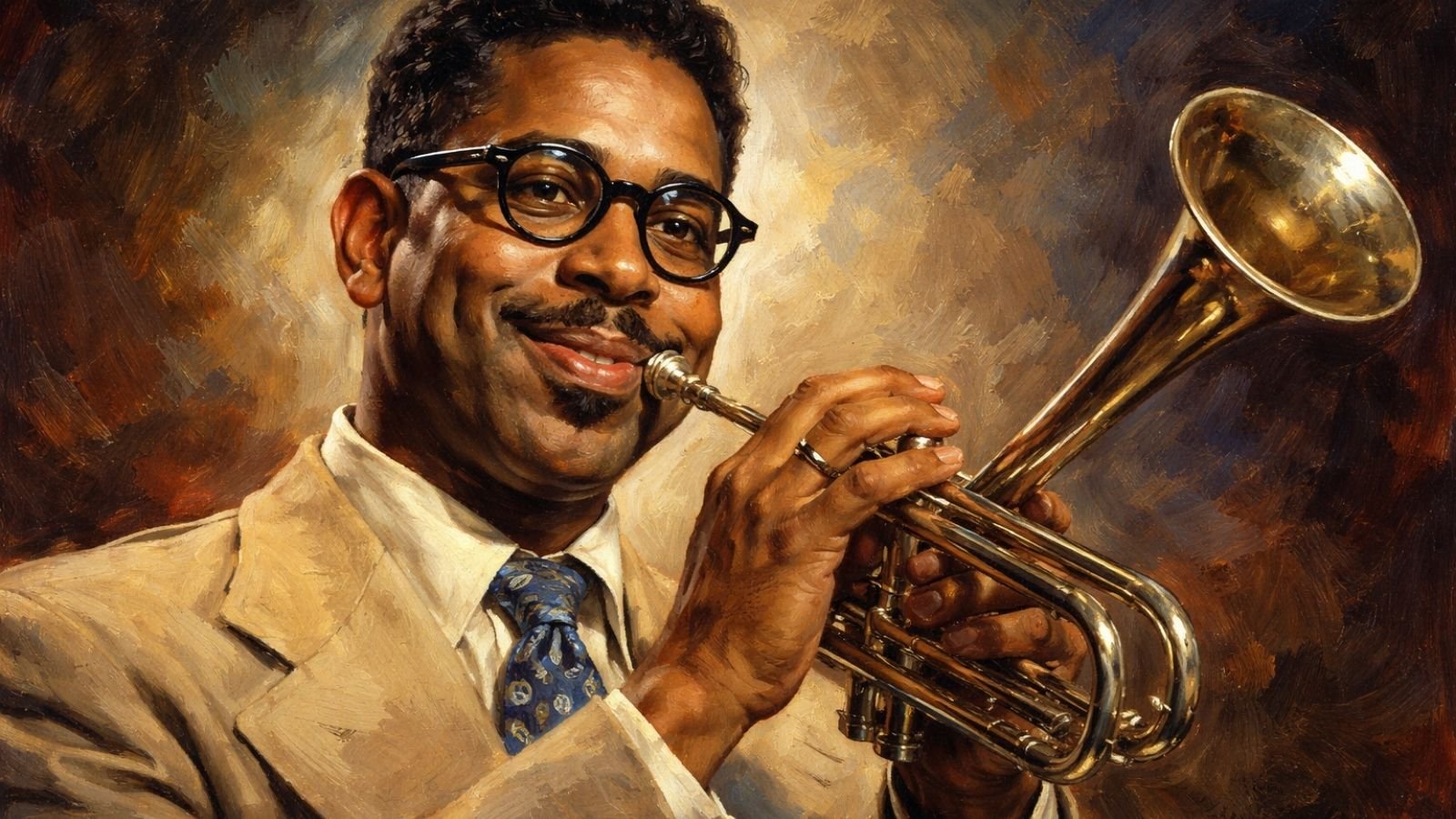
Dizzy Gillespie never looked like someone inventing a musical revolution. He smiled too much. He joked on stage. He puffed his cheeks like a cartoon character and bent his trumpet as if rules were optional. Audiences laughed before they realised they were hearing something radically new. That balance between laughter and intellect became his quiet superpower.
He entered the world in 1917 as John Birks Gillespie in Cheraw, South Carolina, a small town with more churches than opportunities. Music arrived early and stayed. His father played instruments casually and expected discipline. When his father died, teenage Gillespie turned music from pastime into escape route. He absorbed trumpet records obsessively, especially Roy Eldridge, whose ferocity convinced him that speed and precision could feel emotional rather than mechanical.
Philadelphia sharpened him. New York transformed him. By the late 1930s he worked inside the big-band system, earning money while quietly disagreeing with almost everything about it. Swing valued smoothness and predictability. Gillespie wanted surprise, tension, jokes inside harmony. He played chords that sounded wrong until they suddenly made sense. Band leaders rarely enjoyed that kind of curiosity.
The clash with Cab Calloway turned into legend. Calloway accused him of sabotaging performances with strange harmonies. Someone threw a spitball on stage. Accusations flew, a fight broke out, knives appeared, and Gillespie lost his job. Jazz history often begins politely. Bebop began mid-argument.
Late-night jam sessions offered freedom. Minton’s Playhouse became a laboratory where musicians tested ideas without mercy. Gillespie pushed tempos to uncomfortable speeds and altered chord progressions until familiar songs felt unfamiliar. The goal was not elitism, despite later accusations. The goal was progress. If music stayed easy, it stayed stuck.
Bebop emerged without permission. It replaced dance-floor friendliness with listening-room intensity. Melodies twisted. Harmonies multiplied. Solos turned into conversations with the underlying structure rather than decoration on top. Gillespie understood that structure deeply. He talked harmony like an engineer discussing load-bearing walls.
His compositions showed that clarity and complexity could coexist. Groovin’ High hid sophisticated harmonic substitutions beneath a playful exterior. Salt Peanuts used humour as rhythmic punctuation. A Night in Tunisia sounded unlike anything else at the time, dramatic and slightly ominous, driven by a bass line that hinted at rhythms far beyond Manhattan.
That hint became commitment when Gillespie encountered Afro-Cuban music seriously rather than cosmetically. Collaborating with Cuban percussionist Chano Pozo changed his understanding of rhythm. Jazz rhythm sections usually prioritised swing feel. Afro-Cuban music prioritised layered conversation, anchored by clave. Gillespie did not dilute either tradition. He let them argue, overlap, and fuse.
Manteca landed like a declaration. Horn lines danced around percussion instead of dominating it. Rhythm stopped behaving like background support and became equal partner. Audiences heard something global without needing a passport. Afro-Cuban jazz did not sit politely at the margins after that. It rewired the centre.
Gillespie’s leadership mattered as much as his trumpet. He insisted that his musicians learn the rhythmic logic rather than imitate surface patterns. That approach influenced generations who later explored Brazilian, West African, and modal frameworks. Jazz stopped pretending it lived in isolation.
On stage, Gillespie dismantled seriousness without sacrificing depth. He sang nonsense syllables, cracked jokes mid-solo, and addressed audiences like collaborators rather than witnesses. Critics sometimes mistook that warmth for frivolity. They missed the strategy. Complexity travels further when carried lightly.
His cheeks became part of the myth. Classical teachers warn against puffing them. Gillespie ignored them and developed a technique uniquely his own. Acoustic analysis later showed his embouchure redistributed air pressure efficiently. What looked wrong worked brilliantly. Jazz thrives on such heresies.
The bent trumpet followed accident rather than intention. Someone fell on his instrument at a party. The upward angle changed projection and sightlines. Gillespie kept it. Image and sound aligned. He became impossible to confuse with anyone else.
While others treated modern jazz as private rebellion, Gillespie engaged politics openly. His mock presidential campaign in 1964 skewered racial hypocrisy with humour sharper than outrage. He promised a Blues House and cabinet members drawn from musical royalty. The joke carried weight because it revealed how culture already shaped diplomacy more honestly than speeches did.
The State Department soon discovered that truth and sent him abroad as a cultural ambassador. Gillespie toured extensively through Africa, the Middle East, and Eastern Europe. He played jazz while speaking candidly about American racism. Audiences respected the honesty. Propaganda softened into conversation.
Later years brought spiritual grounding through the Baháʼí Faith. Gillespie spoke about unity without sermonising. Jazz already embodied the principle. Individual voices mattered. Collective listening mattered more.
Mentorship defined his legacy quietly. Young musicians passed through his bands and left sharpened. He demanded musical literacy and rewarded curiosity. John Coltrane, Sonny Rollins, Arturo Sandoval, and many others absorbed his insistence that discipline enables freedom rather than limiting it.
Financial success rarely matched influence. Bebop never sold like swing. Yet Gillespie adapted. He toured constantly, taught, recorded, and collaborated without diluting his ideas. Longevity became another argument in his favour.
He died in 1993, leaving behind more than recordings. Modern jazz harmony, global rhythm integration, and the idea that intelligence and joy belong together owe him a debt. He proved that music could think, laugh, and invite everyone into the room at once.
Myths linger. Some credit him with inventing bebop alone. Others remember only the jokes. Reality sits comfortably between. Gillespie built systems. He connected worlds. He understood that revolutions survive longer when they smile.
Jazz still follows his lesson. Complexity does not need to scowl. Innovation does not require coldness. Sometimes the smartest person in the room also laughs the loudest.