Did Nero Really Set Rome Ablaze?
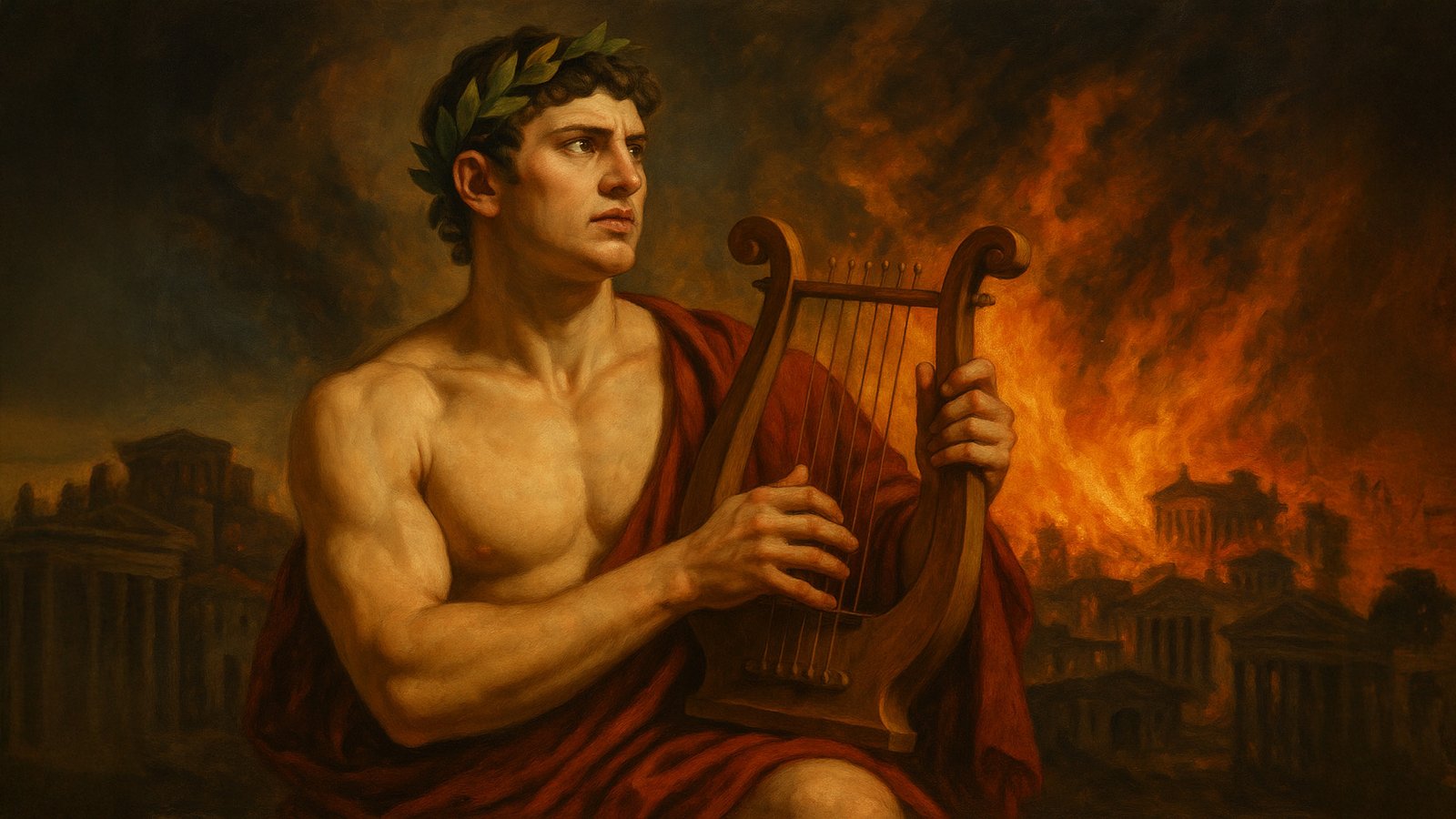
Nero and the Great Fire of Rome sit together in the public imagination like a scandalous celebrity couple you never quite separate, no matter how many historians shout from the sidelines that it’s complicated. The image feels fixed: Nero lounges somewhere scenic, Rome roars in flames below, and he strums a lyre with the calm of a man rehearsing for a tragic opera. The fact that the violin won’t exist for another millennium never bothers anyone. People adore a good story, especially when it paints an emperor as a pyromaniac with artistic frustration. Yet once you step past the dramatic glow, the whole affair starts looking far stranger, far funnier, and far more human than the popular version suggests.
Rome in July always seemed one sigh away from combusting. The city stuffed itself with wooden balconies, tight streets and cookshops that sent heat into the alleys long before breakfast. Anyone wandering around the capital felt the simmering tension: one overturned lamp, one kitchen mishap, one spark carried by a particularly playful gust could set the stage for disaster. Fires broke out so frequently that Romans barely blinked when smoke rose in some far-off district. They only worried when it spread towards their front door. The night of the Great Fire promised nothing more unusual than the familiar scent of warm stone and oversupplied tavern ovens. Yet something caught, and the flames raced through the Circus Maximus area as if the city had written an open invitation.
People later recalled that the first hours felt chaotic even by Roman standards. Traders threw their stock into the streets in desperation. Families dragged furniture into alleyways already swirling with embers. Animals bolted from enclosures. The sound carried through the city like a monstrous tide. Rome tried to fight back, but the fire danced along rooftops, leapt across lanes, and treated stone walls like temporary inconveniences. The city seemed to breathe out heat. The flames reached districts no one imagined vulnerable, and the wind encouraged them as if it enjoyed the spectacle. The blaze roared for days, calmed for a moment, then found new fuel and burst back with renewed enthusiasm. By the end, ten of the fourteen districts lay in ruins, and the survivors looked around with the stunned expression of people who’d woken up in a different world.
Meanwhile Nero, that eternal suspect of convenient storytelling, wasn’t even in the city. He stayed at his villa in Antium, enjoying sea breezes that didn’t smell of roasted timber. Word reached him quickly, and he rushed back to Rome with the alarmed urgency of a man who clearly hadn’t planned any of this. His return didn’t fit the image of a scheming arsonist pleased with his work. He opened the doors of his gardens to the newly homeless. He arranged temporary shelters inside public buildings. He organised food supplies for crowds left with nothing. He tried to direct whatever firefighting efforts remained possible. People later insisted on imagining him as a villain, but no one behaves like a villain from a melodrama when actual flames threaten half the capital.
Still, myths thrive on stubborn soil. Rumours grew legs with impressive speed. Some swore Nero watched the fire from a tower and performed a song about the fall of Troy. Others insisted shadowy characters hindered firefighting, shouting they served imperial orders. A few speculated Nero set the blaze to clear land for the palace he dreamed of, a fantasy so large it required enormous swathes of Rome. The Domus Aurea did indeed rise after the disaster, a sprawling palace complex with lakes and gardens that looked like someone reimagined Rome as a private landscape painting. Conveniently for critics, the palace made an excellent motive. When an emperor ends up with a gleaming architectural wonder on the ruins of people’s homes, no one needs much encouragement to connect dots.
Yet reality rarely works in neat straight lines. Nero lost property during the fire as well, including his earlier palace on the Palatine. Starting a blaze that wipes out your own residence feels like an unusual urban redevelopment strategy, even for a ruler famous for dramatic gestures. Ancient authors such as Suetonius and Cassius Dio offered wonderfully expressive descriptions of Nero’s behaviour, but they wrote long after the events. They wrote under emperors who needed someone to blame for decades of political instability. Nero made a convenient figure for moral cautionary tales. When a dynasty collapses, the successor often points at the previous ruler and proclaims, “Look what a disaster he was; aren’t you glad we’re here now?”
Tacitus, often treated as the most disciplined voice in this chorus, didn’t accuse Nero outright. He noted the rumours. He recorded suspicions among people who searched desperately for someone to blame. He wrote about how the city whispered its fears and theories. But he stopped short of presenting guilt as fact. Modern historians cling to this restraint because Tacitus loved a dramatic moment, and if he avoided certainty, he must have lacked solid evidence.
The fire’s origins seem far more ordinary than the legends allow. The Circus Maximus stored goods that turned the entire structure into a tinderbox. Wooden seating surrounded the arena. Shops crowded against each other. A midsummer wind often howled along the valley. Accidental ignition looks vastly more plausible than orchestrated destruction. The city served as its own accomplice, offering the fire everything it needed.
Nero, for all his flaws, acted decisively afterwards. He introduced new building regulations. He insisted on wider streets to prevent future disasters. He ordered builders to use fire-resistant materials. He tried to impose some logic on Rome’s famously chaotic layout. People admired the reforms as sensible, though few praised him openly while their homes still smouldered. When someone suffers such a loss, they rarely thank the person in charge, even if he does something useful.
The famous persecution of Christians added another layer to Nero’s notoriety. They were a small and unfamiliar group at the time, and when panic surged, the emperor pointed at them. His decision led to brutal treatment, and early Christian writers understandably portrayed him as a monstrous tyrant. Their stories shaped much of Nero’s later reputation. Once an emperor appears in moral literature as a symbol of cruelty, the flames of rumour burn merrily for centuries.
Modern scholars explore the whole picture with a cool head. They read the ancient texts with a sceptical eye. They examine archaeological evidence. They compare the behaviour of other emperors during crises. Most agree that Nero didn’t burn Rome. He exploited the opportunity to rebuild it on his terms, which fits the personality he displayed throughout his reign. He adored spectacle. He adored novelty. He adored transforming the city into something impressive. But loving grand architecture doesn’t prove guilt. Opportunist doesn’t always mean arsonist.
This leaves us with a deliciously ironic situation. Nero committed enough questionable acts during his life that historians barely cope with the list. He executed rivals. He frightened the senate. He chased artistic glory with the enthusiasm of someone determined to receive applause even if he had to drag the audience in himself. But the one crime nearly everyone associates with him almost certainly never happened. His real life provides so many sensational episodes that inventing one seems almost unnecessary, yet Roman political storytelling never missed a chance to embellish. Once the story of Nero as the man who let Rome burn took hold, nothing could dislodge it.
People adore villains who perform with theatrical flair. Nero fits the bill so perfectly that the truth didn’t stand a chance. The more intricate, ambiguous and human version of events struggles to compete with the image of an emperor pouring musical emotion into a burning skyline. The story survives because it’s irresistible. It warns against rulers who drift away from reality. It entertains. It exaggerates. It satisfies a deep cultural love for poetic irony.
Rome eventually rose from the ashes, built sturdier and slightly wiser. Nero didn’t rise quite so gracefully. His political enemies advanced. His support crumbled. His final days felt tragic even by imperial standards. But the Great Fire never stopped clinging to his name. Centuries later, schoolchildren still picture him as the emperor who played while the city burned.
History sometimes plays a cheeky trick. It offers a myth that looks cleaner, brighter and more dramatic than the truth, and people accept it with enthusiasm. But if you wander back through the smoke of legend, you find a Rome vulnerable to accidental catastrophe and an emperor racing home to confront a disaster he never asked for. You find fear, chaos, political scheming and a population desperate for answers. You find a city that mourned, rebuilt, adapted and carried on.
And you find Nero not as a mastermind of destruction but as a ruler whose reputation got scorched far more thoroughly than his palace walls. The flames died out long ago. The myth still glows. Sometimes that says more about us than about him.